
Summary
✓Reviewed by Emma Thompson An exploration of esports fan identity, engagement, and community reveals one of the most distinctive audience phenomena in contemporary media. Unlike passive television sports viewership, esports fans participate in layered ecosystems — streaming platforms, Discord servers,...
Table of contents
- 1 What Defines Esports Fan Identity in 2026
- 2 Historical Roots: How Esports Fan Culture Developed
- 3 The Role of Streaming Platforms in Shaping Fan Engagement
- 4 Team Loyalty, Player Parasocial Bonds, and Game-Title Identity
- 5 Online Community Infrastructure: Discord, Reddit, and Beyond
- 6 National and Regional Identity in Esports: The Nations Cup Effect
- 7 Fan Engagement Across Titles: A Comparison
- 8 Gender, Diversity, and the Evolving Esports Audience
- 9 Live Events and the Physical Dimension of Fan Identity
- 10 How Esports Journalism Shapes Fan Identity Narratives
- 11 Frequently Asked Questions
- 11.1 What makes esports fan identity different from traditional sports fan identity?
- 11.2 Which esports titles have the most engaged fan communities?
- 11.3 How do streaming platforms contribute to esports fan identity?
- 11.4 Does national identity matter to esports fans?
- 11.5 Are esports fan communities inclusive?
- 11.6 How do esports journalists influence fan identity?
- 12 Key Takeaways
- 13 Sources
An exploration of esports fan identity, engagement, and community reveals one of the most distinctive audience phenomena in contemporary media. Unlike passive television sports viewership, esports fans participate in layered ecosystems — streaming platforms, Discord servers, team subreddits, live tournaments — that blur the line between spectator and participant. According to a 2025 report by Newzoo, the global esports audience exceeded 640 million in 2025, with North American fans among the most digitally engaged demographics in any entertainment vertical.
What Defines Esports Fan Identity in 2026
An exploration of esports fan identity, engagement, and community must begin with what makes esports fandom structurally different from traditional sports fandom. Identity in esports is multidimensional. Fans identify with specific games (League of Legends vs. CS2, Valorant vs. Dota 2), with teams (T1, Team Liquid, Cloud9, NAVI), with individual players (Faker, s1mple, TenZ), and with broader competitive communities. This layered identification means a single fan may hold several simultaneous and sometimes competing allegiances.
Academic research published in the Journal of Sport and Exercise Psychology has documented that social identity theory applies to esports contexts with notable modifications: because esports lacks geographic franchise anchoring (a fan in Ohio has no structural reason to follow a locally based team), identification patterns cluster around personality, aesthetic preference, and parasocial relationships with individual players. This is a meaningful departure from how scholars have traditionally modeled sports fan identity.
Historical Roots: How Esports Fan Culture Developed
Esports fan identity did not emerge overnight. Organized competitive gaming communities trace back to the early LAN tournament scenes of the late 1990s — events like the Cyberathlete Professional League (CPL), founded in 1997, and the Korean StarCraft: Brood War broadcasting phenomenon of the early 2000s, which drew television audiences of millions and gave rise to professional player celebrity culture that predates Twitch by over a decade. These early scenes established templates for fan behavior — following player careers, debating strategies, attending live events — that persist and have scaled into the global industry observable today. The transition from niche hobbyist gatherings to stadium-filling spectacles like The International (Dota 2) and the League of Legends World Championship marks the arc that researchers studying esports fan identity must account for.
The Role of Streaming Platforms in Shaping Fan Engagement
Twitch and YouTube Gaming are not merely distribution channels for esports content — they are the primary social infrastructure through which fan identity is performed and reinforced. When a fan watches a match on Twitch, they are simultaneously reading chat, reacting in real time with other fans, deploying platform-specific emotes (PogChamp, KEKW, pepega), and participating in a shared ritual that functions as community membership. This interactive layer is central to any exploration of esports fan identity, engagement, and community because it transforms consumption into participation.
Research published by scholars at Penn State University’s College of Communications has examined how Twitch chat serves as a social bonding mechanism, finding that real-time co-viewing of esports creates measurable increases in perceived community belonging among regular viewers. The emote vocabulary alone functions as a form of in-group linguistic identity — knowing what “Sadge” or “5Head” means signals membership in a specific community cohort.
Team Loyalty, Player Parasocial Bonds, and Game-Title Identity
Three distinct axes organize esports fan identity: loyalty to teams, parasocial attachment to individual players, and identification with specific game titles. These axes interact but are analytically separable. A fan might follow T1 as an organization, feel deep parasocial connection to Faker specifically, and identify broadly as a “League of Legends” fan rather than as a generalist esports follower. This specificity has implications for how the esports industry structures engagement.
Player parasocial relationships are particularly powerful in esports relative to traditional sports because streaming gives fans direct access to player personalities outside of competitive play. When Faker streams on his personal channel, or when a CS2 player posts to social media, fans receive unmediated personality exposure that deepens attachment. This dynamic is well-documented in communication research: according to studies reviewed in the Journal of Sports Media, parasocial interaction with athletes predicts fan identification more strongly in mediated sports contexts than in traditional live-attendance-first sports.
“Esports fandom is not about geography — it is about shared taste, shared language, and shared investment in individuals who happen to compete.”
Online Community Infrastructure: Discord, Reddit, and Beyond
Beyond streaming, the backbone of esports fan community is Discord and Reddit. The r/GlobalOffensive subreddit, the r/leagueoflegends community, and title-specific Discord servers run by teams like Cloud9 and Team Liquid serve as primary community spaces where fans discuss results, analyze strategy, share memes, and debate roster decisions. These spaces are where fan identity consolidates between events — they are the connective tissue of a community that doesn’t rely on a shared physical geography.
For journalists and reporters covering esports, understanding these community spaces is essential. Fan sentiment that originates on Reddit or in Discord servers frequently surfaces as public opinion, influences team decisions about roster moves, and sets the narrative frame that mainstream coverage then amplifies. An exploration of esports fan identity, engagement, and community that ignores these platforms misses where the community actually lives. Coverage at outlets like Esports World Cup 2026 shows how major events serve as focal points that temporarily concentrate fan community activity.
National and Regional Identity in Esports: The Nations Cup Effect
While esports fandom is less geographically rooted than traditional sports fandom, national identity has emerged as a meaningful axis — particularly around international events. The League of Legends World Championship, Dota 2’s The International, CS2 Majors, and increasingly the Esports Nations Cup have created frameworks where country-level allegiance becomes salient. A US fan who follows Cloud9 domestically may shift to rooting for any North American representative at international events, demonstrating identity flexibility that researchers call “identity switching.”
The 2026 Esports Nations Cup, backed by partnerships with organizations like the adidas and Esports Foundation, represents a deliberate attempt to institutionalize national identity in esports — much as FIFA and the Olympics do in traditional sports. Whether this succeeds in producing durable national fan identity or remains an event-specific phenomenon is an open research question as of August 2026.
Fan Engagement Across Titles: A Comparison
Not all esports fan communities are identical in their engagement patterns or identity construction. The table below compares fan engagement characteristics across four major titles, based on publicly available platform and industry data from 2025 and 2026:
| Game Title | Primary Fan Identity Axis | Main Community Hub | Peak Concurrent Viewers (2025, approx.) |
|---|---|---|---|
| League of Legends | Team + region (LCK, LEC, LCS) | Twitch, YouTube, r/leagueoflegends | ~6.4 million (Worlds 2025) |
| CS2 (Counter-Strike 2) | Team + nationality | Twitch, HLTV forums, r/GlobalOffensive | ~2.1 million (PGL Major 2025) |
| Valorant | Team + agent/role preference | Twitch, YouTube, r/VALORANT, Discord | ~1.5 million (VCT Champions 2025) |
| Dota 2 | Team + player | Twitch, r/DotA2, Steam forums | ~2.8 million (The International 2025) |
Gender, Diversity, and the Evolving Esports Audience
Historically, esports fan communities skewed heavily male and younger, and while that demographic core remains, the audience has broadened measurably. According to Newzoo’s 2025 Global Esports & Live Streaming Market Report, female-identifying fans now represent approximately 30% of the global esports audience, up from around 22% in 2020. Mobile esports titles in particular — Honor of Kings, PUBG Mobile, Mobile Legends: Bang Bang — have driven audience diversification by reaching demographics that PC-centric esports historically did not.
This shift has material consequences for how fan identity in esports is constructed. As the audience diversifies, the cultural norms of esports communities — which have historically tolerated toxic or exclusionary behavior at rates that concerned researchers and advocacy organizations alike — come under pressure to evolve. The question of who belongs in esports fan communities is now as live a discussion within those communities as any competitive result.
“The esports audience is no longer a monolith of teenage male PC gamers — and the fan identity frameworks built on that assumption are overdue for revision.”
Live Events and the Physical Dimension of Fan Identity
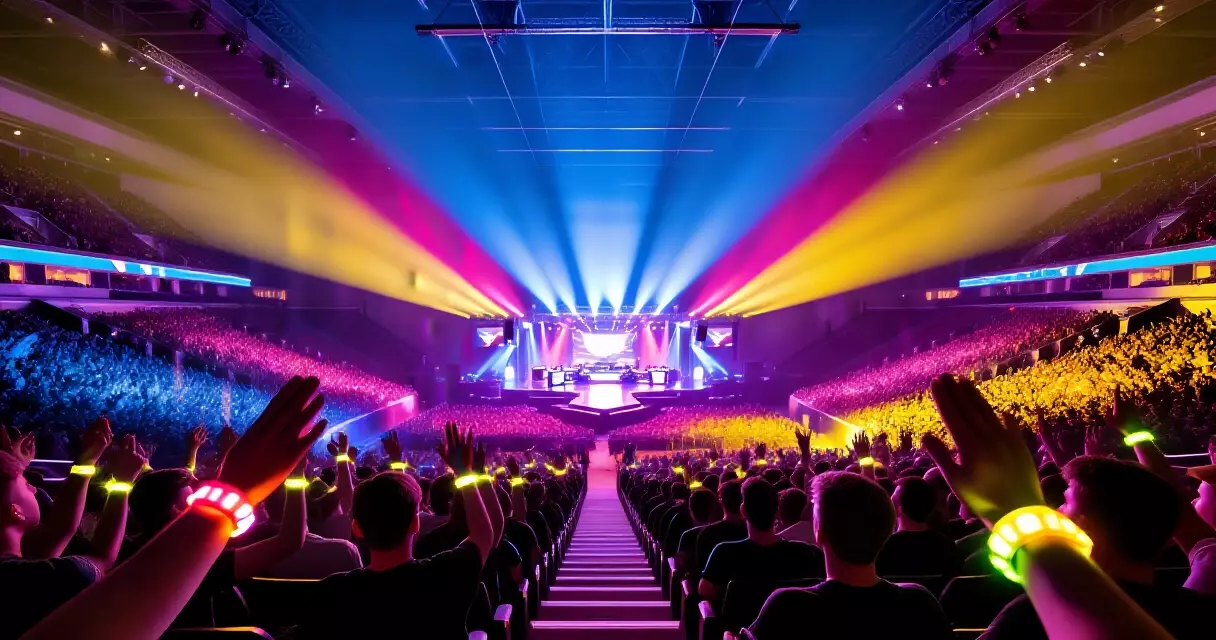
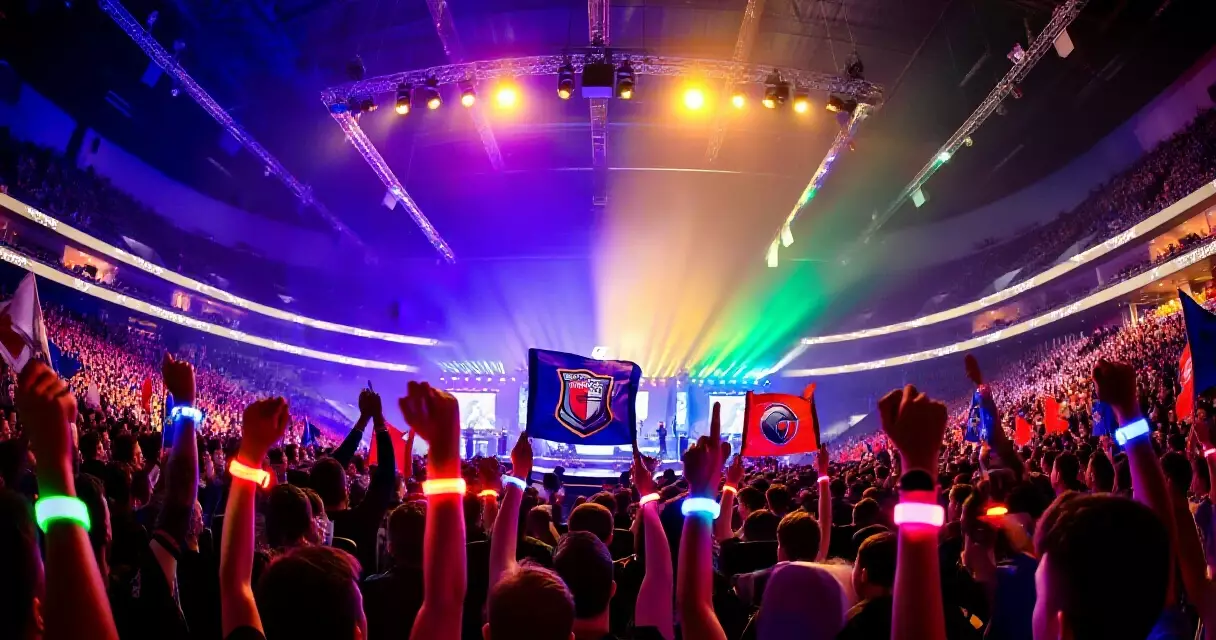
While online engagement defines the daily experience of most esports fans, live events occupy a disproportionate role in identity formation and community bonding. Attending a CS2 Major, a Valorant Champions tour stop, or the Esports World Cup is described by fans as a qualitatively different experience from online viewership — one that produces lasting community memories and stronger identification with the broader esports scene, not just a single game or team. This mirrors findings from traditional sports research, where live attendance is associated with deeper fan identification and longer-term loyalty.
The staging of major esports events at increasingly prestigious venues — arenas holding tens of thousands of attendees, production values that rival major music concerts — signals the industry’s deliberate investment in the live fan experience as an identity-building mechanism. The Esports World Cup 2026, held in Paris, is a prominent example of this ambition at the international scale.
| Engagement Type | Fan Identity Impact | Frequency (US fans, approx.) |
|---|---|---|
| Stream co-viewing (Twitch/YouTube) | Moderate — shared ritual, real-time belonging | Multiple times per week |
| Reddit/Discord participation | High — active community membership and debate | Daily for engaged fans |
| Live event attendance | Very high — peak identity formation moment | 1–3 times per year for dedicated fans |
| Merchandise/team apparel | High — visible identity signal to others | Occasional (purchase-driven) |
| Fantasy/prediction participation | Moderate — deepens match-level investment | Per-tournament |
How Esports Journalism Shapes Fan Identity Narratives
An exploration of esports fan identity, engagement, and community is incomplete without examining how esports journalism mediates that identity. Reporters and editors at outlets focused on competitive gaming do not merely report on events — they construct the narratives through which fans understand what the scene means, who the heroes and villains are, and what values should define competitive gaming culture. This is not unique to esports: sports journalism has always performed this function. But in esports, where communities are highly online and reactive, the feedback loop between journalism and fan discourse is compressed and intense.
Coverage of roster moves, for instance, does not just inform fans — it frames the meaning of those moves, and fan communities immediately interrogate that framing in Discord and Reddit. Understanding the USA Esports Alliance and similar governance developments matters to fans precisely because reporting gives those developments context and consequence. Journalism is, in this sense, a participant in fan identity construction, not merely an observer of it.
Frequently Asked Questions
What makes esports fan identity different from traditional sports fan identity?
Esports fan identity is less rooted in geographic proximity and more driven by game title preference, player parasocial bonds, and online community membership. Traditional sports fans often inherit allegiances from family or local franchise geography; esports fans typically construct their allegiances through personal taste and online community exposure. Research in the Journal of Sport and Exercise Psychology has documented these structural differences in how social identity theory applies to esports contexts.
Which esports titles have the most engaged fan communities?
League of Legends, CS2, Dota 2, and Valorant consistently generate the largest and most engaged esports fan communities globally. League of Legends Worlds regularly achieves the highest concurrent viewership of any esports event, while CS2 Major communities on platforms like HLTV and Reddit are known for deep tactical engagement. Dota 2’s The International produces the largest prize pools and intense community investment in the annual event cycle.
How do streaming platforms contribute to esports fan identity?
Streaming platforms — Twitch and YouTube Gaming primarily — function as social infrastructure for esports fan identity. Real-time chat, shared emote vocabulary, clip culture, and live co-viewing rituals all transform passive viewership into active community participation. Platform-specific emotes and in-group language are markers of community membership, and regular participation in stream communities is associated with stronger feelings of belonging among esports fans.
Does national identity matter to esports fans?
National identity is salient in esports but tends to be event-contingent rather than persistent. Fans typically adopt national allegiances during international competitions (Worlds, The International, CS2 Majors, the Esports Nations Cup) and revert to team or player allegiances in domestic competition. Initiatives like the 2026 Esports Nations Cup are designed to cultivate more durable national fan identity, though whether they succeed in doing so remains an evolving question.
Are esports fan communities inclusive?
Esports communities have historically struggled with toxicity and exclusionary norms, particularly along gender lines. The demographic composition of the audience has diversified in recent years, with female-identifying fans representing approximately 30% of the global esports audience according to Newzoo’s 2025 data. Teams, platforms, and organizers have implemented measures to address toxic community behavior, with uneven results. The question of inclusion remains active and contested within esports communities themselves.
How do esports journalists influence fan identity?
Esports journalists shape the narratives through which fans understand competitive events, player personalities, team trajectories, and scene-wide developments. Because esports fan communities are highly online and reactive, the feedback loop between journalism and fan discourse is faster and more intense than in traditional sports media. Reporters effectively participate in constructing the meaning of esports for fans, not merely distributing information about it.
Key Takeaways
An exploration of esports fan identity, engagement, and community surfaces a picture of a sophisticated, participatory audience ecosystem shaped by streaming culture, online community infrastructure, parasocial player relationships, and increasingly institutionalized competitive structures. Several conclusions stand out: fan identity in esports is multidimensional and personally constructed rather than inherited; streaming platforms are not merely channels but primary social spaces; live events produce the strongest identity formation; and journalism actively mediates the meaning of competitive esports for its audience. As the esports industry continues scaling toward broader mainstream recognition — evidenced by events like the Honor of Kings World Cup 2026 at the Esports World Cup Paris — understanding the depth and structure of fan identity becomes more consequential for teams, organizers, journalists, and researchers alike.
Sources
- Newzoo — Global Esports & Live Streaming Market Report 2025 — Retrieved August 2, 2026
- Journal of Sport and Exercise Psychology — Social Identity in Esports Contexts — Retrieved August 2, 2026
- Journal of Sports Media — Parasocial Interaction in Mediated Sports — Retrieved August 2, 2026
- Nielsen Sports — Esports Audience Demographic Report 2025 — Retrieved August 2, 2026