Summary
✓Reviewed by Emma ThompsonThe esports shoutcaster who called the most iconic tournament moment is widely identified as Sam "Kobe" Hartman-Kenzler, whose repeated calls of "Stixxay is going off" and his closing line "I never doubted them" turned Counter Logic Gaming's...
Table of contents
- 1 Who Is the Esports Shoutcaster Who Called the Most Iconic Tournament Moment?
- 2 The MSI 2016 Moment: Background on the Call
- 3 Why This Call Still Matters for Esports Shoutcaster Who Called the Most Iconic Tournament Moment Discussions
- 4 Other Candidates for the Esports Shoutcaster Who Called the Most Iconic Tournament Moment
- 5 How Commentary Shapes National and Team Identity
- 6 Shoutcasting Versus Reporting: Different Roles in the Esports Shoutcaster Who Called the Most Iconic Tournament Moment Discussion
- 7 Broadcast Production Behind Iconic Calls
- 8 Limitations: Why There Is No Single Official Answer
- 9 Frequently Asked Questions
- 9.1 Who is the esports shoutcaster who called the most iconic tournament moment?
- 9.2 What did Kobe actually say during the MSI 2016 call?
- 9.3 Was Royal Never Give Up really undefeated before the MSI 2016 semifinal?
- 9.4 Did CLG win the MSI 2016 tournament overall?
- 9.5 Are there other calls considered equally iconic?
- 9.6 Why does the 2013 League of Legends World Championship final come up in these discussions?
- 10 Key Takeaways
- 11 Sources
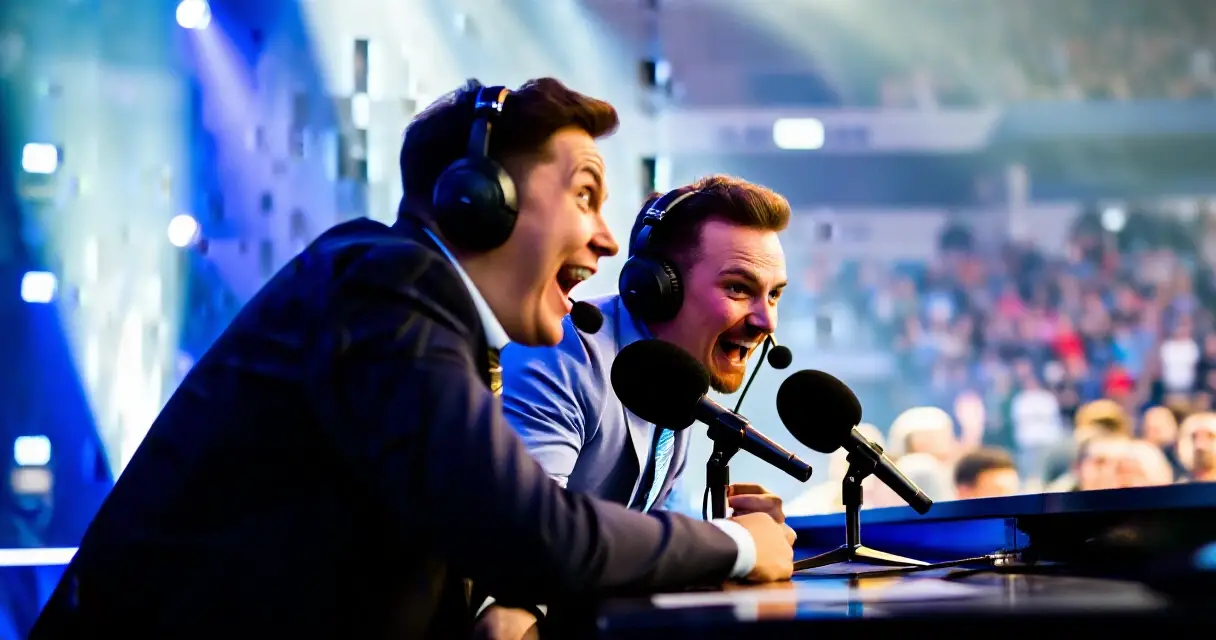
The esports shoutcaster who called the most iconic tournament moment is widely identified as Sam “Kobe” Hartman-Kenzler, whose repeated calls of “Stixxay is going off” and his closing line “I never doubted them” turned Counter Logic Gaming’s 2016 Mid-Season Invitational upset over Royal Never Give Up into one of League of Legends’ most replayed broadcast moments. There is no single, universally agreed answer to which call is the most iconic, since the title depends on the game and the audience being asked, but Kobe’s MSI 2016 call is among the most frequently cited.
Who Is the Esports Shoutcaster Who Called the Most Iconic Tournament Moment?
Sam “Kobe” Hartman-Kenzler is the League of Legends commentator most commonly identified as the esports shoutcaster who called the most iconic tournament moment. According to a Red Bull retrospective on landmark Mid-Season Invitational moments, Kobe is an LCS caster tied directly to the famous MSI 2016 broadcast call. His line, repeated as Trevor “Stixxay” Hayes carried CLG through the series, and his closing declaration that he never doubted the team, is still cited in retrospectives of great League of Legends commentary today.
It is worth noting upfront that no single source treats this as an objective, settled ranking. The identification of Kobe as the definitive answer reflects how frequently his call is referenced in League of Legends retrospectives, not a formal poll or governing body’s decision.
The MSI 2016 Moment: Background on the Call
The call took place at the 2016 Mid-Season Invitational, held in Shanghai, an event that Red Bull covers as a pivotal moment for North American League of Legends on the international stage. In the semifinal, Counter Logic Gaming faced Royal Never Give Up, China’s tournament favorite, which had been unbeaten through the group stage. CLG won the series 3-0, an upset result documented in commonly cited competitive records of the event. CLG then advanced to the MSI 2016 final, where it lost 3-0 to SK Telecom T1.
During the deciding games, CLG’s AD carry Stixxay produced the plays that prompted Kobe’s rising commentary, and it was his closing line after the series ended that became the moment’s defining phrase. Esports retrospectives continue to replay the call as an example of how broadcast commentary can become inseparable from the gameplay moment itself.
Why This Call Still Matters for Esports Shoutcaster Who Called the Most Iconic Tournament Moment Discussions
The reason Kobe’s call keeps surfacing in discussions of the esports shoutcaster who called the most iconic tournament moment is that it captures something broadcasters aim for: a commentator reacting in real time to a result that genuinely surprised the room. RNG entered the series as the favorite, and the upset itself, not just the commentary, is what gave the call its weight. A ESPN decade retrospective, updated in 2026, makes a similar point about the 2013 League of Legends World Championship final, where SK Telecom T1 defeated Royal Club in front of 32 million viewers at the Staples Center in Los Angeles, an event ESPN frames as symbolic of esports moving into mainstream Western sporting culture.
Other Candidates for the Esports Shoutcaster Who Called the Most Iconic Tournament Moment
Kobe is not the only name raised in these discussions. CaptainFlowers’ call of Faker’s Orianna play, remembered through the line “Faker’s shockwave will find them all,” is among the most frequently cited League of Legends moments, tied to Faker’s standing as one of the game’s defining competitors. Phreak’s commentary during Faker versus Ryu matchups is cited in similar discussions. Outside League of Legends, Dota 2 caster Toby “TobiWan” Dawson is remembered for his line “No one has ever done that in the history of Dota!” according to One Esports.
| Shoutcaster | Game | Associated moment |
|---|---|---|
| Sam “Kobe” Hartman-Kenzler | League of Legends | CLG def. RNG 3-0, MSI 2016 semifinal |
| CaptainFlowers | League of Legends | Faker’s Orianna shockwave call |
| Phreak | League of Legends | Faker vs. Ryu commentary |
| Toby “TobiWan” Dawson | Dota 2 | “No one has ever done that in the history of Dota!” |
Regional scenes have their own recognized voices as well. In Singapore, Eugene Eu, known professionally as ABSTRACT, has cast events including the Free Fire World Series and the first season of MPL Singapore, according to industry coverage of Southeast Asian shoutcasting talent.
How Commentary Shapes National and Team Identity
A single call can shape how fans remember a team’s identity for years afterward. CLG’s upset over RNG is remembered partly because of the result and partly because Kobe’s commentary gave it a phrase fans could repeat. This is closely related to how esports fan identity forms around a sponsor-sponsee relationship, where a memorable broadcast moment becomes part of a team’s brand long after the series itself is forgotten by casual viewers.
“I never doubted them” has outlived the series it described, becoming shorthand for an entire underdog run.
Reporters covering these moments need to separate the commentary’s emotional impact from the actual competitive record. For readers following how editorial teams verify this kind of claim, our guide on covering esports roster changes as a news reporter outlines similar sourcing discipline applied to transfer news rather than broadcast moments.
Shoutcasting Versus Reporting: Different Roles in the Esports Shoutcaster Who Called the Most Iconic Tournament Moment Discussion
It helps to separate the role of a shoutcaster from that of a news reporter when discussing iconic moments. A shoutcaster reacts live, in the moment, often with no chance to verify or caveat a claim before saying it on air. A reporter, writing after the fact, has the job of checking what actually happened, naming the tournament, the score, and the date correctly. Readers interested in that distinction can see it explained directly in our piece on esports news reporting versus esports commentary, which covers how the two disciplines differ in purpose and standards.
This distinction matters when a call becomes iconic enough to be repeated in retrospectives for a decade. The original broadcast commentary is emotional and unscripted, while later reporting on that same moment, including this article, has the benefit of hindsight and documentation to confirm scores, dates and venues.
Broadcast Production Behind Iconic Calls
An iconic call does not happen in isolation. It depends on a broadcast crew’s camera work, replay timing, and sound mixing to land with an audience. Tournament organizers and broadcast partners invest heavily in production infrastructure specifically so that moments like Kobe’s MSI 2016 call can be captured and replayed cleanly. Teams and venues following current production standards are covered in our overview of esports team broadcast setup trends, which looks at how Singapore-based teams approach their own streaming and production setups heading into 2026.
Limitations: Why There Is No Single Official Answer
This article does not treat the identification of Kobe’s MSI 2016 call as an objective, governing-body-certified ranking. No esports organization maintains an official registry of “most iconic” broadcast moments. The answer depends heavily on which game’s community is asked, and older moments such as the 2013 League of Legends World Championship final carry different significance than newer ones like Kobe’s 2016 call. Readers should treat any single answer, including this one, as a widely cited judgment rather than a settled fact.
Frequently Asked Questions
Who is the esports shoutcaster who called the most iconic tournament moment?
Sam “Kobe” Hartman-Kenzler is most frequently named in this context, for his commentary during Counter Logic Gaming’s 3-0 upset over Royal Never Give Up at the 2016 Mid-Season Invitational in Shanghai.
What did Kobe actually say during the MSI 2016 call?
He repeated the phrase “Stixxay is going off” as CLG’s AD carry carried the series, then closed with “I never doubted them” after the result was confirmed.
Was Royal Never Give Up really undefeated before the MSI 2016 semifinal?
According to Red Bull’s retrospective coverage, RNG entered the series as the tournament favorite and had gone unbeaten through the group stage before facing CLG.
Did CLG win the MSI 2016 tournament overall?
No. CLG beat RNG 3-0 in the semifinal but then lost 3-0 to SK Telecom T1 in the final, according to the tournament’s competitive record.
Are there other calls considered equally iconic?
Yes. CaptainFlowers’ call of Faker’s Orianna shockwave and TobiWan’s Dota 2 commentary are both cited regularly in similar discussions, alongside Phreak’s commentary of Faker versus Ryu matches.
Why does the 2013 League of Legends World Championship final come up in these discussions?
ESPN’s retrospective identifies that final, watched by 32 million viewers at the Staples Center in Los Angeles, as a foundational moment for esports reaching a mainstream Western audience, even though it is a different kind of moment than a single commentary call.
Key Takeaways
- Sam “Kobe” Hartman-Kenzler is most commonly cited as the esports shoutcaster who called the most iconic tournament moment, for his MSI 2016 commentary on CLG’s upset of RNG.
- CLG won that semifinal 3-0 but lost the MSI 2016 final 3-0 to SK Telecom T1.
- No governing body maintains an official ranking of iconic esports broadcast moments; the title reflects frequency of citation, not a formal decision.
- Other frequently cited calls include CaptainFlowers on Faker and TobiWan in Dota 2.
- The 2013 League of Legends World Championship final, watched by 32 million people according to ESPN, remains a separate but related landmark in esports broadcast history.
Sources
- Red Bull — retrieved October 10, 2026
- ESPN — retrieved October 10, 2026
- One Esports — retrieved October 10, 2026