
Summary
✓Reviewed by Emma Thompson How ESL FACEIT Group operates the esports event production and broadcast side of competitive gaming is one of the most consequential questions in the industry today. When fans watch a CS2 major or a global FACEIT...
Table of contents
- 1 What Is ESL FACEIT Group and Who Owns It
- 2 A Brief History of ESL’s Broadcast Infrastructure
- 3 How ESL FACEIT Group Structures Its Event Production Operations
- 3.1 Multi-Stage Arena Setups
- 3.2 Remote and Distributed Production
- 4 The Broadcast Side: Platforms, Feeds, and Technology
- 4.1 Hybrid IP and Baseband Workflows
- 5 EFG’s Partnership Model for Large-Scale Events
- 6 How EFG Produces Broadcasts for Multiple Game Titles Simultaneously
- 7 EFG’s Studio Facilities and Permanent Production Infrastructure
- 8 EFG’s Role in the Esports World Cup
- 9 Frequently Asked Questions
- 9.1 What is ESL FACEIT Group’s primary role in esports?
- 9.2 Who owns ESL FACEIT Group?
- 9.3 How does EFG handle broadcasting across multiple game titles at once?
- 9.4 What platforms do EFG events stream on?
- 9.5 Does ESL FACEIT Group produce broadcasts entirely in-house?
- 9.6 What technology does EFG use for its broadcasts?
- 10 Key Takeaways
- 11 Sources
How ESL FACEIT Group operates the esports event production and broadcast side of competitive gaming is one of the most consequential questions in the industry today. When fans watch a CS2 major or a global FACEIT championship, the cameras, caster desks, replay feeds, and simultaneous streams running across Twitch, YouTube, and dedicated platforms are all the product of a single company’s enormous production apparatus. According to Sports Video Group’s 2024 report on the Esports World Cup, EFG’s 2024 Riyadh production alone required three main stages, three secondary stages, eight analyst studios, and eight caster booths running simultaneously — a scale that rivals any traditional sports broadcast operation.
What Is ESL FACEIT Group and Who Owns It
ESL FACEIT Group was formed in 2022 following the acquisition of both ESL and FACEIT by Savvy Games Group, a holding company owned by Saudi Arabia’s Public Investment Fund. According to Wikipedia’s ESL entry, the combined deal was valued at US$1.5 billion — ESL at US$1.05 billion and FACEIT at US$500 million. Craig Levine and Niccolo Maisto were named to lead the combined group, with Ralf Reichert, the longtime ESL co-founder, serving as executive chairman.
The merger gave Savvy Games Group control over two of the industry’s most recognizable esports brands. ESL had spent over two decades building out large-format live events and broadcast infrastructure for titles including Counter-Strike, StarCraft II, and Dota 2. FACEIT had built one of the world’s largest competitive gaming platforms, hosting millions of matches and serving as the official ranked platform for CS2 in many regions. Together under EFG, these two operations form a vertically integrated structure that can run both the competitive matchmaking layer and the production and broadcast layer of major esports events.
A Brief History of ESL’s Broadcast Infrastructure
ESL’s roots as a broadcast organization stretch back to the early 2000s, when it began producing live Counter-Strike and Warcraft III events in Germany. By the mid-2010s, ESL had established dedicated studio infrastructure in Cologne and, through the DreamHack acquisition, in Stockholm — both of which now operate under the EFG umbrella. The Stockholm complex, described in detail by IHSE’s broadcast solutions case study, houses six independent production studios capable of running concurrent broadcasts for different titles. This long development of owned infrastructure distinguishes EFG from tournament organizers that rely entirely on third-party production vendors for every event.
How ESL FACEIT Group Structures Its Event Production Operations
How ESL FACEIT Group operates the esports event production side of competitive gaming depends heavily on the format of the event. For arena-scale events like IEM Katowice or the Esports World Cup, EFG deploys what Sports Video Group described in March 2025 as a “global production unit” that subdivides into specialty divisions based on event location, game title, and broadcast requirements. For studio-based league play — such as regular season FACEIT leagues or ESL Pro League broadcasts — production is handled from EFG’s permanent facilities.
The production floor at a large EFG event typically includes multiple observer stations — crew members who control in-game cameras to capture player perspectives — alongside traditional broadcast camera operators covering the physical stage. A master control room handles live switching between in-game feeds and stage cameras, while separate producer channels manage analyst desk segments, player interviews, and pre-produced highlight packages. This layered production model closely mirrors how traditional sports broadcasters handle multi-angle live events, adapted for the dual-camera reality of esports (physical cameras plus in-game software cameras).
Multi-Stage Arena Setups
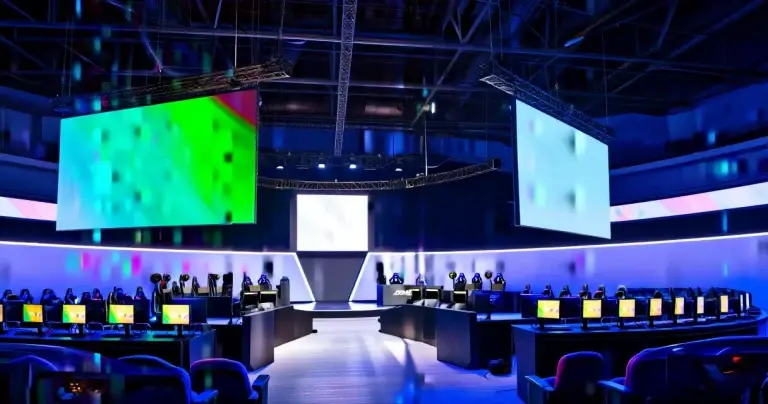
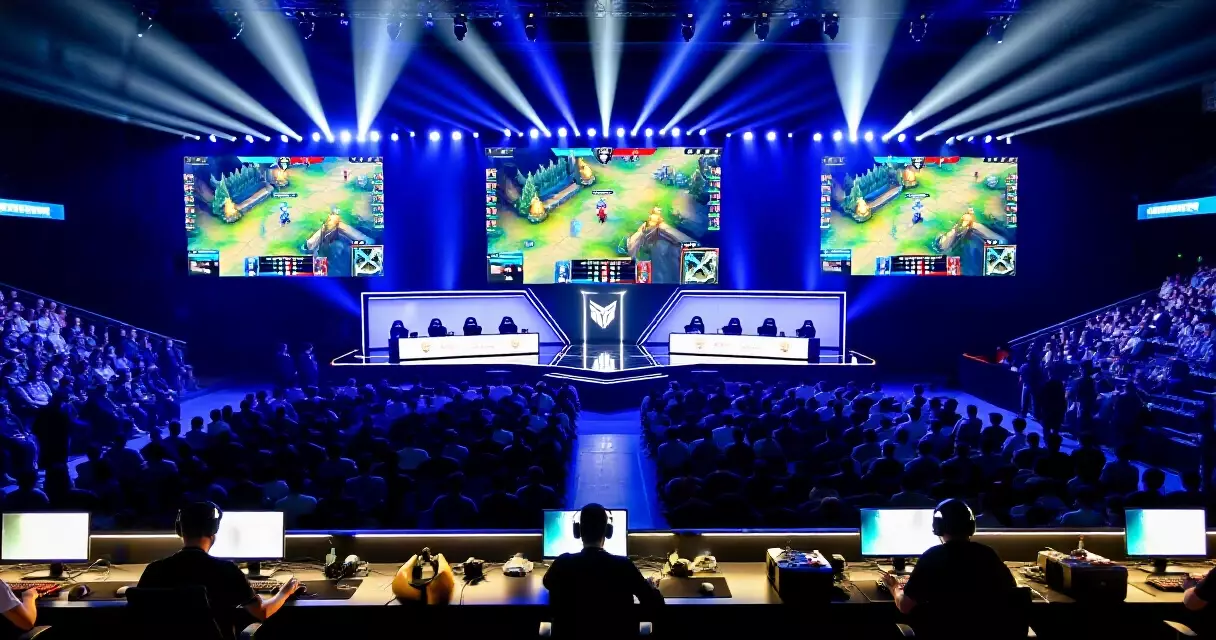
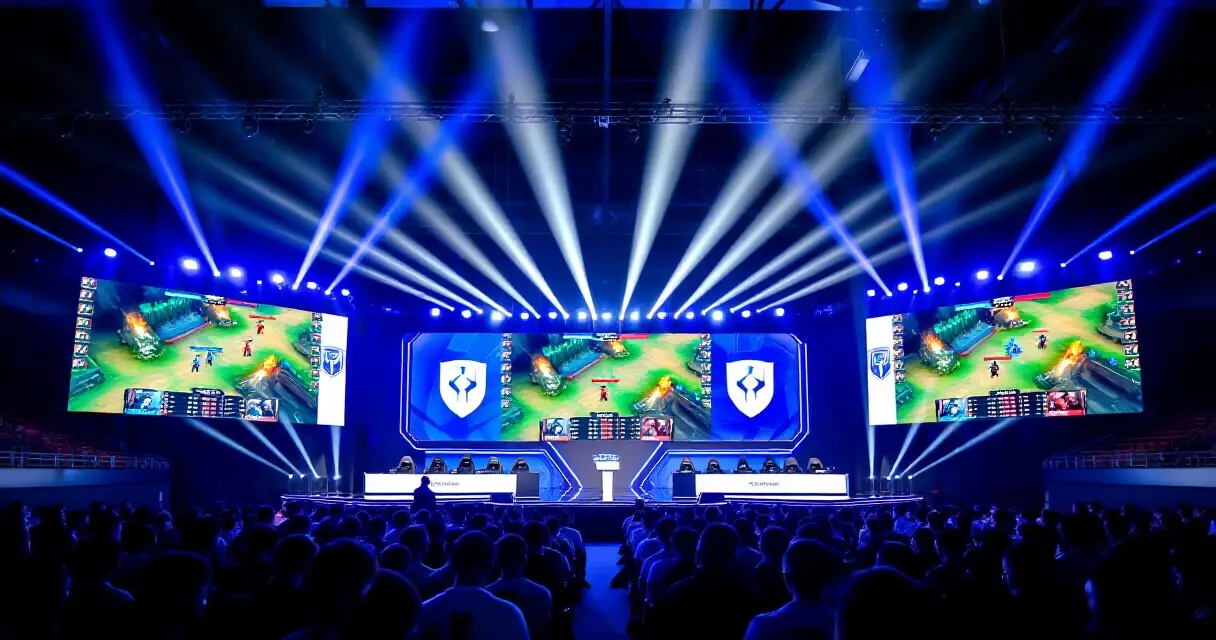
For the 2024 Esports World Cup in Riyadh, EFG’s production architecture as reported by Sports Video Group included three main stages, three secondary stages, eight analyst studios, eight caster booths, and one dedicated production studio — all operating simultaneously across a single venue complex. This scale requires a production management layer that coordinates scheduling, technical handoffs, and resource sharing between titles. Staff rotate between game-specific production teams, and a central operations function ensures that broadcast windows for different titles do not collide.
Remote and Distributed Production
EFG has invested significantly in remote production capability. In early 2025, Sports Video Group reported that EFG produced three global competitions in three countries across two continents over a single weekend — a feat that required centralized technical direction from a hub facility while local crews handled physical camera work and player management on the ground. This distributed model reduces travel costs and allows EFG to scale production across more events without proportionally scaling its permanent headcount.
The Broadcast Side: Platforms, Feeds, and Technology
How ESL FACEIT Group operates the broadcast side of competitive gaming centers on multi-platform distribution. EFG delivers live event content primarily on Twitch and YouTube, with certain events also available through FACEIT Watch — the integrated viewing experience built into the FACEIT platform itself. For major events like IEM and the Esports World Cup, EFG also coordinates regional language streams, with separate caster and analyst teams producing localized versions of the same broadcast for audiences in different markets.
The technical complexity of EFG’s broadcast output is substantial. According to TVBEurope’s 2026 Esports World Cup coverage, the event’s broadcast infrastructure handled more than 60 simultaneous feeds, used nine production lines, and required more than 21 RF links for wireless broadcast operations — all with over 150 crew members on site. That output dwarfs what most regional sports leagues produce for a single championship event.
For the 2026 Esports World Cup, EFG’s broadcast infrastructure managed more than 60 simultaneous feeds — a production scale that rivals major traditional sports championships.
Hybrid IP and Baseband Workflows
EFG’s technical evolution has moved toward hybrid broadcast architectures combining traditional baseband signal routing with IP-based systems such as SMPTE ST 2110, the broadcast industry standard for transporting uncompressed video and audio over IP networks. Sports Video Group’s August 2025 analysis of EFG’s hybrid production model described this shift as central to how the company now handles the signal routing and distribution demands of multi-stage events. IP-based workflows allow EFG to route feeds between studios and stages more flexibly than traditional point-to-point baseband connections, supporting the high feed counts reported at recent major events.
EFG’s Partnership Model for Large-Scale Events
For its largest events, EFG does not operate entirely with in-house production resources. The company works with specialist outside broadcast partners to supplement its own technical capabilities. Gravity Media, a broadcast services company, has been publicly identified as a key production partner for EFG’s major event delivery. EFG and Gravity Media announced a formal partnership for delivering live broadcasts of premier global esports events, according to ESL FACEIT Group’s official press release. In practice, this means Gravity Media supplies outside broadcast trucks, engineering crew, and specialized signal infrastructure while EFG’s production team retains editorial and creative control over the broadcast itself.
This partner-led model is common in broadcast-heavy sports industries. Traditional broadcasters routinely contract outside broadcast vendors for large stadium events while keeping show-running and talent direction in house. EFG has adopted the same structure, treating specialist vendors as infrastructure providers rather than full production partners. The result is that EFG can scale to events with 150-plus crew and 60-plus feeds without permanently employing every technical specialist required for that level of output.
How EFG Produces Broadcasts for Multiple Game Titles Simultaneously
One of the defining operational challenges for how ESL FACEIT Group operates the esports event production and broadcast side of competitive gaming is the multi-title environment. A single event like the Esports World Cup features competition across CS2, VALORANT, Dota 2, League of Legends, PUBG Mobile, and other titles — each requiring its own observer team, caster pair, and production line. EFG manages this by organizing game-specific production verticals that operate with relative autonomy within the shared venue infrastructure.
Each title’s broadcast is treated as a standalone production with its own show-runner, though central scheduling and technical coordination prevent conflicts over shared resources such as satellite uplinks, fiber connections, and power infrastructure. The Esports World Cup 2026 schedule illustrates how EFG staggers match windows across titles to manage the broadcast load — rarely do two finals-equivalent matches run at the same time, allowing production resources to shift between game verticals as needed.
EFG’s Studio Facilities and Permanent Production Infrastructure
Beyond arena events, EFG maintains owned studio infrastructure that underpins its league-format broadcasts. The Stockholm facility, operated under the DreamHack brand and profiled in an IHSE broadcast solutions case study, houses six independent production studios. These studios allow EFG to run concurrent broadcasts for different game titles or different regional broadcasts of the same title without competing for physical space. The Cologne facility serves a similar function for events run through the ESL brand.
The production workflow within these facilities processes both live physical camera feeds and in-game observer feeds, with technical directors switching between sources in real time. Highlight packages, replays, and pre-produced segments are integrated through a broadcast graphics and media management layer. The esports media trends shaping 2026 point toward further consolidation of these studio operations as EFG looks to run more content from permanent facilities rather than building temporary production infrastructure for every event.
EFG’s Stockholm facility houses six independent production studios — a permanent infrastructure investment that separates the company from tournament organizers who build broadcast capacity from scratch for each event.
EFG’s Role in the Esports World Cup
The Esports World Cup represents the clearest public demonstration of how ESL FACEIT Group operates the esports event production and broadcast side of competitive gaming at maximum scale. EFG has served as the official operating partner for the EWC, responsible for tournament operations, broadcast programming, and production delivery across all featured titles. In 2024, Sports Video Group reported EFG managing the full production infrastructure across more than a dozen game verticals running simultaneously in Riyadh. In 2026, TVBEurope confirmed EFG’s continued role with an even larger infrastructure footprint.
The EWC relationship illustrates EFG’s position in the broader esports ecosystem: the Esports World Cup Foundation sets the event’s strategic direction and title selection, while EFG handles the operational and broadcast execution that makes the event viewable for audiences worldwide. This separation of strategic ownership from operational execution is a model that has become common in large sports properties, where rights holders and production operators are distinct entities.
Frequently Asked Questions
What is ESL FACEIT Group’s primary role in esports?
EFG is the world’s largest third-party esports tournament organizer and broadcast producer. It runs competitive events, manages the FACEIT platform for ranked matchmaking, produces live and studio broadcasts across multiple titles, and handles operational logistics for events including the Esports World Cup, IEM events, and ESL Pro League. It is distinct from game publishers — EFG does not own the titles it broadcasts, but licenses the rights to operate competitive events for those titles.
Who owns ESL FACEIT Group?
EFG is owned by Savvy Games Group, a holding company controlled by Saudi Arabia’s Public Investment Fund. The acquisition was completed in 2022 for a combined US$1.5 billion, bringing ESL and FACEIT under a single corporate structure. The company’s day-to-day leadership includes Craig Levine and Niccolo Maisto, with Ralf Reichert serving as executive chairman.
How does EFG handle broadcasting across multiple game titles at once?
EFG organizes game-specific production verticals, each with its own show-runner, observer team, and caster pair, operating within shared venue infrastructure. A central scheduling and technical coordination layer prevents resource conflicts. At the Esports World Cup, this model allowed EFG to run independent broadcast operations for more than a dozen titles simultaneously while maintaining a unified production infrastructure for signal routing, power, and connectivity.
What platforms do EFG events stream on?
EFG distributes live event content primarily on Twitch and YouTube. Some events are also available through FACEIT Watch, the integrated viewing experience within the FACEIT platform. For major events, EFG also coordinates regional language streams with localized caster and analyst teams, effectively producing multiple simultaneous versions of the same broadcast for different international audiences.
Does ESL FACEIT Group produce broadcasts entirely in-house?
Not entirely. For large arena events, EFG works with specialist outside broadcast partners — most notably Gravity Media — who supply broadcast trucks, engineering crew, and signal infrastructure. EFG retains editorial and creative control over the broadcast while vendors provide the underlying technical delivery. For studio-based league broadcasts, EFG’s own Stockholm and Cologne facilities handle production without outside broadcast support.
What technology does EFG use for its broadcasts?
EFG has moved toward hybrid broadcast architectures combining traditional baseband routing with IP-based systems such as SMPTE ST 2110. This allows flexible signal routing between stages and studios and supports the high simultaneous feed counts required at events like the Esports World Cup. RF wireless links are used for camera mobility, with more than 21 RF links reported at the 2026 EWC. The IHSE broadcast solutions case study also highlights EFG’s use of KVM-over-IP systems for distributed production control across its studio facilities.
Key Takeaways
- ESL FACEIT Group is the world’s largest third-party esports tournament organizer and broadcast producer, formed from the 2022 merger of ESL and FACEIT under Savvy Games Group.
- EFG’s production model combines owned studio infrastructure in Stockholm and Cologne with distributed arena setups and outside broadcast partnerships for major events.
- The 2026 Esports World Cup required more than 150 on-site crew, nine production lines, more than 60 simultaneous feeds, and more than 21 RF links — according to TVBEurope.
- EFG manages multi-title event production by organizing game-specific production verticals within shared venue infrastructure, coordinated by a central technical operations layer.
- The company distributes content across Twitch, YouTube, and FACEIT Watch, with regional language streams produced in parallel for international audiences.
- Hybrid IP-based broadcast workflows, including SMPTE ST 2110, are now central to EFG’s technical production architecture for large events.
For fans following the competitive CS2 circuit, the PGL CS2 Major 2026 coverage demonstrates how EFG’s production model plays out across individual tournaments — the same infrastructure principles that power the EWC are applied at title-specific majors throughout the year.
Sources
- ESL (company) — Wikipedia — Retrieved August 27, 2026
- Delivering Over 3,500 Video Signals for the Esports World Cup — TVBEurope — Retrieved August 27, 2026
- ESL FACEIT Group Details Its Esports World Cup Production in Riyadh — Sports Video Group — Retrieved August 27, 2026
- How EFG Produced Three Esports Events Across Two Continents in One Epic Weekend — Sports Video Group — Retrieved August 27, 2026
- Esports World Cup 2025: Inside EFG’s Hybrid Production — Sports Video Group — Retrieved August 27, 2026
- ESL Esports Broadcast — IHSE Solutions — Retrieved August 27, 2026
- ESL Gaming and Gravity Media Partner for Live Broadcast of Premier Global Esports Events — ESL FACEIT Group — Retrieved August 27, 2026