
Summary
✓Reviewed by Emma Thompson The question of who is behind the new Riot Games esports broadcast identity changes cuts to the heart of how the company has restructured its entire competitive gaming operation over the past several years. From the...
Table of contents
- 1 Who Leads Riot Games’ Esports Broadcast Organization
- 2 The Historical Arc: From Regional Leagues to a Unified Brand
- 3 Further Group and the LEC Visual Identity Redesign
- 4 AWS and the Infrastructure Behind Riot’s Broadcast Identity
- 5 The Publishing and Esports Merger: What It Means for Broadcast
- 5.1 How the Org Restructure Changed Creative Decisions
- 5.2 Platform Technology as Part of Identity
- 6 KICK and the Expanding Distribution Identity
- 7 Riot Games Broadcast Identity Changes: Key Decisions Compared
- 8 Why the LCS-to-LTA Rebrand Matters for Broadcast Identity
- 9 Frequently Asked Questions
- 9.1 Who is John Needham and what is his role in Riot’s broadcast identity?
- 9.2 What design agency created the LEC broadcast identity?
- 9.3 What role does AWS play in Riot’s broadcast identity changes?
- 9.4 Why did Riot add KICK as an official broadcaster in 2026?
- 9.5 What was the LCS-to-LTA rebrand and who decided it?
- 9.6 Are Riot’s broadcast identity changes driven by external agencies or internal teams?
- 10 Sources
The question of who is behind the new Riot Games esports broadcast identity changes cuts to the heart of how the company has restructured its entire competitive gaming operation over the past several years. From the unification of the LoL Esports brand in 2020 to the opening of a 70,000-square-foot Remote Broadcast Center in Seattle in 2024, Riot’s broadcast identity overhaul is the product of deliberate executive decisions, in-house creative teams, specialized design agencies, and major technology partnerships — none of which operate in isolation.
Who Leads Riot Games’ Esports Broadcast Organization
The most consequential figure in Riot Games’ esports broadcast identity changes is John Needham, who currently serves as the executive overseeing a combined Publishing & Esports organization. According to a Riot Games announcement, Needham’s expanded role merged esports, publishing, international, platform technology, and music under one leadership chain — a structural decision that directly determines how broadcast identity is planned, funded, and executed across all Riot titles. Prior to this consolidation, esports and publishing operated under separate chains of command, which fragmented decision-making around brand presentation.
Needham’s elevation signals that Riot is no longer treating broadcast identity as a purely cosmetic concern. When production infrastructure, platform distribution, and music licensing all report to the same executive as competitive events themselves, the look and feel of a Riot broadcast becomes an integrated product decision rather than a marketing afterthought.
The Historical Arc: From Regional Leagues to a Unified Brand
Understanding who is behind the new Riot Games esports broadcast identity changes requires tracing a deliberate, multi-year journey. For most of League of Legends’ first decade, each regional league — the LCS in North America, the LEC in Europe, the LCK in Korea — operated with a largely distinct visual identity, production style, and broadcast package. The fragmentation was visible: fans switching between regional streams encountered different graphics packages, different broadcast music, and different presenter aesthetics.
In 2020, as reported by Wikipedia’s League Championship Series entry and confirmed by Riot’s own statements, the company launched the unified LoL Esports brand — a single visual umbrella intended to tie regional tournaments together. The stated rationale, attributed at the time to Riot spokesperson David Higdon, was that as League of Legends entered its second decade, the brand should reflect values that reinforce gaming as a meaningful life pursuit. The 2025 season pushed this further: the LCS merged with CBLOL and LLA to form the League of Legends Championship of The Americas (LTA), retiring the LCS name and reorganizing competitive structures around a unified continental model.
Further Group and the LEC Visual Identity Redesign
On the creative side, one of the clearest external answers to who is behind the new Riot Games esports broadcast identity changes is Further Group, the design agency responsible for the League of Legends European Championship rebrand. Further Group created the LEC’s complete visual identity and broadcast package, including the logo — described by the agency as capturing the spirit of “Unleash Together,” an explosion of triumph and celebration. The agency’s work extended to roadshows and set design, demonstrating that Riot’s broadcast identity changes are not handled by a single internal department but by a collaboration between Riot’s in-house teams and specialized external creative partners.
AWS and the Infrastructure Behind Riot’s Broadcast Identity
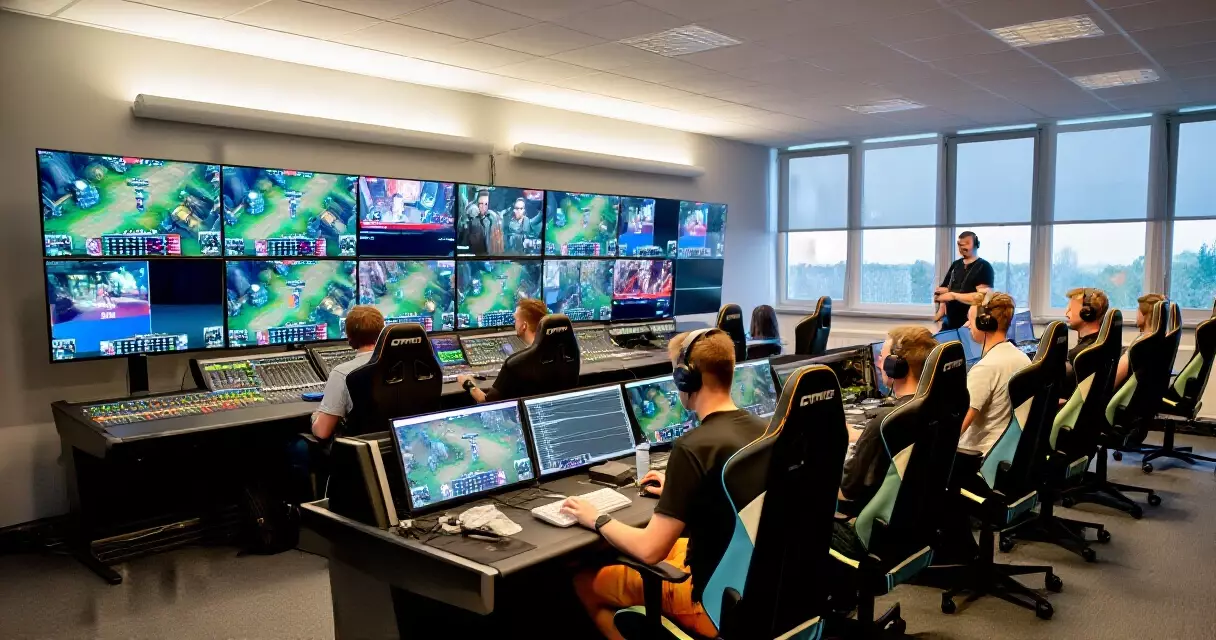
Broadcast identity is not only about visuals — it is also about the technical infrastructure that determines what a production can look like at scale. Here, Amazon Web Services (AWS) is the defining partner. According to Sports Video Group’s January 2025 report, Riot’s Seattle Remote Broadcast Center is a 70,000-square-foot facility powered by AWS, joining a first RBC in Dublin. Together, these two centers enable a follow-the-sun operations model — internally referred to as Project Stryker — that allows Riot to produce and distribute live esports content globally and in multiple languages without requiring large on-site production crews at every venue.
This remote-first production model is itself a broadcast identity statement. It standardizes the look, feel, and audio quality of Riot events regardless of where in the world they are physically taking place, ensuring that a viewer watching a League of Legends match from Southeast Asia receives the same production values as someone watching a North American LTA event.
Riot’s remote broadcast centers are not just cost-saving infrastructure — they are the physical expression of a global broadcast identity, designed to deliver a consistent production standard across every time zone Riot competes in.
The Publishing and Esports Merger: What It Means for Broadcast
How the Org Restructure Changed Creative Decisions
The organizational restructure that placed John Needham over a combined Publishing & Esports unit — detailed in Riot’s official announcement — had a specific creative implication: broadcast identity decisions are now made within the same structure that governs music licensing, in-game publishing events, and international content. This is unusual in the esports industry, where production departments typically report up through event operations rather than through a publishing or media organization.
The practical effect is that Riot’s broadcast packages — the opening cinematics, the in-broadcast music, the thematic overlays tied to new champion releases — are no longer negotiated across separate organizational silos. They are planned together, which explains why recent Riot broadcasts have leaned more heavily into original music and cinematic crossover moments as part of the broadcast identity itself, not just as promotional content adjacent to it.
Platform Technology as Part of Identity
The same restructure placed platform technology under Needham’s remit. This matters because the platforms on which Riot distributes its broadcasts — and how they are experienced by viewers — are now part of the same organizational decision-making chain as the visual identity itself. Riot’s universal Riot ID system, which replaced game-specific Summoner Names and standardized player identity across all Riot titles, is an early indicator of how platform-level decisions now reinforce broadcast-level branding. A viewer who recognizes a player by their Riot ID on stream is experiencing a form of brand coherence that the old, fragmented system could not produce.
KICK and the Expanding Distribution Identity
In June 2026, Riot Games announced that KICK would join its global roster of official streaming platforms. According to Riot’s official announcement, starting with MSI 2026, KICK would carry live broadcasts for global and regional events across LoL Esports, VALORANT, and Teamfight Tactics, excluding China and Korea. Riot framed the decision as giving players more ways to watch, co-stream, and engage with its games and esports — language that positions distribution expansion as part of the broadcast identity, not separate from it.
This is a meaningful signal. The platforms Riot chooses to distribute on are themselves a broadcast identity choice, communicating which audiences Riot considers part of its competitive gaming community and what kinds of viewer experiences it is willing to officially endorse. For fans and industry followers tracking who is behind the new Riot Games esports broadcast identity changes, the KICK decision illustrates that distribution strategy is now an explicit part of identity governance, not an afterthought handled by a separate rights and licensing team.
Riot Games Broadcast Identity Changes: Key Decisions Compared
| Change | Year | Key Party Responsible | Scope |
|---|---|---|---|
| LoL Esports unified brand launch | 2020 | Riot Games internal esports team (David Higdon, spokesperson) | Global — all regional leagues |
| LEC visual identity & broadcast package | 2019–2020 | Further Group (external design agency) | European league only |
| Publishing & Esports org merger | 2021 | John Needham (President, Esports → Publishing & Esports) | Company-wide structural |
| Project Stryker / remote broadcast model | 2022 onward | Riot Games + AWS partnership | Global production infrastructure |
| Seattle Remote Broadcast Center opened | 2024 | Riot Games (AWS-powered, 70,000 sq ft) | Americas and follow-the-sun ops |
| LCS → LTA rebrand and merger | 2025 | Riot Games esports leadership | Americas competitive structure |
| KICK added as official broadcaster | 2026 | Riot Games distribution strategy team | Global (ex China, Korea) |
Why the LCS-to-LTA Rebrand Matters for Broadcast Identity
One of the most visible recent examples of who is behind the new Riot Games esports broadcast identity changes is the replacement of the LCS with the League of Legends Championship of The Americas. As documented by Wikipedia’s LCS entry, the 2025 season saw the LCS merge with the Campeonato Brasileiro de League of Legends (CBLOL) and Liga Latinoamérica (LLA) to form the LTA, with the LCS name retired and rebranded as LTA North. This was not a cosmetic change — it required new logos, new broadcast packages, new on-air graphics, new music, and new competitive format presentation. Each of those elements was decided within Riot’s combined Publishing & Esports organization.
The community reaction was mixed, with some fans and analysts arguing on Reddit that Riot’s response to concerns about the LCS rebrand revealed a disconnect between the organization’s internal broadcast identity logic and fan expectations. That tension is itself part of the story: who is behind these changes is also a question about accountability, and the LTA rebrand made clear that these decisions rest entirely within Riot’s corporate hierarchy rather than with independent league operators or team owners.
The LCS-to-LTA transition made plain that Riot’s broadcast identity is a corporate product decision, not a community-governed one — a fact that defines both the speed of change and its accountability structure.
| Broadcast Identity Layer | Who Controls It | External Partner (if any) |
|---|---|---|
| Visual brand / logo / graphics package | Riot Games internal creative + agencies | Further Group (LEC); others vary by region |
| Production infrastructure | Riot Games esports ops | AWS (Remote Broadcast Centers) |
| Broadcast music & audio | Riot Games Publishing & Esports | Riot Music internal label |
| Platform distribution | Riot Games distribution strategy | Twitch, YouTube, KICK (from MSI 2026) |
| Player / team identity on broadcast | Riot Games platform technology | Riot ID system (internal) |
| Competitive format presentation | Riot Games esports leadership (Needham) | None — fully internal |
Frequently Asked Questions
Who is John Needham and what is his role in Riot’s broadcast identity?
John Needham is the Riot Games executive who leads the combined Publishing & Esports organization, a structure that brings together esports, publishing, international content, platform technology, and music under one leadership chain. According to Riot’s own announcement of the restructure, Needham was the then-President of Esports before his role was expanded. His position means that broadcast identity decisions — from visual package to platform distribution — ultimately fall within his organizational remit.
What design agency created the LEC broadcast identity?
Further Group, a specialist design agency, created the League of Legends European Championship’s visual identity and broadcast package. Their work included the LEC logo, the overall brand system, and physical elements like roadshow and set design. The logo was designed around the concept of “Unleash Together,” reflecting themes of collective triumph in competitive play.
What role does AWS play in Riot’s broadcast identity changes?
AWS powers Riot’s remote broadcast infrastructure, including the two Remote Broadcast Centers in Dublin and Seattle. The Seattle facility, reported by Sports Video Group in January 2025 as 70,000 square feet, enables Riot to produce multilingual live esports broadcasts without requiring large on-site crews. The internal program, Project Stryker, describes this as a follow-the-sun operations model. AWS’s role is technical rather than creative, but it fundamentally enables the production scale and consistency that defines Riot’s broadcast identity in practice.
Why did Riot add KICK as an official broadcaster in 2026?
Riot announced in June 2026 that KICK would join its global streaming roster starting with MSI 2026, covering LoL Esports, VALORANT, and TFT outside China and Korea. Riot’s stated reason was to give fans more ways to watch, co-stream, and engage with its games and esports. The addition is notable given that KICK’s ownership structure had previously made it a controversial choice in esports distribution discussions, representing a shift in Riot’s platform identity policy.
What was the LCS-to-LTA rebrand and who decided it?
The LCS (League Championship Series) was merged with CBLOL and LLA in 2025 to form the League of Legends Championship of The Americas, with the LCS name retired and replaced by LTA North. This decision was made entirely within Riot Games’ esports leadership structure — not by team owners or an independent governing body. It required a complete overhaul of broadcast graphics, competitive format presentation, and regional identity, all executed under the Publishing & Esports organization led by John Needham.
Are Riot’s broadcast identity changes driven by external agencies or internal teams?
Both. Riot’s broadcast identity is shaped by a combination of internal creative and engineering teams, external design agencies (notably Further Group for the LEC), and technology partners (AWS for production infrastructure). Strategic decisions about what the brand should communicate, which platforms to distribute on, and how competitive formats are presented remain with Riot’s internal leadership under John Needham. The execution of specific visual identities for individual leagues has involved external agencies on a project basis.
Sources
- Riot Games — Connecting Games with Esports, Music & Publishing — Retrieved August 3, 2026
- Sports Video Group — An Esports Production Palace: Riot Games’ Seattle Remote Broadcast Center (January 2025) — Retrieved August 3, 2026
- Riot Games — Expanding our Global Esports Distribution with KICK (June 2026) — Retrieved August 3, 2026
- Wikipedia — League Championship Series (esports) — Retrieved August 3, 2026
- Further Group — LEC Rebrand: Riot Games Esports Identity for Europe — Retrieved August 3, 2026
- Wikipedia — Riot Games — Retrieved August 3, 2026