
Summary
✓Reviewed by Emma ThompsonA 720Hz monitor. A 4K camera feed running at 59.94 frames per second. A dedicated internet line rated at 200 Mbps or higher, just to be allowed on-site. These are not aspirational numbers anymore, they are the...
Table of contents
- 1 What Is Driving Esports Team Broadcast Setup Trends Right Now
- 2 Key Numbers Behind Esports Team Broadcast Setup Trends
- 3 A Short History of How Esports Broadcast Setups Got Here
- 4 Capture and Transport: The Core of Esports Team Broadcast Setup Trends
- 4.1 Why Venue Connectivity Floors Keep Rising
- 5 Display Hardware: 720Hz OLED Enters Competitive Play
- 6 Compute and Peripheral Trends Shaping Broadcast-Ready Teams
- 7 Cabling Standards Compared: SDI, Fibre, and HDMI
- 8 Limitations and What Reported Standards Do Not Guarantee
- 9 Frequently Asked Questions About Esports Team Broadcast Setup Trends
- 9.1 What is the current baseline video standard for esports broadcasts?
- 9.2 Why are esports venues moving away from HDMI?
- 9.3 What internet speed does a venue need to host a broadcast tournament?
- 9.4 Is the 720Hz OLED monitor used by every esports team?
- 9.5 What network setup do professional players use compared to broadcast production?
- 9.6 What GPU hardware does esports broadcast production typically require?
- 10 Key Takeaways on Esports Team Broadcast Setup Trends
- 11 Sources
A 720Hz monitor. A 4K camera feed running at 59.94 frames per second. A dedicated internet line rated at 200 Mbps or higher, just to be allowed on-site. These are not aspirational numbers anymore, they are the baseline that Singapore-linked esports productions are being built around in 2026, and understanding esports team broadcast setup trends now means understanding a full production chain, not just a webcam and a headset.
What Is Driving Esports Team Broadcast Setup Trends Right Now
The short answer: broadcast engineering for competitive gaming has become conservative and standardized even as displays get flashier. Capture and transport choices have converged on 4K at 59.94 fps as the accepted floor for leading esports production, while cabling has quietly shifted away from consumer-grade HDMI toward SDI and fibre for anything beyond a short run. That split, reliable core infrastructure paired with headline-grabbing peripheral hardware, is the defining shape of esports team broadcast setup trends heading into the Singapore Major window.
For readers tracking the wider hardware conversation, this sits alongside ongoing shifts in tournament stage PC requirements, since broadcast and competitive computing infrastructure at a venue are now planned together rather than as separate line items.
Key Numbers Behind Esports Team Broadcast Setup Trends
Based on available industry production data, these figures are best treated as reported operating standards for large-scale events rather than fixed regulatory requirements, since much of the sourcing behind them comes from vendor pages and trade coverage rather than tournament organizer technical documents.
A Short History of How Esports Broadcast Setups Got Here
Esports broadcast infrastructure did not start at 4K. Early LAN-era productions leaned on consumer HDMI runs, single-camera setups, and best-effort venue internet, which worked when audiences were small and stakes were lower. As prize pools and viewership grew through the 2010s, production teams borrowed more from traditional broadcast television, adopting professional-grade transport like SDI and building redundancy into venue networks. The current baseline, 4K capture, fibre for long or clean signal paths, and multi-gigabit production backbones, is the result of that decade-long convergence between gaming production and mainstream broadcast engineering rather than a sudden 2026 invention.
Esports production has quietly become broadcast television with a controller in frame, and the cabling choices prove it.
Capture and Transport: The Core of Esports Team Broadcast Setup Trends
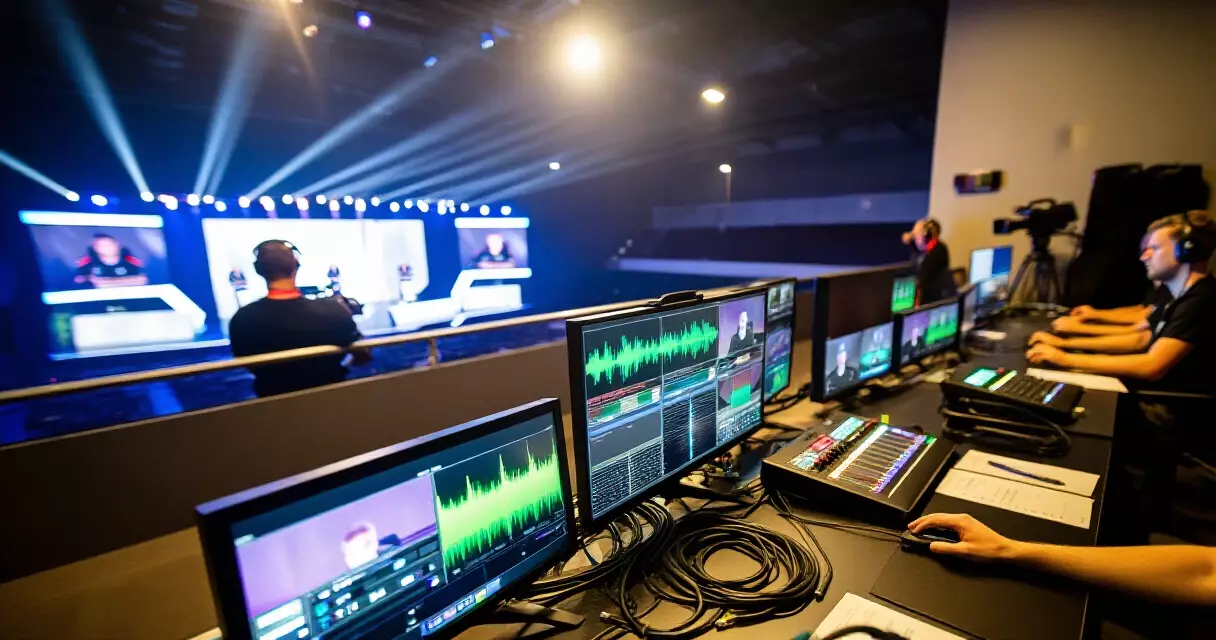
According to industry production reporting cited across 2026 event-planning coverage, leading esports broadcasts now treat 4K capture at 59.94 fps as a baseline rather than a premium option. That has pushed transport decisions downstream: SDI cable, which supports runs of up to roughly 100 metres without signal degradation, has become the default for in-venue routing, while active HDMI is generally recommended only for short runs of around 15 metres or less before a conversion to SDI. Fibre is reserved for the longest and cleanest signal paths, particularly across large or multi-floor venues where cable runs would otherwise strain copper-based options.
Why Venue Connectivity Floors Keep Rising
A minimum 200 Mbps dedicated internet connection is described in current industry planning sources as the accepted floor for venue-level esports broadcasts in 2026, up from the older 100 Mbps dedicated standard. On the production side, larger esports broadcasts are reported to run on 10 Gbps networks, with redundancy and uninterruptible power supply backups built in, while player-side traffic in high-end environments is commonly isolated on dedicated 1 Gbps VLANs over wired Ethernet.
Display Hardware: 720Hz OLED Enters Competitive Play
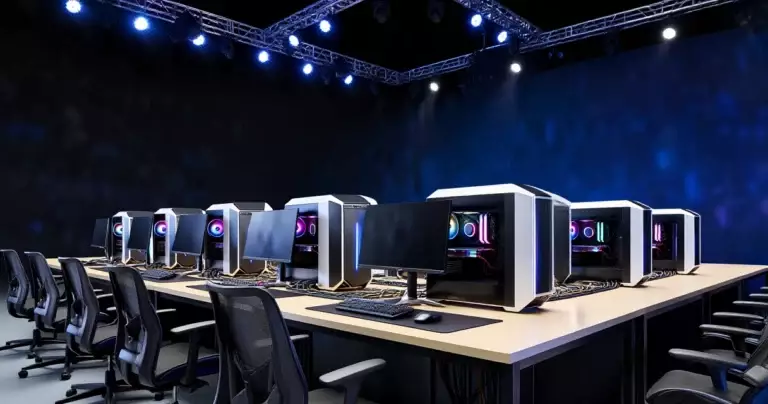
The most visible shift in esports team broadcast setup trends this year is on the display side. The ASUS ROG Swift OLED PG259QWS Ace, a 24.5-inch 1920×1080 OLED monitor with a 720Hz refresh rate, is presented in late August and early September 2026 coverage as the current high-end esports display tied to the PGL Singapore Major 2026. That places the older 240Hz to 360Hz class of 1080p esports monitors below the newest top-tier standard referenced in this cycle of coverage, even though those panels remain common in professional tournament play more broadly, where 144Hz or higher is typically treated as the entry requirement.
CB_IMAGE_PLACEHOLDER
Esports Charts has reported that ASUS ROG’s 2026 hardware deployment is set to appear across PGL Counter-Strike and Dota 2 events, including the Singapore Major, while ASUS ROG’s own Singapore site highlights its newer 24.5-inch monitors as bringing OLED panel technology into esports for the first time at this scale. For a deeper technical comparison of these display categories, readers can also see how esports team PCs and tournament stage PCs differ in the broader hardware stack surrounding these displays.
Compute and Peripheral Trends Shaping Broadcast-Ready Teams
On the compute side, one 2026 esports event-planning source sets an NVIDIA RTX 4070 as the production GPU floor, while large-scale productions may step up to RTX 6000 Ada-class cards for encoding and graphics-heavy overlay work. On the peripheral side, Razer’s Singapore esports page states that its HyperSpeed Wireless Gen-2 technology is used across what it describes as the number one headset brand among esports professionals, a claim that reflects vendor marketing rather than independent measurement and should be read that way.
| Component | 2026 Reported Standard | Source Type |
|---|---|---|
| Capture format | 4K at 59.94 fps | Industry production reporting |
| Venue internet | 200 Mbps dedicated minimum | Industry production reporting |
| Production network | 10 Gbps with redundancy and UPS | Esports event-planning source |
| Player-side network | Wired Ethernet, 1 Gbps dedicated VLAN | Esports event-planning source |
| Production GPU floor | NVIDIA RTX 4070 (up to RTX 6000 Ada-class) | Esports event-planning source |
How we know: the figures above are drawn from named industry event-planning and production-reporting sources current as of the 2026 season and should be read as reported operating standards for large-scale productions rather than universal or legally mandated specifications.
Cabling Standards Compared: SDI, Fibre, and HDMI
| Transport Type | Typical Use Case | Effective Range |
|---|---|---|
| Active HDMI | Short in-booth or desk runs | Roughly 15 metres or less |
| SDI | Standard venue-wide routing | Up to 100 metres without degradation |
| Fibre | Long-distance or multi-floor signal paths | Longest and cleanest option available |
This cabling hierarchy is one reason production budgets have shifted, since fibre and SDI infrastructure requires more upfront investment than an HDMI-only setup but avoids the degradation risk that comes with longer consumer-grade runs. Teams and organizers following live tournament production gear rankings will recognize this same SDI-and-fibre priority reflected in current equipment recommendations.
Limitations and What Reported Standards Do Not Guarantee
It is worth being direct about the limits of this picture. Several of the most specific 2026 figures cited here come from industry reporting and vendor pages rather than from Singapore government bodies or official tournament organizer technical specifications, so they should be treated as current reported standards, not binding legal requirements. Smaller regional Singapore esports events, university leagues, and grassroots tournaments will often fall short of the 200 Mbps connectivity floor or the full 4K, 59.94 fps capture chain described above, since that level of infrastructure typically appears at flagship events tied to major organizers and title publishers.
Coverage of the PGL Singapore Major itself sits alongside other regional storylines Singapore-based fans are following, including Esports World Cup 2026 scheduling and broader questions about whether PGL Major match reporting reflects the same infrastructure standards discussed here.
Frequently Asked Questions About Esports Team Broadcast Setup Trends
What is the current baseline video standard for esports broadcasts?
Industry production reporting describes 4K capture at 59.94 fps as the 2026 baseline for leading esports productions. This applies most consistently to flagship, large-scale events rather than every regional broadcast.
Why are esports venues moving away from HDMI?
Active HDMI is generally reliable only for short runs of about 15 metres or less. SDI supports runs of up to 100 metres without signal degradation, and fibre handles the longest or most demanding paths, which is why both have become the dominant venue transport methods over long-run HDMI.
What internet speed does a venue need to host a broadcast tournament?
A minimum 200 Mbps dedicated connection is described as the accepted floor for venue-level tournament broadcasts in 2026, replacing the older 100 Mbps dedicated benchmark.
Is the 720Hz OLED monitor used by every esports team?
No. The ASUS ROG Swift OLED PG259QWS Ace at 720Hz is cited in coverage tied specifically to the PGL Singapore Major 2026 and ASUS ROG’s broader 2026 event partnerships. It represents the newest top tier, not the typical setup across all professional play, where 240Hz to 360Hz panels remain common.
What network setup do professional players use compared to broadcast production?
Player-side setups are commonly built on wired Ethernet with dedicated 1 Gbps VLANs in high-end environments, while production-side networks for larger broadcasts are reported to run at 10 Gbps with redundancy and UPS backup power.
What GPU hardware does esports broadcast production typically require?
One 2026 esports event-planning source lists an NVIDIA RTX 4070 as the production GPU floor, with larger productions scaling up to RTX 6000 Ada-class cards for heavier encoding and graphics workloads.
Key Takeaways on Esports Team Broadcast Setup Trends
- 4K capture at 59.94 fps is now the reported baseline for leading esports production in 2026.
- SDI and fibre have displaced long-run HDMI, with active HDMI limited to roughly 15 metres before conversion.
- A 200 Mbps dedicated venue connection is described as the new broadcast floor, up from 100 Mbps.
- The ASUS ROG Swift OLED PG259QWS Ace, a 720Hz 1080p OLED monitor, marks the newest competitive display tier tied to the PGL Singapore Major.
- Production networks increasingly run on 10 Gbps backbones, with player traffic isolated on dedicated 1 Gbps VLANs.
Treat these esports team broadcast setup trends as the current reported ceiling for flagship, organizer-backed events rather than a universal requirement for every tournament, and expect the gap between headline display technology and workhorse transport infrastructure to remain a defining feature of competitive gaming production through the rest of 2026.
Sources
- ASUS ROG Swift OLED PG259QWS Ace product page — retrieved September 15, 2026
- Esports Charts — retrieved September 15, 2026
- Razer Singapore Esports — retrieved September 15, 2026