
Summary
The International 2021 – a single Dota 2 tournament – awarded $40 million in prizes, making it the largest prize pool in esports history at the time. That figure was not the result of a corporate sponsorship windfall; it was...
Table of contents
- 1 A Brief History: From LAN Parties to Stadium Finals
- 2 Tournament Formats: The Structures That Decide Champions
- 2.1 Single Elimination
- 2.2 Double Elimination
- 2.3 Round Robin (Group Stage)
- 2.4 Swiss System
- 2.5 Regular Season / Franchise League
- 2.6 Battle Royale Scoring
- 3 How Prize Pools Work: Allocation, Crowdfunding, and Guarantees
- 4 The Qualification Ladder: How Teams Earn Their Spot
- 5 Tournament Tiers: What Separates a Major from a Regional Event
- 6 Online vs. LAN: Why Location Still Matters
- 7 Who Runs Esports Tournaments: Organizers, Publishers, and the Ecosystem
- 8 Watching Esports Tournaments: Broadcast Production and Audience Scale
- 9 Esports Tournaments and the Path to Professionalism
- 10 FAQ: Esports Tournaments Explained
- 10.1 What is an esports tournament?
- 10.2 How are esports tournament brackets decided?
- 10.3 How do esports tournament prize pools get funded?
- 10.4 What is the difference between a Major and a minor in esports?
- 10.5 How do teams qualify for major esports tournaments?
- 10.6 Can amateur players enter esports tournaments?
- 10.7 Where can I watch esports tournaments?
- 10.8 How are esports tournament results used for world rankings?
- 11 Sources
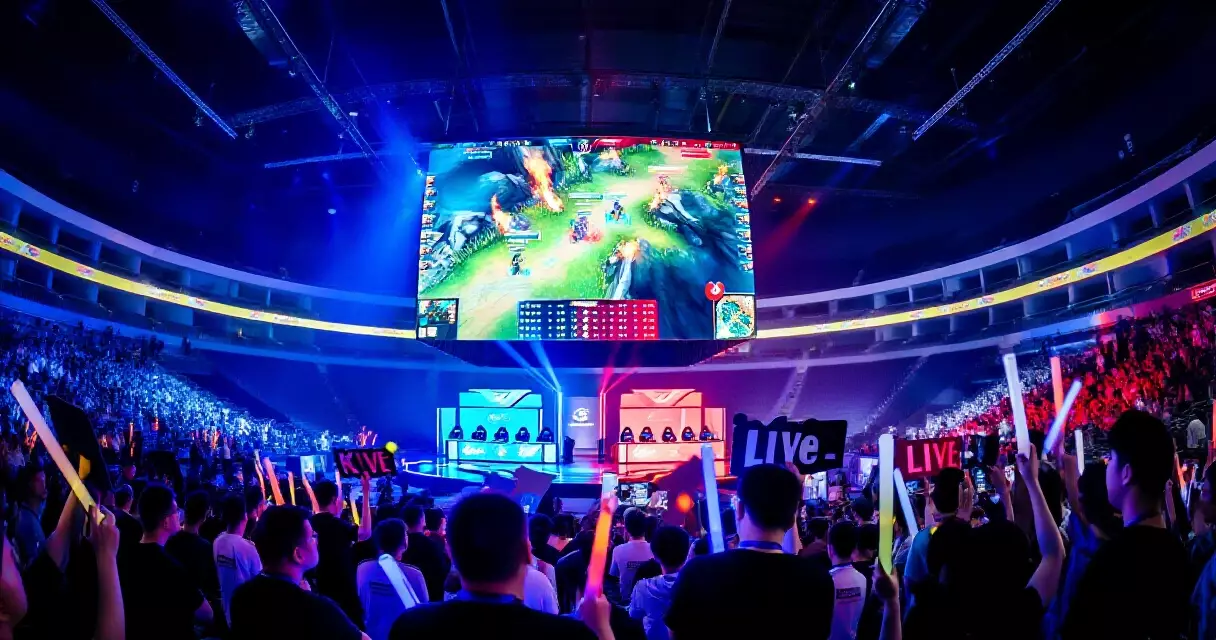
The International 2021 – a single Dota 2 tournament – awarded $40 million in prizes, making it the largest prize pool in esports history at the time. That figure was not the result of a corporate sponsorship windfall; it was crowdfunded almost entirely by the game’s own player base through in-game item purchases. That one data point captures what makes esports tournaments unlike anything else in competitive entertainment: a global audience, decentralized funding, and prize money that rivals traditional sports leagues, all built around people playing video games at an elite level.
A Brief History: From LAN Parties to Stadium Finals
Competitive gaming existed long before anyone called it esports. The first documented video game competition on record took place at Stanford University in October 1972, where students competed in Spacewar! for a year’s subscription to Rolling Stone magazine, according to records held by Stanford’s archives. For the next two decades, competitive gaming remained a hobbyist activity organized through local arcades and early internet bulletin boards.
The competitive scene began to professionalize in the late 1990s. The Cyberathlete Professional League (CPL) launched in 1997 and held some of the first tournaments with cash prizes exceeding $10,000. South Korea’s establishment of the Korea e-Sports Association (KeSPA) in 2000 gave institutional legitimacy to competitive StarCraft: Brood War, which had become a national phenomenon broadcast on dedicated cable television channels. Korean pro gamers became genuine celebrities during this era.
The modern esports tournament infrastructure emerged between 2010 and 2016. Riot Games launched the League of Legends Championship Series (LCS) in 2013 as a fully salaried, franchised league – the first of its kind in esports. Valve introduced The International in 2011 with a then-record $1 million prize pool. Activision Blizzard, ESL, FACEIT, and PGL all built competing tournament ecosystems during this window, giving rise to the multi-tiered circuit structure that most games use today.
Tournament Formats: The Structures That Decide Champions
Not all esports tournaments use the same bracket structure, and the format chosen has significant consequences for how upsets happen, how long the event runs, and how fair the outcome feels to competitors and viewers. Six primary formats dominate competitive play today.
Single Elimination
In a single-elimination bracket, one loss ends a team’s run. This is the most dramatic format – every match carries maximum stakes – and it is used for the final stages of major events because it creates clear narrative tension. The downside is that a single bad game on a given day can eliminate a legitimately strong team. Most tournament organizers avoid using pure single elimination for the full bracket, reserving it for playoff rounds after a group stage has already filtered the field.
Double Elimination
Double elimination is the most common format for mid-to-large esports events. Teams that lose once drop into a “lower bracket” rather than being eliminated. They can fight back through the lower bracket and re-enter the grand finals. The team that loses twice is out. This format is used by Valve’s Majors (CS2 and Dota 2), ESL Pro League, and countless regional circuits because it gives top teams a safety net while still rewarding consistency. The trade-off is run time – a double-elimination bracket takes significantly longer to complete than a single-elimination one of the same size.
Round Robin (Group Stage)
In a round-robin group stage, every team plays every other team in the group at least once. This format is used to produce a reliable ranking before knockout rounds begin. League of Legends Worlds uses a group stage; most CS2 Majors use a Swiss system (a variant of round robin) for the challengers stage. Round robin produces the fairest results over time but is impractical for large fields because the number of required matches scales quadratically with team count.
Swiss System
The Swiss system pairs teams with identical win-loss records in each round, continuing until a team reaches either a qualifying threshold (e.g., 3 wins) or an elimination threshold (e.g., 3 losses). This format, borrowed from chess tournaments, is now standard at CS2 Majors for their opening stages. It accommodates large fields without requiring every team to play every other team, and it naturally surfaces the strongest contenders through head-to-head filtering rather than fixed bracket draws.
Regular Season / Franchise League
Franchise leagues such as the League of Legends Championship Series (LCS) and, historically, the Overwatch League run structured regular seasons across weeks or months, awarding points based on weekly match results before a playoff bracket determines the champion. This format aligns closely with traditional professional sports and supports a predictable broadcast calendar for sponsors and media partners.
Battle Royale Scoring
Games like PUBG, Fortnite, and Apex Legends use a points-based scoring system because battle royale matches involve large numbers of teams simultaneously rather than head-to-head matchups. Points are typically awarded for placement (finishing position) and kills. The PUBG Global Series, for example, uses a formula that weights placement heavily, making survival strategy as important as mechanical skill. Aggregating points across multiple matches over a tournament day determines advancement or final standings.
A comparison of the major formats:
| Format | Matches Required (8 teams) | Allows Second Chance? | Common Use Case |
|---|---|---|---|
| Single Elimination | 7 | No | Playoff finals stages |
| Double Elimination | 13-15 | Yes (once) | CS2 Majors, Dota 2 The International |
| Round Robin | 28 (full) | N/A – points-based | Group stages, franchise leagues |
| Swiss System | Variable (score-based) | Up to threshold | CS2 Major challengers stage |
| Battle Royale Points | Multi-match sessions | Cumulative scoring | PUBG Global Series, Fortnite Champion Series |
How Prize Pools Work: Allocation, Crowdfunding, and Guarantees
Prize money in esports comes from three main sources: publisher guarantees, third-party tournament organizer sponsorships, and player-driven crowdfunding. Understanding which source funds a specific event matters because it determines how stable that prize pool is year over year.
Publisher guarantees are commitments made by the game developer to fund a prize pool directly from company revenue. Riot Games funds the League of Legends World Championship prize pool directly. This model produces consistent, predictable prize amounts but keeps the ceiling lower than crowdfunded alternatives – and gives the publisher full control over format, schedule, and rules.
Crowdfunded prize pools were pioneered by Valve with The International’s “Compendium” (later the Battle Pass) model beginning in 2013. A percentage of each Battle Pass sale contributed to the prize pool, which meant dedicated player communities could drive prize totals far beyond what any single sponsor would commit. The International 2021’s $40 million pool – the highest in esports history – was built almost entirely through this mechanism. Valve takes 25% of Battle Pass revenue; the remaining 75% flows to the prize pool. The model has since been retired in its original form, but it demonstrated the viability of community-funded prize pools at scale.
Third-party organizer prize pools come from companies like ESL, PGL, BLAST Premier, and DreamHack, which license game titles and operate tournaments independently. These prize pools are funded through a combination of sponsorship deals, media rights, ticket sales, and co-investment from publishers. ESL Pro League’s annual prize pool for CS2 exceeds $3 million across multiple seasons.
Prize distribution follows a standard descending scale. First place typically receives between 30-40% of the total pool, with percentages dropping steeply for lower placements. At a $1 million tournament, the winner might take $300,000-$400,000, while teams finishing in 7th-8th place might receive $20,000-$30,000 each. Most prize structures begin paying out at the point a team is eliminated from contention – so reaching the top 8 of a major event carries guaranteed monetary value.
“The International 2021’s $40 million prize pool – built almost entirely by the game’s own players through in-game purchases – proved that an esports audience could fund a prize structure that rivals the earnings of major professional sports championships.”
The Qualification Ladder: How Teams Earn Their Spot
Getting into a major esports tournament is not simply a matter of registering. Most elite events use a multi-stage qualification system that filters thousands of aspirants down to the 8, 16, or 24 teams that appear on the broadcast stage. This ladder typically has four tiers.
Tier 4 – Open qualifiers: Anyone can enter. These are typically online brackets open to any team that registers before the deadline. Tens of thousands of players may participate in a game’s open qualifier ecosystem. The top finishers advance to the next stage.
Tier 3 – Regional closed qualifiers: Teams that cleared the open qualifier or hold a standing from a regional league compete in a closed bracket. This stage is typically still online but limited to teams that have already demonstrated a baseline performance level.
Tier 2 – Regional leagues / circuit points: Many game ecosystems run year-long regional leagues (such as the Valorant Champions Tour regional leagues, or ESL Pro League for CS2) that award circuit points over multiple splits or seasons. Finishing well in a regional league is the primary path to major tournament qualification for professional teams.
Tier 1 – Direct invites: The top-ranked teams globally may receive direct invitations to a major event based on world ranking, recent tournament performance, or franchise status. Direct invites bypass the qualification bracket entirely and are typically given to teams that have proven themselves over multiple events.
The exact structure varies significantly by game. CS2 Majors are entirely merit-based through a placement-point system with no direct invites to the main event. Dota 2’s The International has historically given direct invites to top-ranked teams. Valorant Champions uses a hybrid of regional league performance and VCT Points to determine which teams qualify from each region.
| Game | Major Organizer | Primary Qualification Method | Direct Invites? |
|---|---|---|---|
| CS2 (Counter-Strike 2) | PGL, ESL, BLAST | Regional ranking + RMR points | No (RMR-only path) |
| Dota 2 | Valve (PGL) | DPC League standings | Yes (top-ranked teams) |
| League of Legends | Riot Games | Regional league finishes (LCS, LEC, LCK, etc.) | Yes (defending champs / seeds) |
| Valorant | Riot Games | VCT regional leagues + VCT Points | Limited (franchise slots) |
| PUBG | Krafton | PUBG Global Series points | Regional allocation |
| Rocket League | Psyonix / ESL | RLCS regional series | Yes (top global seeds) |

Tournament Tiers: What Separates a Major from a Regional Event
Not all tournaments carry equal weight. The esports community has developed informal but widely understood tier classifications that reflect prize pool size, field strength, qualification difficulty, and production quality. Understanding these tiers explains why winning a regional open qualifier and winning a World Championship both count as “tournament wins” but mean very different things on a player’s resume.
S-Tier / Premier Events are the game’s most prestigious tournaments. Examples include CS2 Majors (prize pool $1.25 million minimum), League of Legends World Championship, Dota 2’s The International, and Valorant Champions. These events attract the best teams globally, carry the largest prize pools, and represent the pinnacle of achievement for a professional player. Winning one of these events defines careers.
A-Tier / Major Invitationals sit below the premier tier but above regional competition. ESL Pro League Finals, BLAST Premier World Final, and similar events fall here. Prize pools typically range from $250,000 to $1 million, fields are strong but may include fewer top-10-globally-ranked teams, and qualification may involve a mix of regional performance and direct invites.
B-Tier / Regional Championships are the top events within a given region. Examples include ESL Pro League regional finals, LCS Championship, or national-level championship finals in markets like Brazil, Southeast Asia, or the Middle East. Prize pools vary widely but typically fall under $250,000. These events determine regional ranking and seeds into higher-tier competitions.
C-Tier and Below includes third-party tournaments, community events, amateur leagues, and online cups. These events may have small prize pools or none at all. They serve as development circuits for emerging talent and provide practice in competitive settings. Platforms like ESL Play, FACEIT, and Battlefy host thousands of these events annually, forming the foundational layer of the competitive ecosystem.
Online vs. LAN: Why Location Still Matters
Esports tournaments are divided into two fundamental environments: online events and LAN (Local Area Network) events. The distinction matters more than casual fans typically realize, and it directly affects how results are interpreted by the competitive community.
In an online tournament, players compete from their home setups or team facilities via internet connection. Online events are logistically simpler and cheaper to run – no travel costs, no venue booking, and no equipment freight. They scale well to large open qualifiers and regional leagues. The trade-off is that online environments introduce variables that LAN events eliminate: internet connection quality, ping differences between players in different cities, the inability to use third-party anti-cheat hardware monitoring, and the psychological difference of competing from a familiar home environment.
At LAN events, all competing players are physically present in the same venue, connected to the same local network. Ping is equalized, hardware is standardized, and physical anti-cheat oversight is possible. The LAN environment produces results the competitive community treats as more authoritative. “Online form” and “LAN form” are distinct performance metrics that analysts track separately – some players and teams consistently perform better or worse when transitioning between the two environments.
The COVID-19 pandemic forced nearly all esports competition online from 2020 through 2021. The return to LAN events in 2022 and beyond revealed meaningful performance gaps in multiple rosters that had built their reputations during the online-only period. For viewers wanting to assess a team’s true capability, LAN results carry substantially more weight.
“Online form and LAN form are treated as separate metrics by analysts and scouts – the pressure of competing on a physical stage in front of thousands of fans produces a categorically different competitive environment than playing from a home setup.”
Major esports venues built specifically for LAN events include dedicated facilities like those reviewed in our Major Esports Arenas and Venues: Where Championships Are Won guide. Facilities like the Fusion Arena in Philadelphia and the HyperX Esports Arena in Las Vegas were purpose-built to host exactly these kinds of premier LAN competitions at scale.
Who Runs Esports Tournaments: Organizers, Publishers, and the Ecosystem
The tournament landscape is shaped by a handful of key actors whose relationships – sometimes collaborative, sometimes competitive – determine which events happen, when, and with what rules.
Game publishers hold main authority over their titles. Riot Games, Valve, Activision Blizzard, Krafton, and Epic Games each decide whether to license their games to third-party organizers or retain control of their own circuits. Riot Games operates its competitive circuits (League of Legends, Valorant) almost entirely in-house. Valve licenses CS2 to third-party organizers like PGL and ESL but maintains the “Major” designation as a controlled brand. This publisher-controlled model gives developers direct influence over the esports ecosystem for their title.
Third-party tournament organizers (TPOs) are companies that build event infrastructure independently. ESL (now part of ESL FACEIT Group, majority-owned by Savvy Gaming Group), PGL (based in Romania), BLAST Premier, and DreamHack are the largest. They invest in venues, broadcast production, talent, and logistics, generating revenue from sponsorships, media rights, and ticket sales. Their relationships with publishers range from fully licensed partners to independent operators running community tournaments without official endorsement.
Professional teams are stakeholders whose collective bargaining power has grown significantly. In franchised leagues (LCS, LEC, formerly the Overwatch League), teams paid franchise fees ranging from $10 million to $35 million for a permanent slot and negotiated revenue-sharing agreements. Teams outside franchise systems depend entirely on prize winnings, sponsorships, and content revenue. The tension between publisher control and team ownership rights has been a recurring source of conflict in esports governance through 2024-2026.
Broadcast platforms shape which tournaments receive wide visibility. Twitch, YouTube Gaming, and regional partners in Korea (AfreecaTV/SOOP), China (Bilibili, Douyu), and Southeast Asia (TikTok Live, Facebook Gaming) determine where audiences can watch. Media rights deals between platforms and organizers can be worth tens of millions of dollars for premier events. The LCS signed a multi-year streaming deal with Amazon’s Twitch; League of Legends Worlds is broadcast across dozens of regional partners.
For a broader look at how specific venues support this ecosystem, see our review of the ESL FACEIT Hub Esports Venues and how dedicated infrastructure underpins professional tournament production.
Watching Esports Tournaments: Broadcast Production and Audience Scale
Esports broadcasts have evolved from basic screen-capture streams to multi-camera, analyst-desk, studio-quality productions that rival conventional sports broadcasts in production value. Understanding how tournaments are broadcast helps explain why viewership numbers and audience measurement in esports differ from traditional sports metrics.
Major esports broadcasts feature play-by-play commentary (called “casting”), color commentary, in-game observer cameras, real-time statistical overlays, and pre-game and post-game analysis desks staffed by former professional players and dedicated broadcast talent. PGL’s CS2 Major broadcasts and Riot Games’ League of Legends Worlds productions are widely cited as benchmark examples of esports production quality.
Viewership measurement in esports uses peak concurrent viewers and average concurrent viewers (ACV) rather than total unique viewers, because the audience watches live streams rather than scheduled broadcasts. The 2022 League of Legends World Championship final between T1 and DRX peaked at 5.1 million concurrent viewers on non-Chinese platforms, according to Esports Charts – a figure that reaches tens of millions when Chinese platform viewership (tracked separately) is included.
Multi-language broadcasting is standard at premier events. CS2 Majors and LoL Worlds are broadcast simultaneously in dozens of language streams. Riot Games has broadcast League of Legends Worlds in over 20 language streams, with regional casters who have developed dedicated fan bases independent of the English main broadcast. This multi-lingual approach is a key factor in the global scale of esports audiences.
Esports Tournaments and the Path to Professionalism
For players aspiring to compete professionally, tournaments are not just competitions – they are the primary mechanism for visibility, sponsorship acquisition, and career advancement. The competitive pipeline from amateur to professional is more structured today than at any previous point in esports history.
Most professional players begin their competitive careers through ranked ladder performance on the game’s public matchmaking system. High rankings attract attention from amateur team rosters, which compete in community leagues and open qualifiers. From there, the path typically runs through academy or challenger-tier teams before reaching a franchise or premier team’s main roster.
Amateur and semi-professional circuits have expanded significantly. FACEIT hosts hundreds of thousands of organized matches monthly across multiple titles. ESL Play’s amateur division runs regular tournaments in over 50 countries. Collegiate esports – organized through bodies like the National Association of Collegiate Esports (NACE) in the United States, which had over 175 member institutions as of 2024 – provides a structured competitive environment for players balancing education and competition.
Scouts and team managers actively monitor tools like HLTV.org player rankings (CS2), OP.GG (League of Legends), and tracker.gg (Valorant, Apex) to identify high-performing players in public matchmaking. A strong tournament performance at a regional qualifier can place a player on the radar of professional teams operating in that region. The combination of public statistics platforms and open qualifier systems means that geographic location is less of a barrier to discovery than it was in esports’ earlier years – though physical relocation to team facilities in major esports hubs (Seoul, Los Angeles, Berlin, Shanghai) often remains a practical requirement for reaching the highest levels of play.
For context on how practice infrastructure supports this pipeline, see our piece on Mobile Esports Training Tips – the underlying training principles apply across platforms. Our What Is Mobile Esports? article also covers how mobile-specific tournament circuits operate differently from PC and console scenes.
FAQ: Esports Tournaments Explained
What is an esports tournament?
An esports tournament is an organized competitive event where individuals or teams compete in one or more video game titles for a defined prize or ranking outcome. Tournaments range in scale from local amateur brackets with no prize pool to international championship events with prize pools exceeding $10 million. They can be held online, at a dedicated LAN venue, or in a large public arena. The structure, qualification requirements, format, and prize distribution rules are set by the tournament organizer – which may be the game publisher, a third-party event company, or a community organization. Esports tournaments are the primary competitive structure for professional players and function as the engine for the entire professional ecosystem, determining rankings, earnings, and team reputations.
How are esports tournament brackets decided?
Bracket seeding at esports tournaments is determined by a combination of factors depending on the event. For open qualifiers, initial bracket placement is typically randomized or determined by registration order. For closed events and majors, seeding is based on regional ranking, circuit points accumulated over a season, or world ranking as maintained by the game’s official or community-recognized ranking system. High seeds receive favorable bracket placement – typically avoiding top-ranked opponents until late rounds. Some events use a “GSL” group stage format in which groups are drawn randomly or seeded based on prior performance. The specific seeding methodology is usually published in the tournament rulebook before competition begins, and disputes about seeding processes have historically been a source of conflict between organizers and teams in several game titles.
How do esports tournament prize pools get funded?
Esports prize pools are funded through several mechanisms that vary by event type. Publisher-funded pools come directly from the game company’s operating budget as part of their esports investment strategy – Riot Games funds LoL Worlds this way. Sponsor-funded pools are built by third-party tournament organizers through brand sponsorship deals, media rights agreements, and ticket revenue – ESL Pro League operates on this model. Community-crowdfunded pools, pioneered by Valve’s Battle Pass system for The International, allow players to buy in-game items with a portion of sales contributing to the prize pool. Some events use a hybrid model combining guaranteed base amounts with a crowdfunding bonus layer. Entry fees from teams are less common at premier events but do appear in some amateur and semi-professional circuit formats. The source of funding affects the consistency of prize amounts year over year, with publisher-guaranteed pools being the most stable.
What is the difference between a Major and a minor in esports?
In esports, a “Major” refers to a top-tier tournament with official recognition from the game publisher, a large prize pool, and global qualification paths. In CS2, Valve designates specific tournaments as Majors with a minimum $1.25 million prize pool and a standardized format. A “Minor” (now called a Regional Major Ranking event or RMR in CS2) is a qualifying tournament that feeds into the Major – teams earn placements at Minors to secure their spot in the Major. In other games, the terminology differs: League of Legends uses “Worlds” and “MSI” as its premier events; Dota 2 uses “The International” and “Majors” under the Dota Pro Circuit; Valorant uses “Champions” and “Masters.” The key distinction is that Majors carry the highest prestige, the largest prize pools, and the most competitive fields, while lower-tier events serve as qualifiers or regional championships that feed into the Major ecosystem.
How do teams qualify for major esports tournaments?
Qualification paths vary by game and tournament organizer, but they generally follow a tiered system. Most players start by competing in open qualifiers, which are accessible to any team that registers. Top finishers in open qualifiers advance to closed qualifiers or regional leagues. Performance in regional leagues over a season awards circuit points or placements that determine slots at major events. Some major events supplement this with direct invitations for consistently high-ranked teams. CS2 Majors use a placement-point system called RMR (Regional Major Ranking) with no direct invites to the main event – every team must qualify on merit. League of Legends Worlds allocates slots based on how each region finishes in their respective professional leagues (LCS, LEC, LCK, LPL, etc.). The specific path is published well in advance by the organizer, and following the qualification schedule is essential for aspiring professional teams.
Can amateur players enter esports tournaments?
Yes – open qualifiers for major tournaments are genuinely open to any registered team, and dedicated amateur platforms make it easier to find competitive opportunities. Platforms like FACEIT, ESL Play, Battlefy, and Challengermode host thousands of organized tournaments annually across multiple titles and skill brackets, with many events requiring no entry fee. In the United States, collegiate esports through the National Association of Collegiate Esports (NACE) provides another structured pathway, with member institutions at over 175 universities as of 2024. The realistic path from open qualifier to professional roster is long and competitive, but it does exist and has produced verified professional players who entered the ecosystem through public qualifier brackets. Participation in lower-tier organized competition is the most accessible starting point for players serious about competitive play.
Where can I watch esports tournaments?
Most major esports tournaments are broadcast free on Twitch (twitch.tv), YouTube Gaming, and platform-specific channels. Riot Games broadcasts League of Legends Worlds and Valorant Champions on their official Twitch and YouTube channels. CS2 Majors stream on the official CS2 Twitch channel and on broadcaster partner channels in dozens of languages. BLAST Premier events are available on BLAST’s official channels. Regional events often stream on locally popular platforms – AfreecaTV (now rebranded as SOOP) in South Korea, Bilibili and Douyu in China, and Facebook Gaming in Southeast Asia. Most events have no paywall for live viewing. Some leagues offer VOD archives through their own websites or YouTube channels for viewers who cannot watch live. The Liquipedia wiki is a reliable resource for finding stream links and schedules across virtually every major esports title and region.
How are esports tournament results used for world rankings?
World rankings in esports are calculated differently by each game’s governing body or community organization. In CS2, the HLTV.org world ranking uses a weighted point system based on recent tournament results, with higher-tier events contributing more points and results decaying over time to reflect current form rather than historical performance. In Dota 2, the Dota Pro Circuit uses a point system where league finishes and Major placements determine regional and global standings used to allocate The International invites. League of Legends does not have a single global ranking during the regular season – teams are ranked within their regional leagues, and the global pecking order is established at international events (Worlds, MSI). Valorant uses VCT Points from Champions Tour events. These ranking systems directly affect which teams qualify for the next tier of competition, making tournament performance a continuous cycle rather than a one-time achievement.
Sources
Newzoo Global Esports & Live Streaming Market Report 2023 – market revenue and audience figures cited throughout this article.
Esports Earnings – The International 2021 – prize pool breakdown and distribution data.
Wikipedia – Esports – historical overview including the 1972 Stanford competition and CPL founding dates.
Wikipedia – The International (Dota 2) – tournament history, Battle Pass crowdfunding mechanism, and prize pool data.
Esports Charts – concurrent viewership figures for LoL Worlds 2022 finals.
National Association of Collegiate Esports (NACE) – member institution count cited in the amateur pathway section.
Wikipedia – Global Esports Federation – national federation count reference.
For additional context on the 2026 competitive calendar, see our Esports Tournaments 2026: Circuit Guide by Game and Region.
Top Esports Organizations 2026: Teams, Rosters, and Performance Rankings