

Summary
✓Reviewed by Emma Thompson Fandom culture and identity in esports has moved from the edges of game studies into one of the field's most active research areas — and with good reason. According to the DiGRA 2025 Proceedings, global esports...
Table of contents
- 1 How Esports Fandom Differs From Traditional Sports Fan Culture
- 2 Historical Background: From LAN Parties to Global Leagues
- 3 The Viewer-Player Identity: Core Findings From Academic Research
- 3.1 Professional Player Fandom as Identity Anchor
- 3.2 Game Title Shapes Fan Identity Type
- 4 Singapore’s Esports Fan Profile: What the Data Shows
- 5 Singapore’s 2026 Sports Recognition and Its Impact on Fandom Identity
- 6 Global vs Local Identity: Dual Loyalties in Esports Fandom
- 7 Community Practices and Active Fan Participation
- 8 Research Methods Used to Study Esports Fan Identity
- 9 Frequently Asked Questions
- 9.1 What makes esports fandom different from traditional sports fandom?
- 9.2 How does player fandom work in esports compared to team fandom?
- 9.3 Is esports fandom global or regional in Singapore?
- 9.4 What did Singapore’s 2026 sports recognition law change for esports fans?
- 9.5 Why do esports fans place such high value on expertise?
- 9.6 Which esports titles have the most distinct fan identity cultures?
- 10 Key Takeaways
- 11 Sources
Fandom culture and identity in esports has moved from the edges of game studies into one of the field’s most active research areas — and with good reason. According to the DiGRA 2025 Proceedings, global esports viewership rose from 435.7 million in 2020 to a projected 640.8 million in 2025, creating an audience whose motivations, loyalties, and self-understandings are only beginning to be mapped by researchers. In Singapore, the picture is especially compelling: a January 2026 parliamentary bill formally recognised esports as a sport, and audience data show that Singaporean fans, despite numbering fewer in raw terms than their neighbours, display unusually high engagement intensity.
How Esports Fandom Differs From Traditional Sports Fan Culture
When scholars began studying fandom culture and identity in esports seriously, one finding kept surfacing: the rules of belonging are different here. In conventional sports, supporting a local club or national team is often the primary identity marker. In esports, the dividing line runs elsewhere. The landmark 2017 paper published by the CMU ETC Press — studying Overwatch, League of Legends, and FIFA communities — found that esports fans define outsiders primarily as casuals: people who lack the technical knowledge to appreciate what is happening on screen. Rival-team allegiance, the engine of football tribalism, is secondary to demonstrating game literacy.
This means fandom in esports is built as much on what you know as on who you cheer for. Fans develop expertise in patch history, player statistics, draft theory, and meta evolution. Displaying that knowledge — in Reddit threads, on Twitch chat, inside Discord servers — is how identity gets performed and validated. The CMU paper describes this as the use of knowledge and skill as cultural capital, a mechanism borrowed from Bourdieu but adapted to digital competitive communities.
Historical Background: From LAN Parties to Global Leagues
Organised esports competition traces its modern roots to the late 1990s, when titles like StarCraft: Brood War drove the first broadcast-format leagues in South Korea. Fan identity during that era was local and television-mediated. By the mid-2000s, events like the World Cyber Games and Electronic Sports World Cup introduced international fandom, letting followers of different nationalities support the same player. The streaming revolution of the early 2010s, led by Twitch, dramatically accelerated audience growth and allowed fans to interact directly with players and each other in real time — shifting fandom from passive viewership toward active community participation. By 2026, this trajectory has produced the layered, knowledge-intensive fan cultures that researchers are now characterising in peer-reviewed literature.
The Viewer-Player Identity: Core Findings From Academic Research
One of the most consequential recent findings in this field comes from a 2023 study published in the Smart Tourism journal (SAGE) by Jialing Zhang, C. Michael Hall, and Myung Ja Kim. Surveying fans in China (n=156) and South Korea (n=127) who identified as fans of specific professional players and had attended at least one offline event, the study found that esports fan identity sits at the intersection of viewer and player identities. Fans do not simply watch; they map professional performance onto their own in-game experience, which deepens emotional investment and drives live-event attendance.
Professional Player Fandom as Identity Anchor
The 2023 SAGE study found that professional player fandom — attaching one’s identity to a specific individual competitor rather than a team — has a measurable influence on consumer behaviour, including purchasing merchandise, subscribing to streaming channels, and travelling to tournaments. This mirrors celebrity fandom in other entertainment sectors but is reinforced by the fan’s own gameplay: watching a favourite player execute a technique the fan has attempted themselves creates a uniquely empathetic bond.
Game Title Shapes Fan Identity Type
The CMU ETC Press research compared Overwatch, League of Legends, and FIFA communities and found meaningful differences in how identity is constructed across titles. FIFA communities showed stronger alignment with traditional sports-fan norms, reflecting football’s existing global culture. League of Legends communities showed the sharpest knowledge-gatekeeping, with fans policing expertise standards more aggressively. Overwatch communities sat in between, reflecting that game’s broader initial appeal to audiences less steeped in competitive gaming traditions. This suggests fandom culture and identity in esports is not monolithic — it varies significantly by game genre and the sporting heritage each title draws on.
“Esports fans use knowledge and skill as cultural capital to demonstrate legitimacy within fan communities — with outsiders defined not by team allegiance, but by a perceived lack of expertise.” — CMU ETC Press, Fandom Culture and Identity in Esports (2017)
Singapore’s Esports Fan Profile: What the Data Shows
For readers in Singapore, local audience data adds important texture to global research. According to the APAC Esports Fan Report (comparing Singapore, Indonesia, and Thailand), Singapore recorded the lowest share of game followers among the three countries at 24%, yet its audience displayed higher gaming-hours intensity than either neighbouring market. This suggests a smaller but more deeply committed fan base — exactly the profile that academic literature associates with stronger identity investment.
The same report found that 60% of Singaporean game followers support regional teams, while 67% support global teams, and 74% follow global leagues and events. The dominant age bracket is 18 to 34, and the audience skews male, though with many members in full-time employment — meaning esports fandom in Singapore is not a student subculture but an adult leisure identity. These numbers align with the coverage model that outlets like esports player transfer analysis serves: readers who follow the professional scene closely enough to care about roster moves and performance data.
Singapore’s 2026 Sports Recognition and Its Impact on Fandom Identity
A landmark shift occurred on January 14, 2026, when the Singapore Parliament passed a bill formally recognising esports — alongside mind sports such as chess and bridge — as sports in their own right. As reported by Channel NewsAsia, the amendment to the Singapore Sports Council Act now allows SportSG to include esports fully within national sports development programs. Minister of State for Trade and Industry Alvin Tan had previously noted that the video games and esports markets are projected to grow at compound annual growth rates of 13.3% and 9.2% respectively, according to CNA’s earlier reporting on the bill.
For fandom identity, legal recognition carries real weight. When a government officially classifies an activity as a sport, it signals cultural legitimacy to fans who have long argued that esports deserves the same standing as football or swimming. This institutional validation may reinforce fan identity by removing the need to defend the activity’s status, allowing community energy to shift toward internal matters: team loyalty, player fandom, and competitive analysis.
Global vs Local Identity: Dual Loyalties in Esports Fandom
One finding that distinguishes esports fan culture from conventional sports fandom is the prevalence of simultaneous global and local loyalties. A Singaporean football fan typically follows the Singapore national team and perhaps one overseas club. Esports fandom operates differently: the APAC data shows fans routinely support both a global franchise — Team Liquid, T1, or NaVi — and a regional entity, often without perceiving any contradiction. This dual loyalty reflects the transnational architecture of most major esports ecosystems, where titles like League of Legends and Valorant are structured around international circuits rather than geographically bounded leagues.
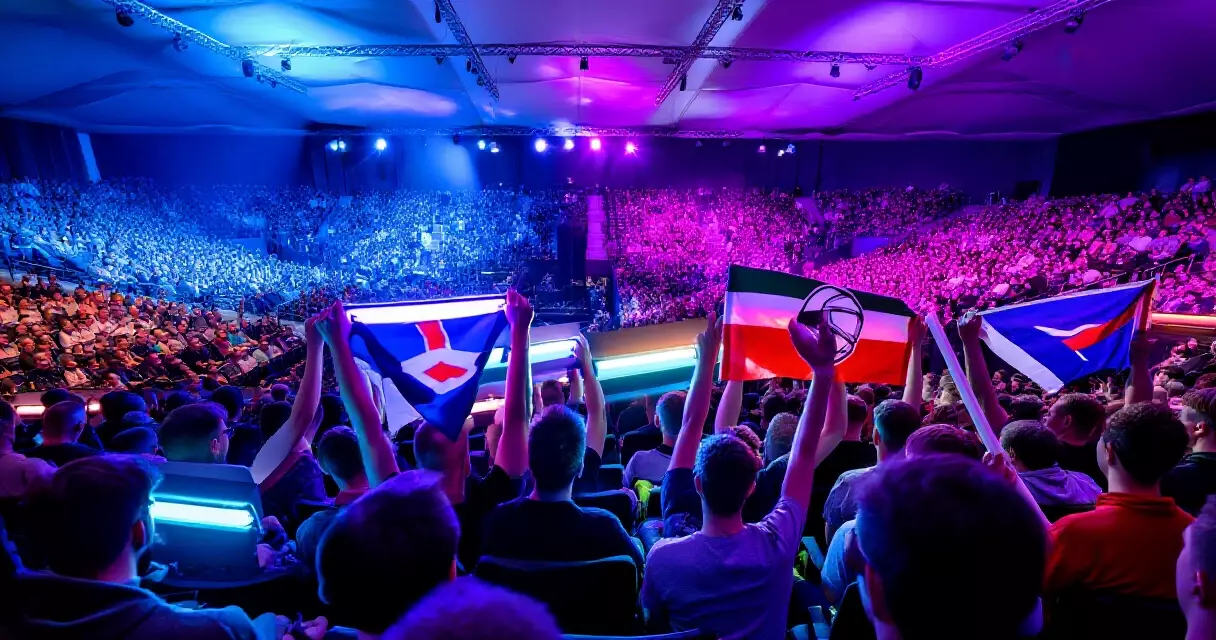
Research published in the Internet Research journal (Emerald) in 2025 examined how national identity shapes esports athletes’ personal branding at international events, finding that athletes extend beyond mere national representation into broader cultural and social dynamics shaped by hyperconnectivity. For fans, this means national pride and cosmopolitan fandom coexist — a Singaporean fan might wear a Singaporean flag at The International while also maintaining a strong attachment to a European or Korean roster, as was visible at The International 2022 held in Singapore.
“National pride and cosmopolitan fandom coexist in esports — a Singaporean fan can wear a national flag while maintaining fierce loyalty to a Korean or European roster, without any sense of contradiction.”
Community Practices and Active Fan Participation
Academic literature increasingly treats esports fans not as passive consumers but as active co-producers of meaning. The DiGRA 2025 Proceedings describe fans as “engaged and skilled audiences who enhance media experiences through interpretive and creative practices.” These practices include producing analysis content, writing community guides, moderating subreddits, creating fan art, and debating strategy in real time during live broadcasts. The platform that hosts this activity — whether Reddit, Discord, Twitter/X, or a game-specific wiki — shapes how identity norms are enforced and contested.
In communities organised around League of Legends, for example, detailed champion-pool analysis and patch commentary function as identity performances: the fan who can explain why a patch note changes pick priority in professional drafts signals insider status. This knowledge-display behaviour is what the CMU ETC Press research identified as the core mechanism of legitimacy-building in esports fandom, and it distinguishes the culture sharply from sports fandoms where emotion and geographic loyalty dominate. Understanding how these community norms operate helps explain why, for coverage teams following the scene — such as those reporting on Esports World Cup schedules and prize pools — the audience expects a level of technical fluency that would be unusual in mainstream sports journalism.
Research Methods Used to Study Esports Fan Identity
Understanding how scholars study fandom culture and identity in esports also matters for evaluating what the evidence can and cannot tell us. The CMU ETC Press 2017 paper used discourse analysis of forum posts across three game communities to identify identity norms — a qualitative method suited to capturing how fans talk about themselves and others, but limited in generalisability. The 2023 SAGE study used quantitative surveys of Chinese and South Korean fans who had attended live events, which gives robust data on behaviour and stated identity, but does not capture fans who only watch online.
The Open University’s work on Japanese esports fans, available through the ORO Open Research Online repository, used cluster analysis on survey data from 500 Japanese esports participants to identify distinct motivational groups. These varied methods mean the field’s findings are complementary rather than directly comparable: qualitative work reveals the mechanics of identity construction while quantitative work measures behavioural outcomes. Taken together, they converge on a consistent picture of esports fandom as knowledge-intensive, participatory, and increasingly legitimate in both cultural and legal terms.
A limitation worth acknowledging: most published research focuses on East Asian and Western European markets. Singapore-specific academic data remains sparse, and the APAC fan report covers three markets at once rather than drilling into Singaporean community norms in depth. As Singapore’s legal recognition of esports matures, more locally focused research would be valuable — and the types of esports player profiles that populate regional scenes are worth examining alongside fan demographics.
Frequently Asked Questions
What makes esports fandom different from traditional sports fandom?
The primary difference is that esports fandom centres on game knowledge and technical expertise rather than geographic or tribal loyalty. According to the CMU ETC Press research on fandom culture and identity in esports, fans distinguish insiders from outsiders mainly by whether they understand the game at a competitive level. In traditional sports, supporting the local team is the dominant identity marker; in esports, knowing the meta is equally or more important.
How does player fandom work in esports compared to team fandom?
The 2023 SAGE study by Zhang, Hall, and Kim found that professional player fandom functions as a key identity anchor, driving event attendance and merchandise purchasing even more strongly than generic team support. When fans closely follow a specific player, they tend to track that player across roster changes — meaning player loyalty can outlast team loyalty in many cases.
Is esports fandom global or regional in Singapore?
Both, simultaneously. The APAC Esports Fan Report shows that 74% of Singaporean game followers track global leagues and events, while 60% also support regional teams. This dual loyalty pattern is common in esports because major titles are structured as global competitions, making it natural to follow international teams while also maintaining regional pride.
What did Singapore’s 2026 sports recognition law change for esports fans?
The January 2026 parliamentary bill formally classifying esports as a sport allows SportSG to include esports in national sports development programs, which can mean public funding, school-level pathways, and official event support. For fans, it signals that the government treats esports fandom as socially legitimate, removing a layer of cultural stigma that previously attached to competitive gaming as a hobby.
Why do esports fans place such high value on expertise?
Esports fans are also typically players. Unlike traditional sports spectators who may never have played professionally, most esports fans have direct experience with the games they watch. This means they can evaluate professional performance with a level of informed judgement unusual in fandom. That expertise becomes a social currency, used to establish credibility and belonging within fan communities, as documented in the CMU ETC Press research.
Which esports titles have the most distinct fan identity cultures?
The CMU ETC Press study found that League of Legends communities enforce knowledge norms most aggressively, while FIFA communities align more closely with traditional football fandom norms. Overwatch sits in between. More broadly, games with longer professional histories and more complex strategic layers — such as Dota 2, CS2, and League of Legends — tend to produce fan cultures where expertise is most intensely valorised.
Key Takeaways
- Fandom culture and identity in esports is structured around game knowledge and expertise as primary social currency, not geographic loyalty.
- The CMU ETC Press (2017) and SAGE Smart Tourism journal (2023) provide the field’s most-cited empirical foundations for understanding these dynamics.
- Global esports viewership reached a projected 640.8 million in 2025, according to Statista data cited in the DiGRA 2025 Proceedings.
- Singapore fans show unusually high engagement intensity relative to raw audience size, with dual global-and-regional loyalties dominant.
- Singapore’s January 2026 parliamentary recognition of esports as a sport formalises a cultural shift that fan communities had been driving for years.
- Fan identity varies meaningfully by game title, with League of Legends communities displaying the strongest knowledge-gatekeeping norms.
- Research limitations include a concentration of studies on East Asian and Western markets, leaving Singapore-specific fan culture underexplored in academic literature.
Sources
- Fandom Culture and Identity in Esports — CMU ETC Press — Retrieved September 1, 2026
- Proceedings of DiGRA 2025 — Retrieved September 1, 2026
- eSports Fan Identity Consumer and Live Game Watching Behavior — Smart Tourism (SAGE) — Retrieved September 1, 2026
- An Exploration of Esports Fan Identity and Engagement — ScienceDirect — Retrieved September 1, 2026
- Mainstreaming Stardom: National Identity and Digital Fan Culture — Internet Research (Emerald) — Retrieved September 1, 2026
- The Emergent Community of Esports Fans in Japan — Open University Research Online — Retrieved September 1, 2026
- Esports, Chess and Bridge Formally Recognised as Sports — Channel NewsAsia — Retrieved September 1, 2026
- APAC Esports Fan Report: Singapore, Indonesia, Thailand — Retrieved September 1, 2026