
Summary
✓Reviewed by Emma Thompson What are the latest esports hardware requirements for tournament play? As of September 2026, the answer depends on whether you are competing at a community LAN, a regional qualifier, or a fully professionalised event — but...
Table of contents
- 1 Why Standardised Hardware Has Become the Tournament Norm
- 2 How Tournament Hardware Requirements Developed Over Time
- 3 PC Hardware: The 2026 Competitive Baseline
- 4 Monitors and Peripherals: The Specifications That Decide Frames
- 4.1 Mouse and Keyboard Policies at Tier-One Events
- 4.2 Headsets and Audio: What Tournaments Require
- 5 Network Infrastructure: The Hidden Hardware Layer
- 6 Singapore’s Esports Tournament Landscape and Hardware Governance
- 7 Broadcast and Streaming Hardware: A Separate Tier
- 8 Title-Specific Hardware Requirements: CS2, VALORANT, and Dota 2
- 9 Frequently Asked Questions
- 9.1 What is the minimum RAM required for esports tournament play in 2026?
- 9.2 Do all esports tournaments require wired internet connections?
- 9.3 What monitor refresh rate is required for professional esports tournaments?
- 9.4 Are players allowed to bring their own peripherals to tournaments?
- 9.5 What GPU do professional esports players use in 2026?
- 9.6 How does the Singapore Esports Association (SGEA) govern hardware requirements?
- 10 Key Takeaways
- 11 Sources
What are the latest esports hardware requirements for tournament play? As of September 2026, the answer depends on whether you are competing at a community LAN, a regional qualifier, or a fully professionalised event — but the floor has risen sharply across all tiers. Standardised PC stations, wired 1 Gbps Ethernet, and high-refresh-rate monitors are no longer luxuries reserved for the top of the bracket; they are baseline expectations that organisers and players alike must plan around.
Why Standardised Hardware Has Become the Tournament Norm
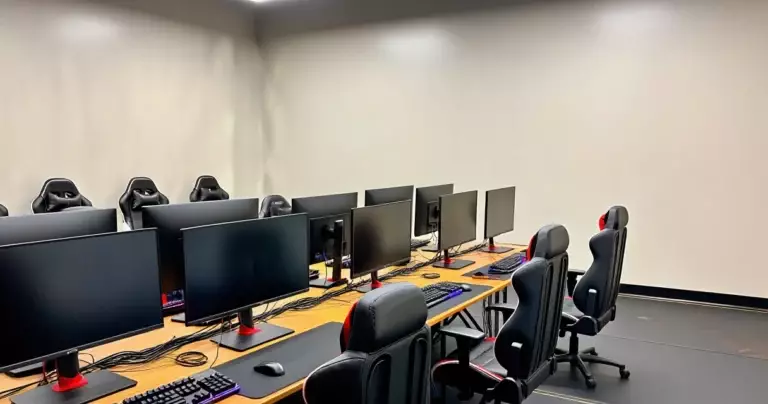
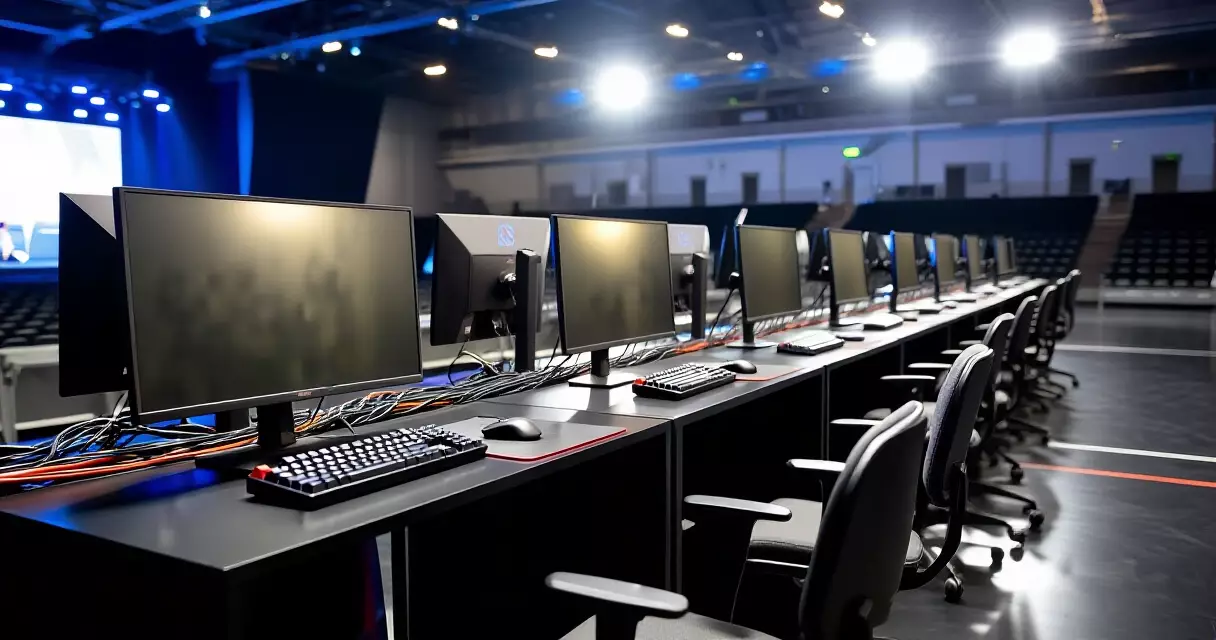
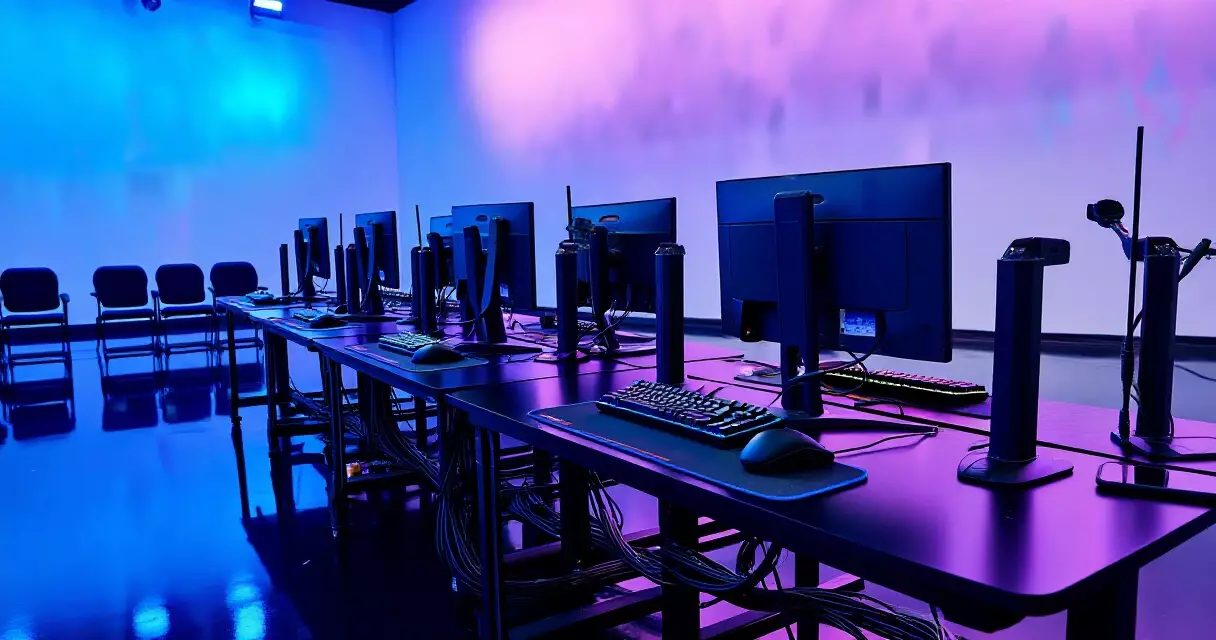
For most of esports’ early history, players brought their own peripherals and competed on whatever PCs the venue could source. That era is over at the professional tier. In February 2026, PGL announced that all 2026 season matches would run on a standardised configuration called the PGL Esports Station, built and supplied entirely by ASUS Republic of Gamers. Every seat at every PGL event uses the same monitor, the same PC internals, and the same peripheral stack — removing any hardware advantage or disadvantage from the competitive equation.
This shift reflects a broader consensus among tier-one organisers: match integrity depends on reproducible, identical conditions. When one player’s system renders frames 12 ms faster than the seat next to them, the result is a competitive variable that has nothing to do with skill. Standardisation closes that gap.
How Tournament Hardware Requirements Developed Over Time
The hardware requirements governing tournament play today grew out of two decades of incremental standardisation. Early 2000s LAN events relied on whatever machines were available in the venue, with players often bringing desktop towers in carry bags. The emergence of dedicated esports organisations in the early 2010s began to drive minimum PC specifications into rulebooks. By the mid-2010s, major titles including CS:GO and League of Legends had tournament operators publishing explicit CPU, GPU, and RAM floors. The 2020s accelerated this trend: the transition from 60 Hz to 144 Hz and then to 240 Hz and 360 Hz panels became an arms race that organisers eventually resolved by specifying the exact model, rather than a class of display. The PGL CS2 Major 2026 and comparable events now treat hardware specifications as part of the official ruleset rather than a logistical footnote.
PC Hardware: The 2026 Competitive Baseline
Tournament organisers and players preparing competitive setups in 2026 are working from a tiered specification landscape. Based on available guidance from HP’s Singapore-facing competitive gaming buyer’s guide (updated July 2026) and broader industry practice, the following breakdowns represent the spectrum from community-level events to professional play.
| Component | Community / Amateur Tier | Professional / Tier 1 |
|---|---|---|
| CPU | Intel Core i5-14400F or AMD Ryzen 5 7600 | Intel Core i9 (HX-series) or AMD Ryzen 7 7800X3D |
| GPU | NVIDIA RTX 4060 or AMD RX 7600 | NVIDIA RTX 4070 Super or RTX 5070 |
| RAM | 16 GB DDR5 | 32–64 GB DDR5 |
| Storage | 500 GB NVMe Gen 4 SSD | 1–2 TB NVMe Gen 4/5 SSD |
| Display | 144 Hz, 1080p | 240–360 Hz, 1080p (e.g. ASUS ROG Strix XG248QSG Ace) |
| Network | Wired Ethernet, 100 Mbps+ | Wired Ethernet, 1 Gbps, dedicated VLAN |
| OS | Windows 10 64-bit | Windows 11 64-bit |
According to guidance published by HP Singapore in July 2026, minimum competitive play requires at least 16 GB of RAM alongside a dedicated GPU and SSD storage — a configuration that would have been considered high-end only a few years ago. At the professional tier, 32 GB is increasingly the standard floor, with some broadcast and production rigs running 64–128 GB.
Monitors and Peripherals: The Specifications That Decide Frames
Display specifications directly affect competitive performance in ways that CPU and GPU benchmarks alone cannot capture. The ASUS ROG Strix XG248QSG Ace, deployed at all 2026 PGL events, runs at 360 Hz at native 1080p — a refresh rate that reduces display-side input lag to under 3 ms per frame. For shooters such as CS2 and VALORANT, where reaction windows are measured in tens of milliseconds, the difference between a 144 Hz and 360 Hz panel is measurable in competitive outcomes.
Peripheral standardisation varies more widely than PC or display standardisation. Most tier-one events specify that players may use their own mice, keyboards, and headsets, subject to a whitelist check. Organisers typically prohibit peripherals with hardware macros, software-defined aim assistance, or non-standard polling rates above a set threshold. Players competing internationally should review the event’s peripheral policy before arriving, as requirements differ between ESL FACEIT Group events, PGL events, and title-specific circuits.
Mouse and Keyboard Policies at Tier-One Events
Leading competitive mice in the 2026 pro scene — including the Logitech G Pro X Superlight 2, Razer DeathAdder V3 Pro, and Zowie EC series — are generally whitelist-approved across events because they carry no hardware-level automation. The key requirement is that any peripheral must not modify input signals in a way that the game client cannot observe. High-polling-rate mice running at 8000 Hz are increasingly common on the pro scene and are accepted at most major events, though some organisers cap polling rates in their rulebooks.
Headsets and Audio: What Tournaments Require
Audio equipment at professional events is often partially standardised. Tournament organisers commonly supply on-ear monitors or noise-cancelling headsets at the station to prevent crowd noise from creating an information advantage — a practice reinforced by the physical soundproofing booths now standard at arena-scale events. Players may use their own in-ear monitors underneath, subject to inspection. The HyperX Cloud series and Logitech G Pro X headsets appear frequently as event-approved options across multiple 2026 circuits.
Network Infrastructure: The Hidden Hardware Layer
Network infrastructure is where esports tournament hardware requirements diverge most sharply from consumer gaming. According to the SPTel Singapore esports connectivity report published in May 2026, professional tournaments enforce strict ping limits under 50 milliseconds, with the target window for competitive match play sitting between 0 and 20 ms. Achieving those figures at a live event requires enterprise-grade infrastructure that goes well beyond standard commercial broadband.
The minimum specification for a live tournament connection, as outlined in the Ticket Fairy esports event planning guide (May 2026), is a dedicated wired connection delivering at least 1 Gbps symmetrical throughput. Public Wi-Fi and shared broadband are expressly prohibited at events that carry competitive integrity requirements. Organisers are expected to implement dedicated VLANs with quality-of-service rules to prevent any one player or stream from monopolising bandwidth during a match.
Sub-millisecond latency and zero packet loss are not optional at professional esports tournaments — they are the baseline the entire competitive infrastructure is built around.
Singapore’s Esports Tournament Landscape and Hardware Governance
Singapore occupies a strategically important position in the Asia-Pacific esports circuit, hosting regional qualifiers and international events across multiple titles. The Singapore Esports Association (SGEA) is the primary national body governing competitive play in Singapore, publishing policies, safe sport materials, and official rulesets for events held under its sanction. As of September 2026, SGEA’s published materials focus on player eligibility, governance, and anti-doping policy rather than specific hardware minimum requirements — those are set at the title or organiser level.
For players and teams based in Singapore entering regional or international competition, the relevant hardware rules will be those published by the specific event organiser: Riot Games for VCT, Valve for Dota 2 and CS2 Majors, PGL for events running the PGL Esports Station configuration, and so on. Singapore’s own The International 2027 speculation has renewed local interest in what venue-level infrastructure will be required — a question that connects directly to the network and hardware specifications organisers demand. The site covers that story separately in its The International 2027 Singapore reporting.
Broadcast and Streaming Hardware: A Separate Tier
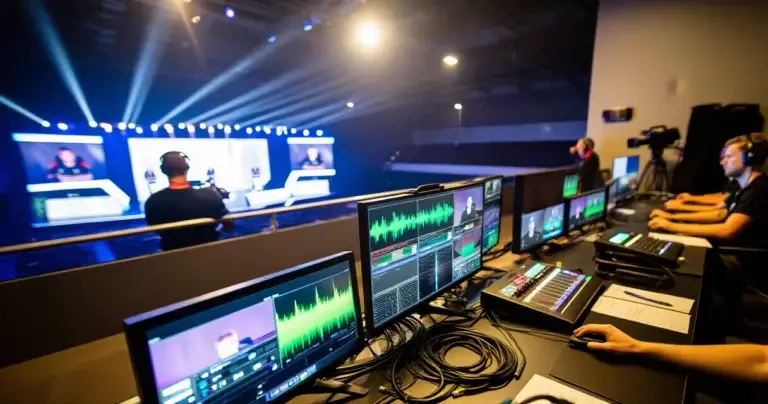
The hardware requirements for the competitive seats at a tournament are distinct from those governing the broadcast and production infrastructure. According to the esports streaming setup guide published by Esports Production Quest (updated 2026), professional-tier event production requires GPU-accelerated encoding machines running at minimum an NVIDIA RTX 4070, with large-scale productions using RTX 6000 Ada-class cards. Network connectivity on the production side runs at 10 Gbps, not 1 Gbps, with redundant power supplies and UPS backup as standard.
| Event Scale | Stream Resolution | Camera Sources | Production RAM |
|---|---|---|---|
| Community | 1080p 30fps | 1–2 | 16 GB |
| Standard | 1080p 60fps | 4–6 | 32 GB |
| Professional | 1080p 60fps / 4K | 8–12+ | 32–64 GB |
| Arena | 4K | 16+ | 64–128 GB |
Camera hardware at professional events commonly includes PTZ units from manufacturers such as Grass Valley alongside fixed studio cameras from Sony or Canon. These production hardware requirements sit outside the player-facing rulebook but are increasingly relevant to organisers running hybrid online-offline events where broadcast quality is part of the competitive product.
Title-Specific Hardware Requirements: CS2, VALORANT, and Dota 2
General hardware floors matter, but competitive players should also check title-specific requirements before entering a tournament. Each major esports title has its own minimum system requirements and, in some cases, organiser-specified client configurations that differ from the consumer defaults.
For CS2, PGL events run on the standardised ASUS-powered PGL Esports Station, which eliminates per-player hardware variance. For VALORANT, Riot Games’ VCT circuit specifies minimum OS and driver versions in its official event rulebook, with an emphasis on anti-cheat compatibility — a point covered in more depth in our reporting on VCT Champions 2026 formats. For Dota 2, events run under PGL or ESL FACEIT Group authority apply their own hardware stack to the venue.
War Thunder Championship Series 2026 illustrates how title-specific requirements can differ significantly from the professional mainstream: the published minimum system spec for that title is a dual-core 2.2 GHz processor with 4 GB RAM, though competitive play at the top bracket runs on hardware far exceeding those minimums. The gap between a title’s minimum spec and the hardware actually deployed at tier-one events is often considerable.
A title’s published minimum PC requirement is a floor for running the game — not a specification for competing at it.
Frequently Asked Questions
What is the minimum RAM required for esports tournament play in 2026?
According to guidance from HP Singapore (July 2026) and industry practice, 16 GB of RAM is the minimum for competitive play at community and amateur tier events. At professional tier-one tournaments, 32 GB DDR5 is increasingly the baseline, with some event stations running 64 GB. Players competing below the professional tier should treat 16 GB as the floor and 32 GB as a practical target for future-proofing.
Do all esports tournaments require wired internet connections?
All events with competitive integrity requirements prohibit Wi-Fi for match play. According to the Ticket Fairy esports event planning guide (May 2026), a dedicated wired connection delivering at least 1 Gbps symmetrical throughput is the minimum for live tournament infrastructure. Wi-Fi creates risks of packet loss, interference, and inconsistent latency that are incompatible with match-level play.
What monitor refresh rate is required for professional esports tournaments?
144 Hz is the practical floor at most community and regional-level events, while 240 Hz and 360 Hz are standard at tier-one professional events. PGL’s 2026 standardised station uses the ASUS ROG Strix XG248QSG Ace at 360 Hz and 1080p resolution. Players aiming for professional-level play should treat 240 Hz as the minimum worth investing in, with 360 Hz becoming the expected ceiling at top events.
Are players allowed to bring their own peripherals to tournaments?
Most tier-one events allow players to bring their own mice, keyboards, and headsets, subject to a whitelist and inspection process. Peripherals with hardware macros, software-assisted aim, or modified input signals are prohibited. The specific whitelist and inspection rules vary by organiser — ESL FACEIT Group, PGL, and title-specific circuits each maintain their own peripheral policies, so players should check the relevant event rulebook before packing their gear.
What GPU do professional esports players use in 2026?
Based on available market and event data, NVIDIA RTX 4070 Super and RTX 5070-class GPUs represent the professional-tier standard for player stations in 2026, with the NVIDIA RTX 4060 marking the practical community-tier ceiling. Broadcast and production rigs at the largest events use higher-end cards such as the NVIDIA RTX 6000 Ada. GPU choice at professional events is typically determined by the organiser’s standardised station configuration rather than individual player preference.
How does the Singapore Esports Association (SGEA) govern hardware requirements?
As of September 2026, the Singapore Esports Association (SGEA) governs player eligibility, competition structure, safe sport policies, and anti-doping frameworks for Singapore-sanctioned events. SGEA does not currently publish a single unified hardware specification list — hardware requirements for events held in Singapore are set at the organiser or title level, following the rules of bodies such as PGL, ESL FACEIT Group, or the relevant game publisher’s competitive division.
Key Takeaways
The latest esports hardware requirements for tournament play in 2026 reflect a consistent industry direction: standardisation at the top end, rising floors throughout, and network infrastructure elevated to the same importance as the PC hardware itself. Players and organisers at every level of competition should treat wired connectivity, 144 Hz-minimum displays, 16 GB+ RAM, and modern discrete GPUs as the current baseline — with the professional tier sitting considerably higher. Staying current with the hardware requirements published by relevant tournament bodies before each event cycle is the most reliable way to avoid eligibility issues or performance disadvantages on match day.
Sources
- Singapore Esports Association — Policies and Handbooks — retrieved September 1, 2026
- Esports Advocate — PGL Taps ASUS for PGL Esports Stations in 2026 — retrieved September 1, 2026
- HP Singapore — Level Up Your Competitive Gaming in Singapore (2026) — retrieved September 1, 2026
- SPTel — Singapore Esports Events: Tournament-Grade Networks (2026) — retrieved September 1, 2026
- Ticket Fairy — Beyond the Screen: Esports Event Planning for Spectacular Tournaments (2026) — retrieved September 1, 2026
- Esports Production Quest — Esports Streaming Setup Guide: Equipment and Configuration (2026) — retrieved September 1, 2026