
Summary
✓Reviewed by Emma ThompsonWhen Singapore's Parliament passed the Singapore Sports Council (Amendment) Bill on 14 January 2026, formally recognising esports as an official sport, it joined a growing list of nations treating competitive gaming as a vehicle for national pride....
Table of contents
- 1 Why National Identity Now Shapes Esports Stardom
- 2 A Brief History of National Identity in Competitive Gaming
- 3 The Intersection of National Identity and Esports at the Asian Games
- 3.1 Why Medal Events Change the Calculus
- 4 Saudi Arabia and the Country-Versus-Country Model
- 5 Singapore’s Legislative Milestone and Esports Identity
- 5.1 The IMDA Ecosystem Pipeline
- 6 Mainstreaming Stardom Through Soft Power and Diplomacy
- 7 Club Identity Versus National Identity in Esports
- 8 Gender, Inclusion, and the Expanding National Roster
- 9 Comparing National Approaches to Esports Identity
- 10 What the Olympic Esports Games Mean for National Stardom
- 11 The Road Ahead: Key Events on the Horizon
- 12 Frequently Asked Questions
- 12.1 What does mainstreaming stardom mean in esports?
- 12.2 How does national identity intersect with esports?
- 12.3 Will esports be in the Olympics?
- 12.4 Why did Singapore recognise esports as a sport?
- 12.5 What is the Esports Nations Cup?
- 12.6 How do esports players become national stars?
- 13 Key Takeaways
- 14 Limitations
- 15 Sources
When Singapore’s Parliament passed the Singapore Sports Council (Amendment) Bill on 14 January 2026, formally recognising esports as an official sport, it joined a growing list of nations treating competitive gaming as a vehicle for national pride. From South Korea’s 44-person delegation heading to the 2026 Asian Games to Saudi Arabia’s inaugural Esports Nations Cup, the intersection of national identity and esports is no longer a fringe academic question. It is driving policy, shaping diplomacy, and turning players into de facto ambassadors for the countries they represent.
Why National Identity Now Shapes Esports Stardom
For most of esports’ history, stardom was defined by team brands and individual streaming personalities. A League of Legends player was a T1 player or a Gen.G player first and a Korean second. That dynamic is shifting. The expansion of country-versus-country competition formats means players are increasingly identified by the flag on their jersey, not just the sponsor logo. According to a 2026 review published in Frontiers in Communication, esports athletes in Korea now function as cultural ambassadors whose performances enhance national reputation in ways analogous to K-pop and K-drama exports.
This shift is not accidental. Governments have recognised that esports reaches demographics that traditional sports infrastructure does not, particularly younger audiences who may never attend a football stadium but will watch a VALORANT final. When a nation’s player lifts a trophy on a global stage, the broadcast audience does not just see a gamer; it sees a country’s flag, anthem, and identity projected into millions of living rooms.
A Brief History of National Identity in Competitive Gaming
The roots of esports as a national endeavour trace back to South Korea in the early 2000s, when the Korean e-Sports Association (KeSPA) formalised pro gaming under government oversight. By 2018, esports appeared as a demonstration sport at the Asian Games in Jakarta, a milestone that Reuters reported was widely seen as a step toward broader institutional recognition. Five years later, China’s Arena of Valor squad won the first-ever Asian Games esports gold medal in Hangzhou in September 2023, an event BBC Sport described as the first gold medal in esports at any multi-sport event. That single result demonstrated how competitive gaming could generate the same surge of national pride as a 100-metre sprint final.
The Intersection of National Identity and Esports at the Asian Games
The Asian Games remain the most visible arena where mainstreaming stardom and national identity converge. Esports was elevated from a demonstration event in 2018 to an official medal sport for the 2022 cycle in Hangzhou, and it returns in that capacity at the 2026 Aichi-Nagoya Games. According to the Korea Times, South Korea will send 36 athletes across nine of 11 esports disciplines in 2026, including its first female national esports athlete, Park So-yeon, who will compete in Identity V.
Why Medal Events Change the Calculus
When an esports match is a medal event, it carries the weight of the national anthem and the medal tally. Players who might otherwise be known only within their game’s community suddenly appear on mainstream sports news. The effect is amplified in countries where traditional medal counts are a matter of public attention, as they are across much of Asia. A gold in League of Legends contributes to the same ledger as a gold in swimming, and the coverage follows.
Saudi Arabia and the Country-Versus-Country Model
Saudi Arabia’s investment in esports has been one of the most consequential developments for national identity in the space. In August 2025, Reuters reported that the foundation behind the Esports World Cup announced the Esports Nations Cup, a biennial country-versus-country competition scheduled to debut in Riyadh. The format explicitly pivots from club-based competition to national representation, banking on patriotic engagement to drive viewership. Reuters linked the initiative directly to Saudi Arabia’s Vision 2030 diversification strategy, illustrating how esports can serve as a soft-power instrument for nation branding.
The same logic underpins the IOC’s decision, confirmed in February 2025, to hold the inaugural Olympic Esports Games in Riyadh in 2027. This is the first time esports will carry the Olympic brand, a threshold moment for mainstreaming stardom at the intersection of national identity and competitive gaming.
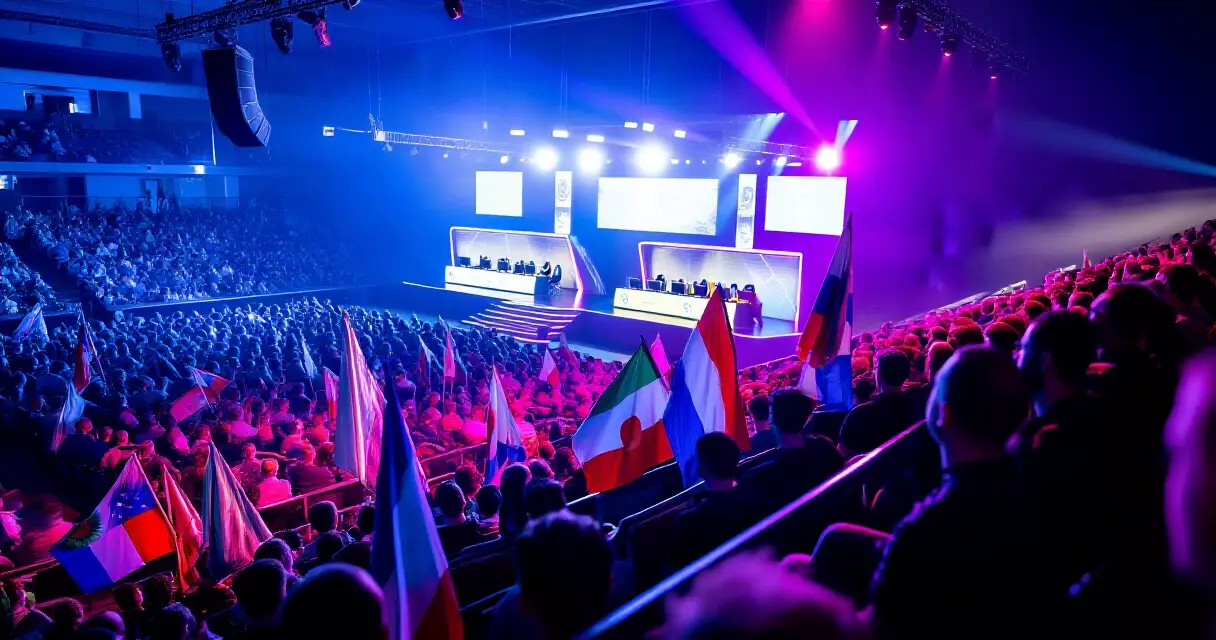
When an esports match is played under a national flag, the player is no longer just a competitor; they become a symbol of where they come from.
Singapore’s Legislative Milestone and Esports Identity
Singapore’s decision to formally recognise esports through the Singapore Sports Council (Amendment) Bill, passed on 14 January 2026, is perhaps the clearest example of a government explicitly linking esports to national sporting identity. As Channel NewsAsia reported, Sport Singapore (SportSG) will now calibrate support for esports based on governance standards and contributions to national sporting objectives. This means esports athletes in Singapore can access government-backed development pathways that were previously reserved for traditional sports.
The IMDA Ecosystem Pipeline
Government support in Singapore extends beyond SportSG. The Infocomm Media Development Authority (IMDA) has supported the games and esports ecosystem through the Singapore Games Association (SGGA) and the Digital for Life initiative. According to a parliamentary response archived on the Ministry of Trade and Industry website, the government views the games sector as a source of job creation, upskilling, and innovation. This positions esports within the broader Smart Nation framework, reinforcing the idea that competitive gaming is part of Singapore’s digital-economy identity, not an outlier.
Mainstreaming Stardom Through Soft Power and Diplomacy
The academic literature increasingly frames esports as a soft-power tool. The 2026 Frontiers in Communication review examined how South Korea deploys esports alongside K-pop and K-drama as part of a coordinated cultural export strategy. The paper described esports athletes as cultural ambassadors whose fanbases extend Korea’s reputation as a technologically advanced, youth-oriented nation. This is mainstreaming stardom in its most literal sense: players who were once niche figures become recognisable faces of national culture on the global stage.
China’s approach is more complex. While Beijing has tightly regulated gaming hours and content, it has simultaneously supported esports venues and events. According to Reuters, Hangzhou authorities invested heavily in esports infrastructure for the 2023 Asian Games, treating the venues as civic assets. The dual approach of regulation and promotion reflects a government that sees esports as a controllable channel for national prestige, distinct from the broader gaming market it aims to manage.
Club Identity Versus National Identity in Esports
One of the defining tensions in mainstreaming stardom at the intersection of national identity and esports is the relationship between club brands and national teams. In traditional sports, the club-versus-country dynamic is well established: a footballer plays for Manchester City during the season and England during international windows. Esports is only beginning to develop equivalent structures.
The Esports Nations Cup and Asian Games are building that dual identity, but most esports competitions remain club-based. The VCT Champions Tour, for instance, organises teams by franchise rather than nationality. This means a player’s national identity surfaces primarily during periodic international events rather than year-round. The question for the industry is whether national-team formats can sustain enough momentum to make country-level stardom a permanent feature rather than a once-every-two-years spectacle.
Gender, Inclusion, and the Expanding National Roster
The mainstreaming of esports stardom also intersects with questions of representation. South Korea’s 2026 Asian Games delegation includes Park So-yeon, the country’s first female national esports athlete, according to the Korea Times. Her inclusion in the Identity V roster signals that national esports identity is beginning to encompass a broader range of participants, though women remain significantly underrepresented across most competitive titles.
Broader inclusivity strengthens the link between esports and national identity because a national team that looks more like the nation it represents carries greater symbolic weight. As more countries formalise their esports programmes, the composition of national rosters will be a visible indicator of how seriously governments and federations take inclusive representation.
Comparing National Approaches to Esports Identity
Different countries have taken markedly different approaches to integrating esports into their national identity. The following comparison, based on reporting from Reuters, BBC, Channel NewsAsia, and the Korea Times, illustrates the range of strategies as of September 2026.
| Country | Key Mechanism | Notable 2025-2026 Development |
|---|---|---|
| South Korea | Government-backed national teams, KeSPA oversight | 44-person delegation to 2026 Asian Games (Korea Times) |
| China | State-supported events with gaming regulation | First Asian Games esports gold in 2023 (BBC Sport) |
| Saudi Arabia | Vision 2030 diversification, event hosting | Esports Nations Cup debut and Olympic Esports Games 2027 (Reuters) |
| Singapore | Legislative recognition, IMDA ecosystem support | Esports recognised as official sport, Jan 2026 (CNA) |
| Japan | Host nation for 2026 Asian Games | Aichi-Nagoya hosting esports as official medal sport |
The club-versus-country tension in esports mirrors traditional sports, but the national-team model is still in its infancy.
What the Olympic Esports Games Mean for National Stardom
The IOC’s confirmation of the 2027 Olympic Esports Games in Riyadh is the single largest institutional endorsement of esports as a domain for national identity. According to Reuters’ February 2025 report, this will be the first event to carry the Olympic brand for esports. If successful, it could create a four-year cycle of Olympic-adjacent esports competition that mirrors the traditional Games, complete with national qualification pathways, opening ceremonies, and medal ceremonies under national flags.
For players, this represents a new tier of stardom. An Olympic gold medallist in esports would carry a fundamentally different public profile than a club-tournament champion. The mainstream media coverage, government recognition, and public attention that come with Olympic association would accelerate the mainstreaming of esports stardom at the intersection of national identity in ways that club-based leagues cannot replicate. As the existing coverage of the Esports World Cup demonstrates, large-scale international events already drive significant audience engagement.
The Road Ahead: Key Events on the Horizon
Several forthcoming events will test how far the intersection of national identity and esports has progressed. The table below summarises the key dates based on confirmed reporting as of September 2026.
| Event | Date | Significance for National Identity | Source |
|---|---|---|---|
| 2026 Asian Games (Aichi-Nagoya) | September 2026 | Esports returns as official medal sport; national teams compete under flags | Korea Times |
| Esports Nations Cup (Riyadh) | Late 2026 | First dedicated country-versus-country esports competition | Reuters |
| Olympic Esports Games (Riyadh) | 2027 | First Olympic-branded esports event; highest institutional recognition | Reuters |
The trajectory is clear. Each event raises the stakes for national identity in esports, and each raises the profile of the players who compete under their country’s banner. Coverage of competitions like the VCT Champions Tour already shows how regional formats create narratives around national and regional pride.
Frequently Asked Questions
What does mainstreaming stardom mean in esports?
Mainstreaming stardom refers to the process by which esports players transition from niche competitive figures into publicly recognised national stars. This happens when players compete under national flags at events like the Asian Games or the Esports Nations Cup, attracting mainstream media coverage and government recognition.
How does national identity intersect with esports?
National identity intersects with esports through national-team competitions, government investment in player development, and the use of esports as a soft-power tool. Countries like South Korea, China, Saudi Arabia, and Singapore have each developed distinct strategies for connecting esports success to national prestige.
Will esports be in the Olympics?
The IOC confirmed in February 2025 that the inaugural Olympic Esports Games will take place in Riyadh, Saudi Arabia, in 2027. This is the first time esports will carry the Olympic brand, though it operates as a separate event from the traditional Summer and Winter Games.
Why did Singapore recognise esports as a sport?
Singapore passed the Singapore Sports Council (Amendment) Bill on 14 January 2026 to bring esports under the formal sports framework. This allows SportSG to direct government resources toward esports development, athlete pathways, and governance standards, integrating competitive gaming into the country’s national sporting objectives.
What is the Esports Nations Cup?
The Esports Nations Cup is a biennial country-versus-country competition announced in August 2025 by the Saudi-backed Esports World Cup Foundation. According to Reuters, it is scheduled to debut in Riyadh and is designed to shift esports viewership from club loyalty to national allegiance. Coverage of related events appears in our reporting on the Esports World Cup schedule.
How do esports players become national stars?
Esports players become national stars primarily through representation at international events that carry national-team formats. Medal events at the Asian Games, the upcoming Olympic Esports Games, and the Esports Nations Cup all create contexts where individual performance is framed as national achievement, attracting broader media coverage and public recognition.
Key Takeaways
The mainstreaming of esports stardom at the intersection of national identity is no longer theoretical. It is being built through legislation in Singapore, through national-team infrastructure in South Korea, through event hosting in Saudi Arabia, and through diplomatic signalling by the IOC. The 2026 Asian Games, the Esports Nations Cup, and the 2027 Olympic Esports Games represent three consecutive milestones that will determine whether national identity becomes a permanent pillar of esports, or remains a periodic overlay on an industry still dominated by club brands. For players, the stakes are clear: the next generation of esports stars may be defined not just by their skill, but by the country they represent.
Limitations
This article focuses on the national-identity dimension of esports stardom and does not cover the commercial economics of esports sponsorship, hardware requirements for competitive play, or the broader casual gaming market. Southeast Asian viewership and market-size figures for 2026 are not included because no authoritative source with verified data was available at the time of writing. Event details for the 2027 Olympic Esports Games remain subject to IOC confirmation.
Sources
- Reuters: Saudi-backed esports foundation to debut Nations Cup in Riyadh — retrieved September 12, 2026
- Reuters: Inaugural Olympic Esports Games to be held in 2027 in Saudi Arabia — retrieved September 12, 2026
- Reuters: Olympic a distant dream despite Asiad boost, esports chief — retrieved September 12, 2026
- Reuters: Esports talent in S. Korea gets boost from big business — retrieved September 12, 2026
- BBC Sport: Asian Games — First esports medal won in Hangzhou — retrieved September 12, 2026
- Korea Times: Korea’s esports national team shares ambitions ahead of Asian Games — retrieved September 12, 2026
- Frontiers in Communication: Esports as soft power diplomacy (2026 review) — retrieved September 12, 2026
- Channel NewsAsia: Esports, chess and bridge formally recognised as sports — retrieved September 12, 2026
- Ministry of Trade and Industry, Singapore: Oral reply to PQ on e-sports and video games — retrieved September 12, 2026
- Wikipedia: Esports at the Asian Games — retrieved September 12, 2026