
Summary
✓Reviewed by Emma ThompsonLive esports tournament production in 2026 demands broadcast-grade gear that can handle high-resolution video feeds, low-latency switching, multi-source audio mixing, and IP-based signal transport. This ranked list of the best esports broadcast gear for live tournament production...
Table of contents
- 1 Why Esports Broadcast Gear Standards Are Changing in 2026
- 2 How This Ranked List of Esports Broadcast Gear Is Organised
- 3 Production Switchers and Video Mixers for Esports Broadcast
- 3.1 Top-Ranked Production Switchers
- 4 Cameras and PTZ Systems for Live Esports Coverage
- 5 Replay and Slow-Motion Servers for Tournament Highlights
- 6 Audio Mixing and Commentary Systems for Esports Broadcasts
- 6.1 Recommended Audio Consoles and Interfaces
- 7 Game Capture Cards and Encoding Hardware for Tournament Feeds
- 8 Best Esports Broadcast Gear for Signal Transport and IP Routing
- 9 Broadcast Monitoring and Multiviewer Displays for Tournament Control Rooms
- 10 Ranked Comparison of Best Esports Broadcast Gear by Category
- 11 Singapore’s Growing Role in Esports Tournament Production
- 12 Frequently Asked Questions
- 12.1 What is the most important piece of broadcast gear for an esports tournament?
- 12.2 Should esports tournaments use SDI or IP-based broadcast equipment?
- 12.3 How many cameras does a professional esports broadcast need?
- 12.4 What audio setup do esports casters need for tournament broadcasts?
- 12.5 What does SMPTE ST 2110 mean for esports production?
- 12.6 How does remote production (REMI) work for esports events?
- 13 Limitations and What This Guide Does Not Cover
- 14 Key Takeaways
- 15 Sources
Live esports tournament production in 2026 demands broadcast-grade gear that can handle high-resolution video feeds, low-latency switching, multi-source audio mixing, and IP-based signal transport. This ranked list of the best esports broadcast gear for live tournament production covers the equipment categories that matter most, from video switchers and cameras to replay servers and intercom systems, drawing on current professional standards and real-world deployments at major events.
Why Esports Broadcast Gear Standards Are Changing in 2026
Esports broadcast production has converged with traditional sports broadcasting in its technical requirements. The transition from SDI-based signal routing to IP-based infrastructure, governed by the SMPTE ST 2110 suite of standards, is now the dominant direction for professional live production. As Steve Reynolds, CEO of Imagine Communications, told IBC, “the industry has kind of coalesced around SMPTE 2110,” with most new projects built on that standard.
In Singapore specifically, the landscape shifted when Parliament passed the Singapore Sports Council (Amendment) Bill on 14 January 2026, formally recognising esports as a sport. According to the Ministry of Culture, Community and Youth, Sport Singapore can now directly support esports infrastructure, training, and structured competitions, increasing demand for professional broadcast equipment in the region.
How This Ranked List of Esports Broadcast Gear Is Organised
This ranking covers the essential gear categories for live tournament production, ordered by their impact on broadcast quality and reliability. Each category identifies the leading equipment options based on current industry deployments and the technical standards that professional esports broadcasts require in 2026. Rankings within each category reflect a combination of feature set, reliability track record, and adoption by established tournament operators.
The assessment draws on publicly documented deployments, manufacturer specifications, and the technical frameworks published by standards bodies including EBU R 153 for live UHD/HDR contribution parameters.
Production Switchers and Video Mixers for Esports Broadcast
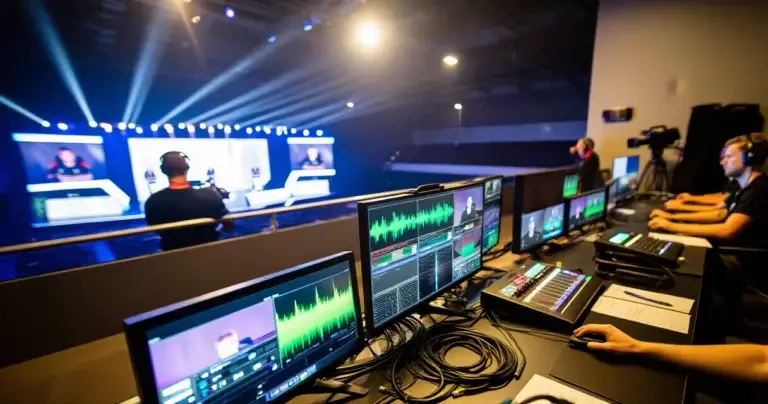
The production switcher is the nerve centre of any live esports broadcast. For tournament production, the switcher must handle multiple camera feeds, game capture inputs, graphics overlays, and replay inserts simultaneously.
Top-Ranked Production Switchers
The Blackmagic Design ATEM Constellation 8K remains the most widely deployed mid-to-high-end switcher in esports production, offering 40 inputs in a 4 M/E configuration with native 12G-SDI and SMPTE ST 2110 IP connectivity. For larger tournaments, the Ross Video Carbonite Ultra and the Sony XVS-G1 offer expanded input counts and tighter integration with IP routing infrastructure. At the entry level for regional LAN events, the ATEM Mini Extreme ISO provides multi-camera switching with built-in recording of individual ISO feeds, which is valuable for post-event highlight production.
Cameras and PTZ Systems for Live Esports Coverage
Esports tournament broadcasts typically use a mix of manned broadcast cameras for player close-ups and stage shots, plus PTZ (pan-tilt-zoom) cameras for overhead venue coverage and crowd reactions. The camera choice directly affects the visual quality that viewers associate with the production.
The Sony BRC-X1000 PTZ camera leads the category for esports venues, delivering 4K output with a 1-inch Exmor R sensor and 12x optical zoom, with both 12G-SDI and IP streaming outputs. For manned positions, the Sony HDC-5500 multi-format live camera and the Panasonic AK-UC4000 are established choices in tournament production. Notably, ARRI announced SMPTE ST 2110 support for the ALEXA 35 Live at IBC 2026, signalling that even cinema-grade cameras are moving toward IP-native live production workflows.
Replay and Slow-Motion Servers for Tournament Highlights
Instant replay is essential for any serious esports broadcast. The replay server allows operators to capture, mark, and play back key moments during a live match, which is fundamental to storytelling in tournament coverage.
The EVS LSM-VIA remains the industry standard for multi-channel replay in large-scale esports events, supporting up to 24 simultaneous recording channels. For mid-tier productions, the Blackmagic Design HyperDeck Extreme 8K and the vMix replay module offer more accessible price points. The key specification for esports replay is minimum input-to-output latency, since tournament observers expect near-instant playback of critical moments such as clutch rounds or team fight outcomes.
In esports production, the replay operator is as important as the observer. The gear must keep up with the pace of competitive gameplay, where decisive moments can happen within fractions of a second.
Audio Mixing and Commentary Systems for Esports Broadcasts
Audio quality separates professional esports broadcasts from amateur streams. A tournament broadcast typically manages at least four distinct audio sources: in-game sound, caster commentary, analyst desk audio, and crowd ambience. According to EBU R 153, professional audio contribution should use AES67-compatible transport, which aligns with SMPTE ST 2110-30 for PCM audio over IP.
Recommended Audio Consoles and Interfaces
The Yamaha TF5 digital mixing console is widely used in esports production for its 48 input channels and intuitive touch-screen workflow. For larger events, the Yamaha RIVAGE PM5 and the Allen & Heath dLive provide Dante/AES67 network audio integration. Wireless intercom for production crew is best handled by the Riedel Bolero system, which uses DECT-based communication with seamless integration into Artist intercom matrices.
Game Capture Cards and Encoding Hardware for Tournament Feeds
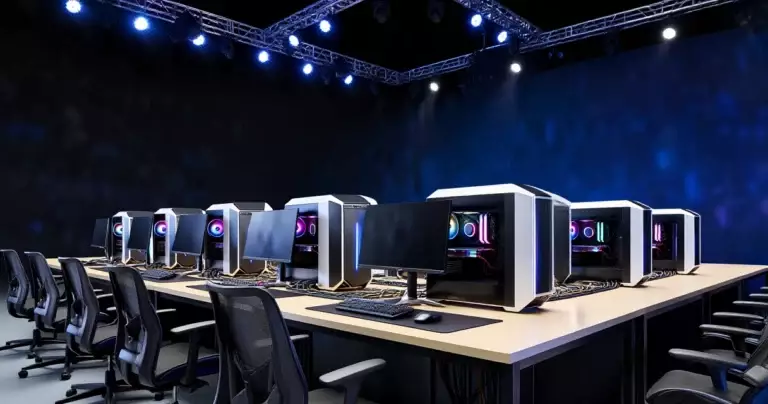
Esports broadcasts require dedicated capture hardware to ingest game feeds from player PCs or consoles. The capture card converts HDMI or DisplayPort output from gaming machines into SDI or IP streams that the production switcher can process. This is a gear category where esports production diverges from traditional sports, since multiple PC feeds must be captured simultaneously across all competing stations.
The Magewell Pro Capture Quad HDMI leads for multi-input scenarios, capturing four HDMI sources on a single PCIe card. For higher-end deployments, the AJA KONA 5 provides 12G-SDI and HDMI 2.0 capture with support for 4K HDR workflows. On the encoding side, the Teradek Prism Flex handles HEVC and H.264 encoding for streaming distribution, while Haivision’s Makito X4 encoder is used for contribution-quality HEVC transport over IP. The related topic of capture card configuration for competitive streaming is covered in detail in our capture card setup guide.
Best Esports Broadcast Gear for Signal Transport and IP Routing
Signal transport is where the ranked list of the best esports broadcast gear for live tournament production intersects most directly with evolving industry standards. The shift from SDI to IP routing is now well advanced.
According to IBC’s coverage, SMPTE ST 2110-22 has expanded the use of compressed video transport, making JPEG XS a practical option for bandwidth-constrained environments. Fox Sports deployed SMPTE ST 2110 with JPEG XS compression for its 2026 REMI (Remote Integration Model) workflow at a major global sporting event, as reported by IBC. This same approach applies to esports tournament production, where remote production hubs can control broadcasts without sending the full production crew on-site.
| SMPTE Standard | Function | Esports Application |
|---|---|---|
| ST 2110-10 | PTP timing and synchronisation | Frame-accurate sync across all production sources |
| ST 2110-20 | Uncompressed active video | Core video transport for switcher and replay inputs |
| ST 2110-30 | PCM audio (AES67 compatible) | Commentary, game audio, crowd sound mixing |
| ST 2110-40 | Ancillary data (captions, timecode) | Closed captions and compliance metadata |
| ST 2022-7 | Seamless protection switching | Redundancy for mission-critical tournament feeds |
Broadcast Monitoring and Multiviewer Displays for Tournament Control Rooms
Production crew need to see every feed simultaneously. Multiviewer displays consolidate camera inputs, game feeds, graphics previews, and program output onto a single or tiled display wall. The Blackmagic Design SmartView 4K provides reference monitoring with 12G-SDI input for individual feed checking, while the Decimator DMON-16SL multiviewer tiles up to 16 sources onto one display. For colour-critical work, the Sony BVM-HX3110 OLED reference monitor remains the gold standard in broadcast environments.
Tournament control rooms in esports also require dedicated monitoring for the observer PC feed, which is the primary gameplay view that reaches the audience. Comparing broadcast monitors to standard gaming displays involves different priorities. The differences between competitive-grade displays and broadcast reference monitors reflect the distinct needs of players versus production crews, a distinction explored in our monitor comparison guide.
Ranked Comparison of Best Esports Broadcast Gear by Category
The following table summarises the top-ranked equipment in each broadcast gear category for live tournament production, based on manufacturer specifications and documented professional deployments as of September 2026.
| Category | Top Pick | Runner-Up | Key Feature |
|---|---|---|---|
| Production Switcher | Blackmagic ATEM Constellation 8K | Ross Carbonite Ultra | 40 inputs, ST 2110 native |
| PTZ Camera | Sony BRC-X1000 | Panasonic AW-UE160 | 4K, 1-inch sensor, 12x zoom |
| Replay Server | EVS LSM-VIA | Blackmagic HyperDeck Extreme 8K | 24-channel recording |
| Audio Console | Yamaha TF5 | Allen & Heath dLive | 48 channels, touch workflow |
| Capture Card | Magewell Pro Capture Quad HDMI | AJA KONA 5 | 4x HDMI on single PCIe |
| Encoder | Haivision Makito X4 | Teradek Prism Flex | Contribution-quality HEVC |
| Intercom | Riedel Bolero | Clear-Com FreeSpeak Edge | DECT wireless, Artist integration |
| Reference Monitor | Sony BVM-HX3110 | Blackmagic SmartView 4K | OLED, colour-critical grading |
These rankings reflect manufacturer-stated specifications and adoption patterns across documented esports and sports broadcast deployments. Actual suitability depends on venue size, budget, and production complexity.
Singapore’s Growing Role in Esports Tournament Production
Singapore’s formal recognition of esports in January 2026 has direct implications for broadcast gear investment in the region. According to the Singapore Government, the country is home to over 200 game-developing and publishing companies, and it has already hosted major international events including The International (Dota 2) and the Wild Rift Horizon Cup. The Straits Times reported that Sport Singapore will now tailor support for esports based on governance standards and contribution to national sporting objectives.
This policy shift means more structured funding for event infrastructure, which includes broadcast production facilities. For tournament organisers operating in or targeting Southeast Asia, Singapore is increasingly positioned as a hub with the venue infrastructure and institutional support to host professionally broadcast esports competitions. The broader context of Singapore’s esports economy is covered in our reporting on esports as an economic force in Singapore.
The gap between a grassroots LAN stream and a broadcast-ready tournament production is defined almost entirely by the gear stack. IP-native equipment built on open standards is closing that gap faster than any previous technology cycle.
Frequently Asked Questions
What is the most important piece of broadcast gear for an esports tournament?
The production switcher is the single most critical item, since it controls which source reaches the broadcast output at any moment. Without a reliable switcher that can handle multiple inputs and seamless transitions, no other gear in the chain can compensate. For professional events, a switcher with native SMPTE ST 2110 support future-proofs the investment.
Should esports tournaments use SDI or IP-based broadcast equipment?
According to IBC’s reporting, most new professional production projects are building on SMPTE ST 2110 IP infrastructure. SDI remains reliable for smaller events, but IP offers greater flexibility for scaling input counts, enabling remote production, and integrating with modern routing and monitoring systems. New purchases in 2026 should prioritise IP-native gear.
How many cameras does a professional esports broadcast need?
A standard esports tournament broadcast uses between 4 and 12 cameras depending on the event scale. A typical setup includes two player-facing cameras, one or two stage-wide shots, a crowd camera, and an analyst desk camera, plus dedicated PTZ cameras for overhead and venue coverage. Larger events such as world championships may use 15 or more.
What audio setup do esports casters need for tournament broadcasts?
Casters need broadcast-quality dynamic or condenser microphones (the Shure SM7dB and Electro-Voice RE20 are common choices), feeding into a digital mixing console that handles at least four separate audio buses: caster commentary, in-game audio, analyst desk, and crowd ambience. AES67-compatible consoles simplify integration with IP-based video workflows.
What does SMPTE ST 2110 mean for esports production?
SMPTE ST 2110 is a suite of standards that separates video, audio, and ancillary data into independently routable IP streams. For esports production, this means any source can be routed to any destination on the network without dedicated physical cabling for each signal path. It also enables remote production, where a central hub controls the broadcast while only cameras and encoders sit at the venue.
How does remote production (REMI) work for esports events?
REMI (Remote Integration Model) sends raw camera and game feeds from the venue to a centralised production facility over IP links, often using JPEG XS compression for low-latency transport. The switcher, replay, graphics, and audio mixing all happen off-site. According to IBC reporting, Fox Sports used this exact approach with SMPTE ST 2110 and JPEG XS for a major 2026 sporting event, and the same model is increasingly viable for esports tournaments.
Limitations and What This Guide Does Not Cover
This ranked list focuses on hardware for the live broadcast signal chain. It does not cover streaming software (OBS, vMix software licences), graphics generation tools (Vizrt, Ross XPression), or content delivery network selection for distributing the final stream to platforms. Pricing is not included because broadcast equipment costs vary significantly by region, configuration, and vendor agreements. For a broader look at how production companies like ESL FACEIT Group handle the full event production workflow, see our coverage of ESL FACEIT Group’s broadcast operations.
Key Takeaways
Building a ranked list of the best esports broadcast gear for live tournament production in 2026 comes down to five priorities: an IP-native production switcher at the core, reliable 4K cameras and PTZ systems, a professional replay server, broadcast-grade audio with AES67 compatibility, and redundant signal transport built on SMPTE ST 2110. Singapore’s formal recognition of esports as a sport and the continued expansion of Asian Games esports medals signal growing institutional demand for this level of production quality across the region.
Sources
- Straits Times: Parliament passes Bill to recognise chess, e-sports and others as sports — retrieved September 11, 2026
- Ministry of Culture, Community and Youth: Second Reading of the SSC Amendment Bill — retrieved September 11, 2026
- MCCY: Unleashing Innovation and Seizing Opportunities in the Esports and Games Sector — retrieved September 11, 2026
- IBC: High standards — live production and the move to IP — retrieved September 11, 2026
- IBC: Fox Sports selects Appear for remote production media processing — retrieved September 11, 2026
- EBU R 153: Parameters for Live Contribution of UHD/HDR — retrieved September 11, 2026
- TV Technology: ARRI to highlight ST 2110 support for ALEXA 35 Live at IBC 2026 — retrieved September 11, 2026