
Summary
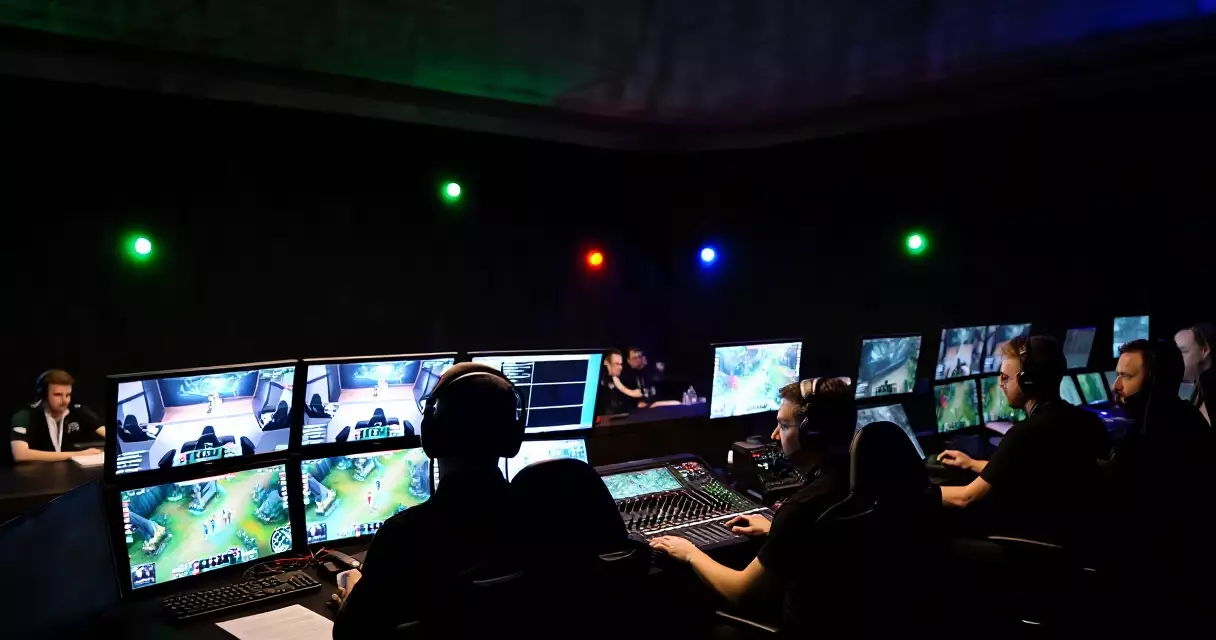
When a Counter-Strike major final draws over 1.8 million concurrent viewers on Twitch alone – as PGL's Antwerp Major did in 2022 – none of that audience sees the fifty-plus production staff coordinating every camera cut, replay, and broadcast graphic...
Table of contents
- 1 From LAN Party Streams to Broadcast-Scale Productions
- 2 The Core Production Infrastructure
- 3 Roles Inside an Esports Production Team
- 4 Graphics, Overlays, and the Data Layer
- 5 Audio Production: Crowd, Commentary, and Game Sound
- 6 Multi-Platform Streaming and Distribution
- 7 Venue Technology and the Physical Production Environment
- 8 Localization, Language Streams, and Regional Broadcast Partners
- 9 Emerging Technology in Esports Broadcast Production (2025–2026)
- 10 Frequently Asked Questions About Esports Broadcast Production
- 10.1 How much does it cost to produce a major esports broadcast?
- 10.2 What software do esports broadcasts use?
- 10.3 What is an Observer in esports broadcasting?
- 10.4 How do esports events broadcast in multiple languages simultaneously?
- 10.5 What is the difference between a production truck and a flypack?
- 10.6 How are esports broadcasts different from traditional sports broadcasts?
- 10.7 What qualifications do esports production professionals need?
- 10.8 How have streaming rights deals changed esports broadcasts?
- 11 Sources
When a Counter-Strike major final draws over 1.8 million concurrent viewers on Twitch alone – as PGL’s Antwerp Major did in 2022 – none of that audience sees the fifty-plus production staff coordinating every camera cut, replay, and broadcast graphic from a room the viewers will never enter. Esports broadcast production has quietly grown into one of the most technically demanding live-event disciplines in media, borrowing heavily from traditional sports television while inventing entirely new conventions to serve a uniquely digital audience.
From LAN Party Streams to Broadcast-Scale Productions
The road from a hobbyist running an Xsplit stream over a home DSL line to today’s multi-camera, multi-language production pipelines was short in calendar years but enormous in technical leap. In the early 2010s, tournaments like DreamHack Winter were broadcast with a handful of cameras, a single commentary desk, and basic motion graphics. Viewer counts in the tens of thousands were considered exceptional.
That changed rapidly once Twitch normalized the idea of watching games as entertainment. Publishers noticed the viewership numbers and started investing in production quality to match – hiring television veterans from ESPN, Sky Sports, and the BBC to consult on set design, graphics packages, and broadcast workflows. Riot Games’ League of Legends Championship Series, launching in 2013 with a dedicated studio in Los Angeles, became an early benchmark: a weekly broadcast modeled on a sports studio show, with analysts, highlight reels, and production values that matched what viewers expected from cable television.
By 2018, Blizzard’s Overwatch League raised the bar again. Every match was produced from the Blizzard Arena in Burbank with a full lighting rig, custom LED volume stages, and a graphics pipeline modeled on NFL broadcasts. That investment – rumored to exceed $8 million per season for production alone – signaled that esports was no longer treating broadcast as an afterthought.
The Core Production Infrastructure
Every esports broadcast, whether produced from a purpose-built arena or a temporary broadcast village erected inside a convention center, depends on a layered stack of infrastructure. Understanding that stack – from physical cabling to cloud encoding – is key to understanding why Tier-1 productions cost what they do and why Tier-2 events so often look noticeably different.
At the foundation is the playing environment itself. Each competitor’s PC or console must output its game signal – typically via an HDMI or DisplayPort capture card – to a central vision-mixing system. At major events, this means dozens of discrete capture feeds arriving simultaneously at a broadcast control room. Tournament organizers like ESL, PGL, and BLAST maintain proprietary broadcast-in-a-box rigs that can be flown to any venue, pre-configured for that game’s capture requirements.
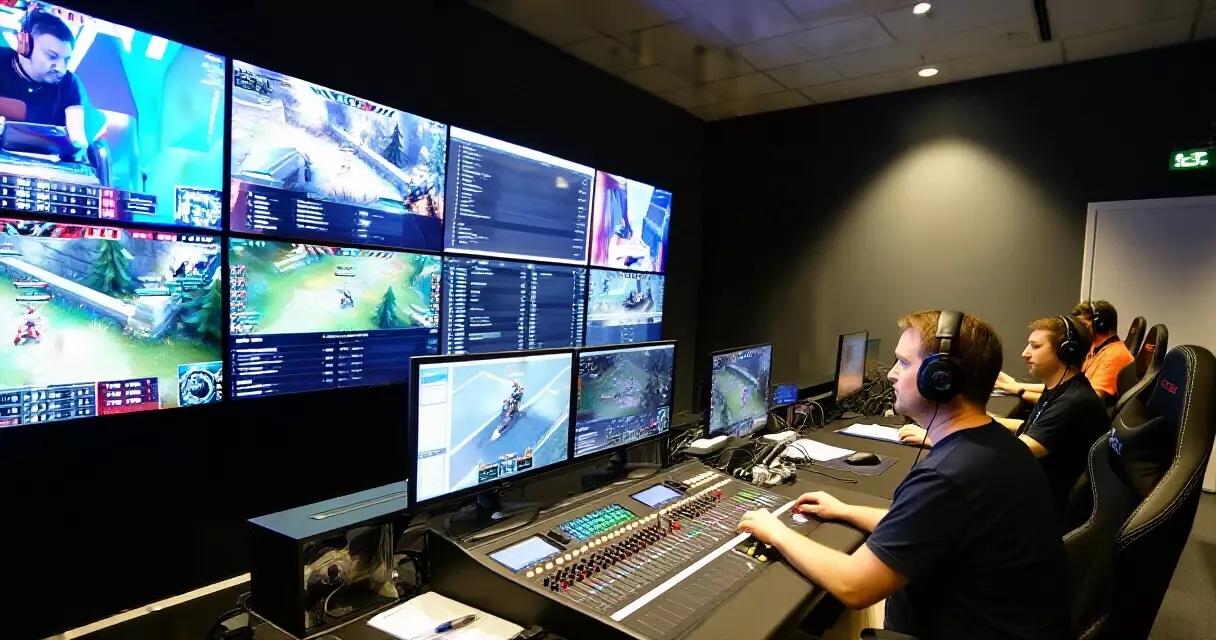
Above the capture layer sits the vision mixing desk – the same class of equipment used in sports broadcasting, with brands like Grass Valley, Sony, and Ross Video prevalent in the industry. A senior vision mixer (called a TD, or Technical Director, in broadcast parlance) cuts between feeds in real time, responding to calls from the broadcast director. In a fast-paced CS2 or Valorant match, a skilled TD may make hundreds of cuts per hour.
Physical cameras typically include a mix of PTZ (pan-tilt-zoom) remotely operated units covering wide arena shots, handheld ENG cameras on the floor for player reaction coverage, and dedicated POV cameras mounted at player stations. High-end productions at venues like the Riot Games Arena in Los Angeles add jib arms, cable-cam rigs, and even drone footage during opening ceremonies.
Roles Inside an Esports Production Team
A full Tier-1 broadcast employs a structure that maps closely to traditional live sports television, with several esports-specific additions that traditional broadcasters don’t need. The following table breaks down the primary roles and their responsibilities:
| Role | Responsibility | Reports To |
|---|---|---|
| Executive Producer (EP) | Overall creative and logistical oversight of the broadcast; budget authority | Tournament organizer / publisher |
| Broadcast Director | Real-time creative decisions: camera calls, pacing, narrative arc | EP |
| Technical Director (TD) | Executes camera cuts and transitions on the vision mixing desk | Broadcast Director |
| Observer / Replay Operator | Controls the in-game spectator camera; selects game-world viewpoints | Broadcast Director |
| Graphics Operator | Triggers lower-thirds, stat cards, and scoreboard updates in real time | TD / Director |
| Replay Operator | Pulls and prepares instant replay clips for broadcast during pauses | Broadcast Director |
| Audio Engineer | Manages commentary, crowd, ambient, and game audio mix | TD |
| Broadcast Talent (Casters/Analysts) | On-air commentary, color analysis, and desk segments | EP / Talent Producer |
| Talent Producer | Coordinates talent schedules, desk rundowns, scripted segments | EP |
| Stream Engineer | Manages encoding, CDN delivery, and platform integrations | Technical Director / Head of Tech |
The Observer role is unique to esports and arguably the most creatively demanding position in the entire production. Unlike a camera operator who physically controls a piece of hardware, an Observer controls a virtual camera inside the game engine itself. In games like Dota 2 and CS2, the Observer client gives access to a free-flying spectator perspective that must anticipate action, frame kills artistically, and move intuitively through 3D space – all while a director calls instructions through an IFB earpiece.
Skilled Observers are rare and exceptionally well-compensated for Tier-1 events. Names like Moonduck’s Slahser and PGL’s observer team are recognized within the industry the same way a great sports camera operator would be. For more on how these events are organized at the structural level, see Esports Tournaments Explained.
Graphics, Overlays, and the Data Layer
One of the sharpest differences between esports broadcasts and traditional sports television is the depth of real-time data integration woven into the on-screen presentation. Esports games generate structured data natively – kill counts, economy states, cooldown timers, map positions – and production teams pipe that data directly into broadcast graphics engines to power dynamic overlays.
The dominant broadcast graphics platforms in esports are Vizrt (Viz Engine), Singular.live, and custom-built solutions developed in-house by large organizers. Riot Games famously built its own internal graphics infrastructure for the LCS and international events, allowing it to pull live game-state data and surface it as animated stat cards, economy trackers, and real-time kill feed graphics without relying on third-party middleware.
For games like League of Legends, Riot provides official data APIs that approved broadcast partners consume directly. Valve uses a similar approach with its Game State Integration system, which exposes live match data to third-party tools. This has enabled a cottage industry of broadcast data tooling, with companies like Bayes Esports Solutions and GRID providing middleware that aggregates, cleans, and distributes live match data to broadcasters, betting operators, and second-screen applications simultaneously.
Motion graphics packages for major events are typically designed months in advance by specialist studios – often the same agencies that design broadcast graphics for NFL, UEFA, and NBA coverage. ESL has worked with agencies including Framestore and Machineworks on its tournament graphics suites. The production pipeline for a full graphics package – from concept to implementation – typically takes three to five months for a major event.
Audio Production: Crowd, Commentary, and Game Sound
Audio engineering for esports presents challenges that have no direct parallel in traditional broadcast. The primary problem is isolation: players cannot hear each other or the crowd during live play (competitive integrity depends on it), yet audiences expect to hear the ambient atmosphere of the arena. Production teams solve this by routing crowd audio through a mixing board that can be attenuated independently, ensuring the live mix rises during crowd reactions – a team fight, a big elimination – without bleeding into player communication channels.
Commentary audio for major events typically arrives from three distinct sources. Primary casters – the play-by-play and color analysts in the main broadcast desk – are miked live in the arena. Co-stream talent may be producing commentary remotely from home studios, often using broadcast-quality microphones like the Shure SM7B or Electro-Voice RE20 connected to audio interfaces from RME or Universal Audio. Third-party language broadcasts at Valve events are typically produced from small local studios in each broadcast region, with game audio delivered to them over an IP feed.
The crowd and the commentators are two separate instruments in the audio mix – a skilled esports audio engineer knows when to let one swell and let the other breathe.
Game audio itself – the sound effects, ability sounds, and ambient soundtrack from the game – is optionally mixed into the broadcast feed, typically at low levels underneath commentary. Some broadcasts omit it entirely; others use it to heighten tension during silent moments before a decisive fight. This is a creative choice made at the director level, and approaches vary dramatically between organizations and even between individual event productions.
Multi-Platform Streaming and Distribution
Getting the finished broadcast signal from the production truck to global audiences involves a distribution architecture most viewers never consider. At the encoding stage, the master broadcast feed is typically encoded at multiple bitrates using hardware encoders (Elemental Technologies, Haivision) or software encoders (FFmpeg-based pipelines) before being pushed to a CDN – content delivery networks including Akamai, Amazon CloudFront, and Fastly handle the bulk of large esports distribution workloads.
Platform fragmentation is one of the defining production challenges of the current era. Major events are expected to stream simultaneously on Twitch, YouTube, and increasingly on regional platforms including Bilibili (China), Trovo (Southeast Asia), and proprietary publisher apps. Each platform has different ingest requirements, resolution caps, and latency profiles. Stream engineers must configure separate encoding jobs for each destination and monitor them concurrently throughout the broadcast.
Exclusive streaming deals have significantly complicated this landscape. Amazon’s multi-year deal with Riot Games for LCS content moved that broadcast off Twitch in the United States – a move that generated significant audience friction during its transition period. PGL’s CS2 events have navigated similar territorial exclusivity arrangements. Production teams must build distribution logic that honors geographic restrictions while maintaining consistent viewer experience across regions.
Latency has become a competitive battleground between platforms. Twitch’s standard stream latency of 15-45 seconds was long accepted as normal, but the rise of synchronized viewing communities – Discord servers watching together, Twitch co-streams – pushed demand for lower-latency options. YouTube’s low-latency HLS and Twitch’s Low Latency Mode (sub-5 seconds) are now standard for live esports broadcasts, though ultra-low latency delivery under one second remains expensive and is used selectively for interactive broadcast experiments.
| Broadcast Tier | Typical Crew Size | Camera Setup | Graphics System | Stream Destinations |
|---|---|---|---|---|
| Tier 1 (Majors / Worlds) | 80–200+ | 8–20+ cameras, jib, cable-cam | Custom + Vizrt / Singular | 4–8 platforms, 10–20 languages |
| Tier 2 (Regional finals, mid-tier LAN) | 20–60 | 4–8 cameras, PTZ-heavy | Singular.live or OBS-based | 2–4 platforms, 2–5 languages |
| Tier 3 (Online leagues, small LAN) | 3–15 | 1–3 cameras or screen-capture only | OBS + StreamElements / StreamLabs | 1–2 platforms, 1 language |
Venue Technology and the Physical Production Environment
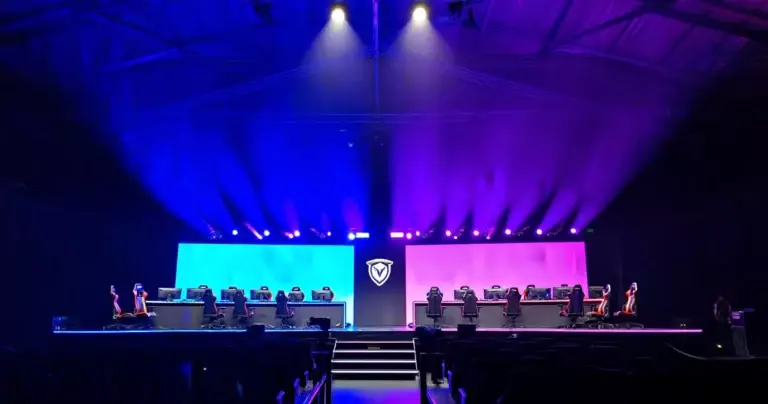
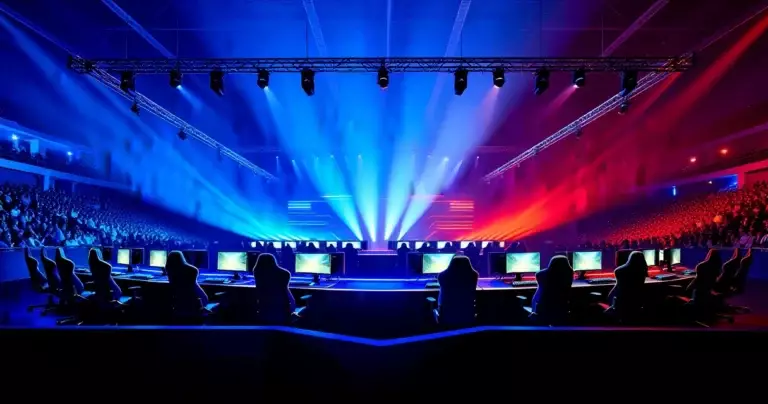
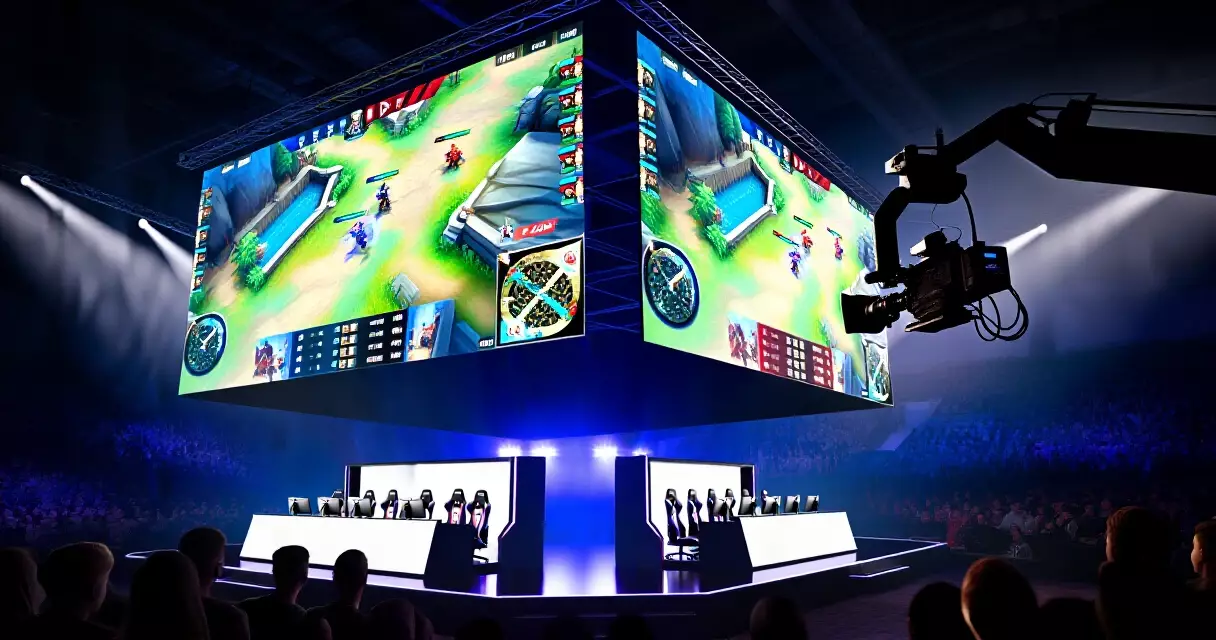
The physical environment where production takes place shapes nearly every creative and technical decision in the broadcast. Dedicated esports facilities like the HyperX Esports Arena in Las Vegas are built with broadcast infrastructure already integrated: fiber runs, broadcast-quality power circuits, pre-wired camera positions, and purpose-designed control room spaces. Producing from a dedicated venue significantly reduces setup time and technical risk compared to a pop-up production inside a convention hall.
For events held in non-dedicated venues – stadiums, arenas, convention centers – the production company must truck in a broadcast village: production trucks or flypacks (portable broadcast racks), temporary fiber infrastructure, portable generator backups, and temporary broadcast control rooms built inside venue spaces. The network and AV requirements for a major event can involve laying multiple kilometers of fiber, deploying 10GbE or 100GbE switching infrastructure, and coordinating with venue IT teams who may have little prior experience with broadcast workloads.
LED volume stages – the same technology popularized by The Mandalorian’s StageCraft system – have entered esports production at the high end, used for opening ceremonies, talent desk backdrops, and player walk-out sequences. ESL and Riot have both deployed curved LED volumes for set pieces at major events, using Unreal Engine-driven real-time environments to create immersive on-camera backgrounds that react to game events in real time.
Every physical constraint of the venue – ceiling height, power capacity, fiber access – becomes a creative constraint that the production team must either solve or design around.
Localization, Language Streams, and Regional Broadcast Partners
Esports audiences are intensely international, and serving them requires a localization infrastructure with no equivalent in domestic sports television. A single Dota 2 International final may be broadcast simultaneously in Russian, Chinese Mandarin, Portuguese, Spanish, German, French, Polish, Romanian, and more than a dozen additional languages – each with its own talent team, its own stream endpoint, and its own graphics localization layer.
Valve pioneered the regional broadcast partner model for Dota 2, licensing broadcast rights to regional production companies – teams like Beyond the Summit (English), RuHub Studio (Russian/CIS), and PerfectWorld (Chinese) – who then produce their own local-language overlays and commentary packages on top of Valve’s official game feed. This model reduces central production costs while enabling genuinely local talent and culture in each broadcast rather than a translated version of the English original.
For events that do not use the regional partner model, localization requires keeping multiple commentary teams in sync with the same match feed. Production coordinators distribute a program feed – typically the world feed, which contains game vision but no commentary audio – to all language booths simultaneously via IP distribution. Each booth then adds its own commentary track and local graphics before streaming to its regional destination. Coordinating broadcast hold points (scheduled pauses for commercial breaks, timeouts, and technical delays) across all language streams simultaneously is a non-trivial logistics problem that requires tight intercom discipline across the entire production.
Understanding the prize structures that attract global talent to these events is covered in detail in our guide to esports tournament prize pools, which contextualizes why the broadcast investment scales with the event’s competitive stakes.
Emerging Technology in Esports Broadcast Production (2025–2026)
The production technology landscape is shifting faster in 2025 and 2026 than at any point since the HD transition. Several converging developments are reshaping what is possible at every budget tier.
AI-assisted replay and highlight generation has moved from experimental to operational at several Tier-1 producers. Systems trained on match data can automatically tag high-probability highlight moments – first bloods, ace rounds, gold swings – and surface pre-cut clip options to replay operators seconds after the in-game event. ESL FACEIT Hub has publicly discussed integrating machine-learning highlight tools into its CS2 production pipeline, reducing the cognitive load on replay operators during dense match segments.
Virtual production – the use of real-time rendered environments on LED volumes – is expanding beyond opening ceremonies into full broadcast set design. Productions at venues like Fusion Arena in Philadelphia have experimented with dynamic LED backdrops that shift to reflect in-game events: a team’s color palette floods the set when they secure an objective, reinforcing the broadcast’s emotional arc with environmental storytelling.
IP-based broadcast infrastructure – specifically SMPTE ST 2110, the standard that replaces traditional SDI cabling with IP networking – is being adopted at the high end of esports production. This transition allows broadcast signals to travel over standard network infrastructure rather than dedicated broadcast cable, reducing fly-pack weight, enabling software-defined signal routing, and facilitating remote production workflows where portions of the crew can work from a central hub rather than being on-site. According to SMPTE’s published case studies, early adopters of ST 2110 in live sports have reduced on-site crew requirements by 15–30% on applicable roles.
Remote Production (REMI) – a workflow where cameras and capture are at the venue but the majority of the production team operates from a central broadcast facility – has become mainstream in traditional sports and is entering esports. PGL operated portions of its CS2 Major production teams remotely during 2024 events, citing both cost efficiency and the ability to use its best operators regardless of geographic location. For a look at the full circuit of major events in 2026, each requiring these production resources, the scale of the industry’s infrastructure commitment becomes clear.
Frequently Asked Questions About Esports Broadcast Production
How much does it cost to produce a major esports broadcast?
Production costs vary enormously by tier. A Tier-3 online broadcast can be produced for under $5,000 per event day using OBS-based workflows and a small remote team. A Tier-2 regional LAN event with a physical stage, 6-8 cameras, and modest graphics typically runs $50,000–$200,000 per event. Tier-1 productions – a CS2 Major, The International, or League of Legends World Championship – involve total production budgets that frequently exceed $2 million per event when crew, equipment, venue integration, graphics, talent, and distribution are all counted. Riot Games has invested reported nine-figure annual sums into its combined global broadcast infrastructure. These costs are typically borne by the tournament organizer, the game publisher, or a combination of both, and are offset by media rights deals, sponsorship packages, and broadcast advertising revenue. The relationship between production investment and viewership ROI is a closely guarded metric, but general industry consensus is that Tier-1 broadcast quality is essential for major sponsorship deals, as brands require a minimum production quality threshold for association.
What software do esports broadcasts use?
The software stack varies by production tier. At the entry level, Open Broadcaster Software (OBS) and Streamlabs OBS are standard tools for small broadcasts, often supplemented by StreamElements for graphics overlays and scene management. Stepping up to mid-tier production, Singular.live has become a popular web-based graphics platform that allows browser-rendered overlays driven by live data feeds without requiring expensive hardware graphics systems. At the top tier, Vizrt’s Viz Engine is the dominant broadcast graphics platform, used by major TV networks and many large esports producers. Vision mixing at the professional level uses hardware switchers from Ross Video, Grass Valley (Trinix), and Sony, though software-defined options from Blackmagic Design (ATEM) are increasingly viable at the mid tier. Encoding is typically handled by FFmpeg-based pipelines, Elemental hardware encoders from AWS, or Haivision Makito encoders, depending on the output requirements and budget.
What is an Observer in esports broadcasting?
An Observer is a production role unique to esports – a specialist who controls the in-game spectator camera during a live broadcast. Using a dedicated spectator client provided by the game, the Observer navigates freely through the game world in real time, framing kills, team fights, and strategic moments for the broadcast audience. It requires an unusual combination of deep game knowledge (knowing where the action will be before it happens), spatial awareness within a 3D environment, and broadcast instinct for visual storytelling. Top Observers are trained over years and are among the most sought-after production personnel at major events. Unlike camera operators in traditional sports, Observers must also work within the technical constraints of the spectator client – some games have limited observer features, and operators must work around those limitations creatively. Games like CS2, Dota 2, and Valorant all have dedicated observer modes with varying feature sets.
How do esports events broadcast in multiple languages simultaneously?
Multi-language broadcasting in esports typically operates through one of two models. The regional partner model, pioneered by Valve for Dota 2, licenses the broadcast rights and game feed to independent regional production companies who produce their own local-language overlays and commentary. This model delivers authentic local content but requires coordination with multiple external teams. The in-house language model, used by Riot Games for Worlds and MSI, has its own language production teams produce commentary from a central facility or from local studios, all sharing the same base program feed. In both models, a world feed – the clean game vision without commentary – is distributed to all language teams over IP. Each team then adds its commentary and regional graphics before encoding and streaming to its local audience. Managing broadcast hold points (pauses, commercial breaks) across all simultaneous streams requires precise intercom coordination and a dedicated multi-language stream manager on the central production team.
What is the difference between a production truck and a flypack?
In broadcast terminology, a production truck is a fully self-contained broadcast control room built into a semi-trailer, typically used for stadium sports broadcasts. A flypack is the esports and touring production world’s preferred alternative: a collection of broadcast equipment – vision mixers, graphics servers, audio consoles, encoding gear – packaged into portable rack-mount cases that can be checked as air freight and unpacked into any space at the destination venue. Flypacks are preferred in esports because events travel internationally and to varied venue types where parking a full broadcast truck may be impractical or impossible. Large organizers like ESL and PGL maintain multiple flypacks configured for their standard event formats, allowing consistent technical setups across geographically diverse events. A full Tier-1 flypack can fill 20-40 road cases and requires a dedicated logistics and advance team to pre-rig and test before the broadcast crew arrives.
How are esports broadcasts different from traditional sports broadcasts?
Several structural differences set esports broadcasts apart from traditional sports television. First, the primary camera is virtual: the Observer’s in-game perspective is the equivalent of the center-field camera in baseball or the high-wide in soccer – except it exists entirely inside a game engine, with no physical hardware to position or maintain. Second, the data density of esports broadcasts is significantly higher: real-time overlays can surface dozens of game-state variables simultaneously, from player health and economy to cooldown timers and map state. Third, the audience is primarily streaming-native: measurement metrics like concurrent viewers and peak viewership on digital platforms are the primary success metrics, not Nielsen TV ratings. Fourth, the presenter formats have developed esports-specific conventions, including the analyst desk format (teams of three to five analysts breaking down replays between matches), the co-stream ecosystem where community personalities commentate over the official feed, and interactive broadcast experiments like Riot’s co-stream events where third-party talent receives official access. You can find details on how the qualifier process works leading up to these productions in our guide to how to qualify for esports tournaments.
What qualifications do esports production professionals need?
The esports production industry draws talent from two primary pipelines: traditional broadcast media education and self-taught community pathways. Formal broadcast production degrees from institutions offering media production programs cover the foundational skills applicable to any live broadcast, including camera operation, vision mixing, audio engineering, and production management. However, many of the most skilled esports-specific roles – Observers, data operators, game-specific graphics engineers – have no traditional educational equivalent and are primarily learned through community involvement: volunteering at local LAN events, producing content for smaller tournament organizers, and building portfolios through grassroots productions. Organizations like the Broadcast Management Group (BMG) have run esports broadcast training programs specifically targeting this skills gap. The variety of tournament formats means production professionals must also understand how different competitive structures affect broadcast pacing, duration, and narrative arc.
How have streaming rights deals changed esports broadcasts?
Exclusive streaming rights deals have fundamentally reshaped esports distribution since 2018. Amazon’s exclusive deal for LCS rights (later restructured) moved that content from Twitch to Amazon Prime Video, generating significant audience drop-off during the transition period. Facebook Gaming signed exclusive deals with several Southeast Asian esports properties in the early 2020s, fragmenting audiences that had previously been concentrated on Twitch and YouTube. The pattern has generally been that exclusive deals generate short-term revenue for organizers but carry audience risk, as esports viewers are less likely than traditional sports fans to follow a broadcast to an unfamiliar platform. By 2025, the industry has largely moved toward multi-platform non-exclusive distribution for top-tier events, with platform exclusivity reserved for specific regional markets or specific content types (VOD replays, documentary content) rather than live match coverage. This shift reflects hard-learned lessons about viewer acquisition cost relative to exclusivity deal value.
Sources
- Newzoo Global Esports & Live Streaming Report 2025 – https://newzoo.com/resources/trending-reports/newzoo-global-esports-live-streaming-market-report-2025-free-version
- SMPTE ST 2110 Standard Overview – https://www.smpte.org/standards/st2110
- Esports Charts – League of Legends World Championship 2023 viewership data – https://escharts.com/tournaments/lol/worlds-2023
- Wikipedia – Esports – https://en.wikipedia.org/wiki/Esports
- Wikipedia – PGL (esports) – https://en.wikipedia.org/wiki/PGL_(esports)
- SMPTE case studies on IP-based production (ST 2110) – https://www.smpte.org/blog/ip-based-production-workflows
- Vizrt broadcast graphics platform documentation – https://www.vizrt.com/products/viz-engine/
Top Esports Organizations 2026: Teams, Rosters, and Performance Rankings