

Summary
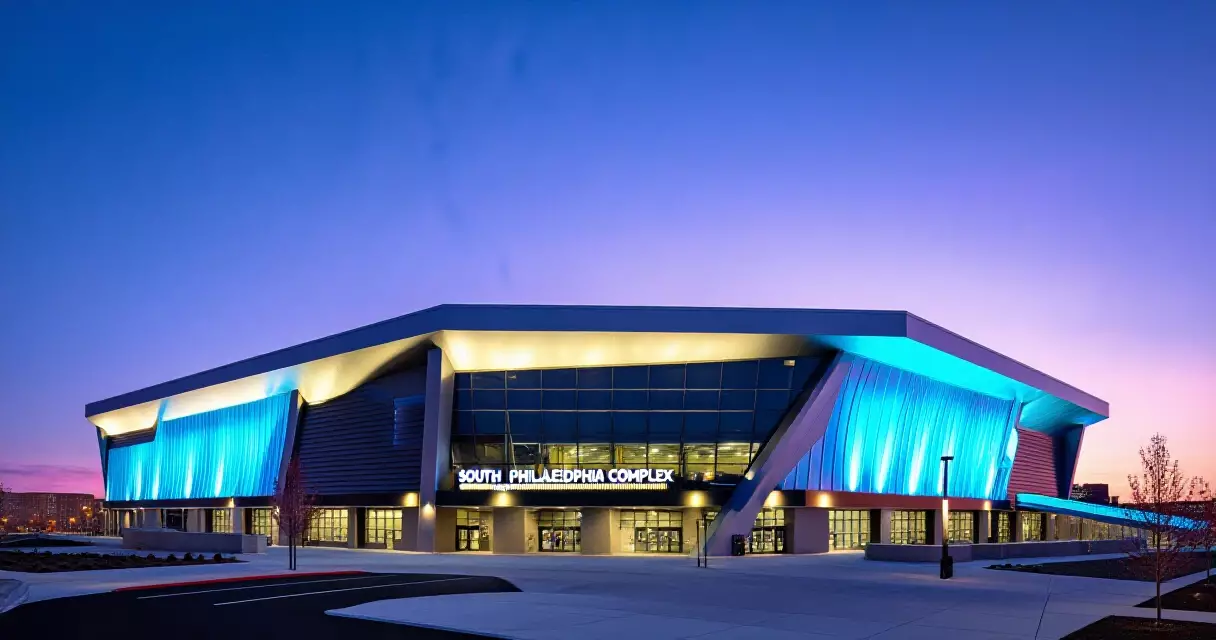
When Comcast Spectacor broke ground on Fusion Arena at the South Philadelphia Sports Complex, the project carried a straightforward ambition: build the first purpose-built, large-scale esports venue in North America. With a planned price tag of roughly $50 million and...
Table of contents
- 1 Background: How Fusion Arena Came to Be
- 2 Location and Accessibility
- 3 Architecture and Interior Design
- 4 Technology Infrastructure
- 5 Events and Programming
- 6 Specs Comparison: Fusion Arena vs. Peer Esports Venues
- 7 Pros and Cons
- 8 Fan Experience: What Attending an Event Is Actually Like
- 9 Pricing and Ticketing
- 10 Challenges and Industry Context
- 11 Future Esports Events and Outlook for 2026
- 12 FAQ: Fusion Arena Philadelphia
- 12.1 Where is Fusion Arena located?
- 12.2 What is the seating capacity of Fusion Arena?
- 12.3 Who designed and built Fusion Arena?
- 12.4 What esports events has Fusion Arena hosted?
- 12.5 How does Fusion Arena compare to other dedicated esports venues?
- 12.6 Is Fusion Arena open to the public?
- 12.7 What makes Fusion Arena’s technology different from a regular sports arena?
- 12.8 What is the future of Fusion Arena given Overwatch League’s uncertainty?
- 13 Sources
When Comcast Spectacor broke ground on Fusion Arena at the South Philadelphia Sports Complex, the project carried a straightforward ambition: build the first purpose-built, large-scale esports venue in North America. With a planned price tag of roughly $50 million and a seating capacity of approximately 3,500, the arena represented a bet that esports audiences would sustain a dedicated bricks-and-mortar home the same way basketball or hockey fans fill their respective buildings night after night. Whether that bet has paid off is a layered question–one that requires looking at the arena’s design, its technology stack, its event history, and how it stacks up against rivals like the HyperX Esports Arena Las Vegas and Blizzard Arena Burbank.
Background: How Fusion Arena Came to Be
The story of Fusion Arena begins with Comcast Spectacor’s decision in 2017 to enter the Overwatch League as a founding franchise. The Philadelphia Fusion team quickly developed a passionate following, and Comcast–already the operator of the Wells Fargo Center–recognized a strategic opportunity: rather than lease space inside an existing multi-purpose arena, build an entirely new venue tuned specifically for competitive gaming. The concept was announced publicly in 2018, with Populous confirmed as the lead architect.
Populous is no stranger to high-profile sports infrastructure. The firm has designed facilities ranging from Yankee Stadium in New York to Tottenham Hotspur Stadium in London, and its involvement in Fusion Arena signaled that this was a serious capital project rather than a converted warehouse. The design brief called for broadcast-grade production capabilities, flexible floor configurations, and an immersive LED environment that would translate well to both in-person attendance and online streaming.
Construction timelines were disrupted significantly by the COVID-19 pandemic, which froze large-scale construction projects and simultaneously collapsed the live event market that the arena depended on for its business case. Those delays pushed back the venue’s operational debut and forced Comcast Spectacor to rethink the phasing of its launch strategy.
Location and Accessibility
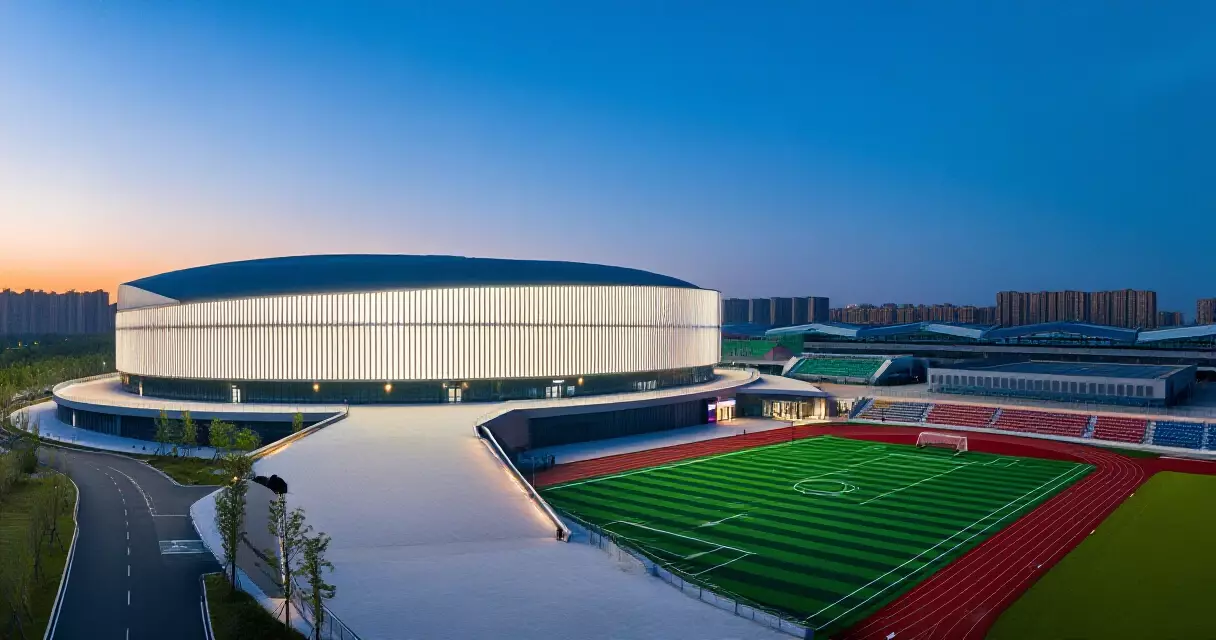
Fusion Arena sits at 3601 South Broad Street within the South Philadelphia Sports Complex–arguably the densest concentration of professional sports facilities in the United States. The Wells Fargo Center (home of the Philadelphia 76ers and Flyers), Citizens Bank Park (Phillies), and Lincoln Financial Field (Eagles) all occupy the same campus. That proximity gives Fusion Arena an immediate advantage: fans already know how to get there, public transit options are established, and the surrounding infrastructure of parking, food, and hospitality has been in place for decades.
SEPTA’s Broad Street Line drops riders at AT&T Station, a short walk from the arena entrance. For drivers, the campus maintains over 20,000 parking spaces across shared lots. The concentration of venues does create traffic competition on major event nights, but Fusion Arena’s targeted events–which typically run on weekends when the neighboring buildings are dark–reduce the conflict considerably.
Architecture and Interior Design
Populous built Fusion Arena around a central performance floor that can be configured for tournament stage setups, player booths, broadcast positions, and spectator viewing in the round or in a proscenium-style arrangement. The bowl seats approximately 3,500 in a tiered layout designed to keep sightlines to both the physical stage and the overhead LED video systems clear from virtually every seat.
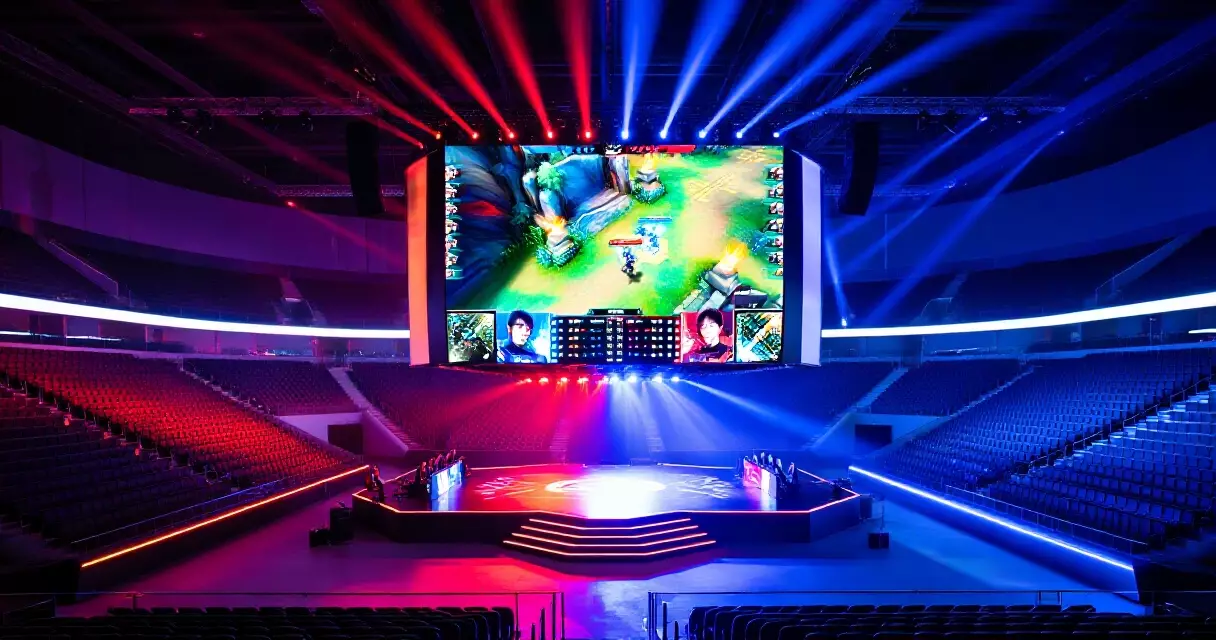
The LED infrastructure is the design’s centerpiece. A large central video board hangs above the floor, supplemented by ribbon displays running the perimeter of the seating bowl and additional LED panels framing the stage area. The total LED surface area is engineered to ensure that spectators anywhere in the arena–including those in the upper tier–have a high-quality visual feed of the action, compensating for the fact that competitive gaming on a distant monitor is inherently harder to follow than a ball in motion on a traditional sports field.
Lighting design was developed with broadcast needs as the primary constraint. The lighting grid supports full broadcast-quality illumination without the kind of color temperature or flicker issues that plagued older venues repurposed for esports. Sound design follows a similar logic: the acoustic treatment targets clean spoken commentary intelligibility–critical for an audience that often follows a caster’s play-by-play as the primary narrative layer–rather than the reverberation profiles that suit concerts.
Fusion Arena was engineered from the floor up to serve two audiences simultaneously: the 3,500 fans in the seats and the millions watching online–and the design does not compromise one for the other.
Technology Infrastructure
The technology specification at Fusion Arena reflects the expectations of a professional broadcast operation rather than a consumer-facing gaming center. Network infrastructure runs on a dedicated fiber backbone with redundant uplinks, supporting the ultra-low-latency LAN environments required for official tournament play across titles like Overwatch 2, Valorant, and Call of Duty. Player stations are isolated on separate network segments from broadcast and spectator Wi-Fi to eliminate cross-contamination of traffic that could influence match conditions.
Broadcast production is housed in a dedicated control room with replay, graphics, and switching capabilities comparable to those found in conventional television production facilities. This matters because the Overwatch League–Fusion Arena’s anchor tenant–distributed its content through the league’s own broadcast agreements, requiring venues to meet specific production standards. The arena’s production suite can output across multiple simultaneous streams, supporting the multi-language, multi-platform distribution model that major esports properties now use. For a deeper look at what these specifications typically involve, our esports venue technology requirements guide breaks down the full network, AV, and stage setup criteria.
Spectator connectivity is handled by a dense Wi-Fi deployment that accounts for the concentration of devices in a full arena. Modern esports audiences skew young and mobile-first; second-screen engagement–checking stats, clipping moments, posting reactions–is standard behavior during events, and venues that cannot support it lose engagement. Fusion Arena’s Wi-Fi architecture was specified to sustain simultaneous high-bandwidth connections across the entire seating bowl.
Events and Programming
The Philadelphia Fusion’s Overwatch League home matches served as the founding anchor programming for Fusion Arena. Overwatch League’s homestand model–introduced for the 2020 season before COVID disrupted its execution–was built on the premise that franchises would host regular home events at dedicated venues, creating a local fan base similar to traditional sports. Fusion Arena was central to that vision for Philadelphia.
Beyond Overwatch League, the venue’s flexible floor plan and broadcast infrastructure position it to host a range of esports titles and formats. The Activision Blizzard tournament ecosystem, Call of Duty League events, and third-party organizer productions are all within scope. The arena’s capacity–3,500 seated–places it in the tier of venues large enough for marquee regional events but intimate enough to maintain the sold-out atmosphere that makes for compelling broadcast content. Compare this to the Riot Games Arena in Los Angeles, which operates at a similar intimacy-focused scale, or the larger general-purpose arenas that host championship-tier events discussed in our guide to major esports arenas.
The arena is also positioned for non-esports programming–live music, corporate events, product launches–which supports the diversified revenue model that most dedicated esports venues require to remain financially viable. This mirrors the approach taken by other top-tier dedicated venues; our analysis of how esports venues make money shows that single-title dependency is the most common cause of venue underperformance.
Specs Comparison: Fusion Arena vs. Peer Esports Venues
To put Fusion Arena’s specifications in context, the table below compares it against four of the most significant dedicated or semi-dedicated esports venues in North America. Data reflects venue specifications as publicly reported.
| Venue | City | Capacity | Est. Cost | Architect / Developer | Primary Anchor |
|---|---|---|---|---|---|
| Fusion Arena | Philadelphia, PA | ~3,500 | ~$50M | Populous / Comcast Spectacor | Philadelphia Fusion (OWL) |
| HyperX Esports Arena | Las Vegas, NV | ~1,000 | N/A (lease) | Allied Esports / Luxor Hotel | Multi-title open events |
| Blizzard Arena Burbank | Burbank, CA | ~450 | N/A (conversion) | Blizzard Entertainment | OWL / HCT / HGC |
| Riot Games Arena | Los Angeles, CA | ~300–400 | N/A (conversion) | Riot Games | LCS / VALORANT Champions Tour |
| ESL FACEIT Hub | Multiple | Varies | N/A (modular) | ESL / FACEIT | CS2 / Dota 2 / multi-title |
Fusion Arena’s 3,500-seat capacity is notably larger than most of its dedicated-esports peers in North America. Only full general-purpose arenas used for championship finals–Scotiabank Arena, Little Caesars Arena, the Kia Forum–exceed it on the esports calendar, and those venues were not built for esports. That makes Fusion Arena arguably the largest purpose-built esports venue in North America by seating, a distinction that carries both opportunity and risk: filling 3,500 seats for a regular-season OWL homestand is a materially harder task than filling 450 at Blizzard Arena.
Pros and Cons
Any honest assessment of Fusion Arena needs to acknowledge both what the project gets right and where the challenges lie. The table below summarizes the key trade-offs.
| Strengths | Weaknesses / Risks |
|---|---|
| Largest purpose-built esports venue in North America (~3,500 seats) | High capacity raises break-even attendance requirements |
| Populous-designed from the ground up for esports and broadcast | Construction and opening delays eroded early momentum |
| Integrated into the established South Philadelphia Sports Complex | Overwatch League instability creates anchor-tenant risk |
| Broadcast-grade production infrastructure (fiber, control room, lighting) | Esports audience development in Philadelphia still maturing |
| Strong SEPTA public transit access (Broad Street Line) | Competition for dates with adjacent Wells Fargo Center |
| Flexible floor supports non-esports programming for revenue diversification | $50M capital outlay requires sustained multi-year utilization to recoup |
The arena’s greatest strength–its ambition to go large in a market where most esports venues stay small–is also its greatest operational challenge.
Fan Experience: What Attending an Event Is Actually Like
The in-arena experience at Fusion Arena is shaped by a few deliberate design choices that set it apart from both converted multipurpose arenas and small gaming lounges. Sightlines from the seating bowl are engineered so that even spectators in upper rows have unobstructed views of both the physical stage and the overhead video board–critical in esports, where reading the game state on a large secondary display often matters as much as watching the players themselves.
The acoustic design targets caster intelligibility. Traditional arenas are optimized for crowd roar and PA announcements; Fusion Arena’s treatment is calibrated for the spoken-word-heavy format of esports broadcasting, where a play-by-play caster and analyst desk drive the narrative continuously. Attendees report that commentary is clear even at full crowd noise, which significantly enhances comprehension of fast-moving team fights in games like Overwatch 2.
Concessions and merchandise are positioned to minimize time away from the action, a lesson the esports venue industry has learned from studying NBA and NHL facilities. Food-service lines that force attendees to miss significant play time are a consistent negative in fan reviews of early converted venues. Fusion Arena’s layout distributes service points to reduce queue lengths during natural breaks in play.
For those who want to compare the fan experience at different tier-one venues before planning a trip, our ranking of the 15 best esports arenas in the world covers the full global landscape, including how Fusion Arena sits within that hierarchy.
Pricing and Ticketing
Ticket pricing for Fusion Arena events has varied by event type and tier. Overwatch League homestand tickets were structured in general admission and reserved tiers, with general admission starting at lower price points to drive attendance volume and premium reserved seating–including floor-adjacent and VIP configurations–commanding higher rates. This tiered structure mirrors what the Overwatch League recommended across all homestand markets to maximize accessibility while capturing higher willingness-to-pay from dedicated fans.
Third-party events and non-esports programming have been priced independently based on the event organizer’s own commercial model, with Fusion Arena operating in a venue rental capacity. Exact current pricing for 2026 events depends on the specific event; fans are encouraged to check the official Comcast Spectacor and venue ticketing channels for up-to-date availability and pricing.
Challenges and Industry Context
Fusion Arena did not open into a stable esports market. The Overwatch League, which the venue was built to anchor, has navigated significant structural changes since its 2018 founding, including the collapse of the homestand model during COVID-19, subsequent renegotiations of media rights, and broader uncertainty about Blizzard Entertainment’s competitive gaming roadmap following its acquisition by Microsoft in 2023. These are industry-level headwinds, not venue-specific failures–but they matter because a dedicated venue’s business model is inseparable from the health of its anchor content.
The broader esports venue sector has faced similar pressures. Academic research on sports venue economic impact, including work published through institutions like the Urban Institute, consistently shows that single-tenant venues carry higher financial risk than those with diversified event calendars. Fusion Arena’s design–with its flexible floor and non-esports programming capability–reflects awareness of this risk, even if the core investment thesis rested on esports demand.
The venue’s size is also relevant in this context. Building the largest purpose-built esports venue in North America at a moment of esports market uncertainty required sustained conviction from Comcast Spectacor’s leadership. Industry bodies like Esports Earnings and the Newzoo Global Esports & Live Streaming Market Report have tracked the long-term growth trajectory of esports viewership, which provides the macro tailwind that investors in dedicated venues are counting on–even when short-term event calendars are volatile.
Future Esports Events and Outlook for 2026
Looking ahead into 2026, Fusion Arena’s programming outlook is shaped by several converging factors. The Overwatch 2 competitive scene continues under Blizzard’s renegotiated structure, and Philadelphia-based events remain part of the regional competitive calendar. More significantly, the venue’s production infrastructure makes it a credible candidate for multi-title third-party events–from Valorant Challengers series to Call of Duty League regionals–as those ecosystems continue expanding their live event footprints.
Comcast Spectacor’s dual position as a venue operator and team owner gives it use to negotiate hosting rights that standalone venue operators lack. The company can package team content, broadcast relationships, and venue hosting into a single commercial proposition that is attractive to tournament organizers. This structural advantage should support a diversified event calendar even if any single title’s competitive health fluctuates.
Corporate and entertainment programming will likely fill calendar gaps. The convergence of gaming culture and mainstream entertainment means that product launches, gaming tournaments for casual audiences, and hybrid live-streaming events are viable programming for a venue with Fusion Arena’s technical specifications. Philadelphia’s large student and young professional population–the core esports demographic–provides a local audience base that regional content can activate.
FAQ: Fusion Arena Philadelphia
Where is Fusion Arena located?
Fusion Arena is located at 3601 South Broad Street in Philadelphia, Pennsylvania, within the South Philadelphia Sports Complex. The campus also houses the Wells Fargo Center, Citizens Bank Park, and Lincoln Financial Field. The venue is accessible via SEPTA’s Broad Street Line at AT&T Station, making it one of the most transit-connected esports venues in the United States. Ample surface and structured parking is available across the shared sports complex lots, and the site is accessible from Interstate 95 and Interstate 76. The proximity to multiple major professional sports venues means the surrounding area has established food, hospitality, and security infrastructure already in place.
What is the seating capacity of Fusion Arena?
Fusion Arena was designed with a seating capacity of approximately 3,500 spectators. This makes it one of the largest purpose-built esports venues in North America, significantly larger than converted competitors like Blizzard Arena Burbank (roughly 450 seats) or the HyperX Esports Arena Las Vegas (roughly 1,000 seats). The tiered bowl design accommodates floor-level general admission areas as well as reserved seating across multiple tiers. The flexible floor configuration also allows the central performance area to be reconfigured for different event formats, trading some seated capacity for expanded floor space when the event design requires it.
Who designed and built Fusion Arena?
Fusion Arena was developed by Comcast Spectacor–the sports and entertainment division of Comcast and the parent company of the Philadelphia Fusion Overwatch League team–with Populous serving as the lead architect. Populous is one of the most prominent sports architecture firms in the world, with a portfolio that includes Yankee Stadium, Tottenham Hotspur Stadium, and numerous other major sports facilities globally. The selection of Populous signaled that Fusion Arena was designed with the same rigorous architectural standards applied to conventional professional sports venues, rather than being treated as a specialized niche build. The $50 million project was one of the most significant dedicated esports venue investments in North American history at the time of its announcement.
What esports events has Fusion Arena hosted?
Fusion Arena was primarily built to host Philadelphia Fusion home matches in the Overwatch League, which adopted a homestand model in 2020 where each franchise was expected to host regular-season events at its own dedicated venue. COVID-19 significantly disrupted that launch calendar, delaying the homestand model’s execution across the league. Beyond Overwatch League, the arena’s production infrastructure makes it suitable for hosting events across multiple esports titles, including Valorant, Call of Duty, and other Activision Blizzard titles. The venue has also hosted non-esports corporate and entertainment programming leveraging its broadcast-grade facilities. For a broader look at how major venues host championship-level esports, see our overview of major esports arenas and venues.
How does Fusion Arena compare to other dedicated esports venues?
Fusion Arena is larger than most of its direct esports-specific peers in North America. The HyperX Esports Arena Las Vegas seats roughly 1,000 and operates within the Luxor Hotel footprint, giving it a very different economic model. Blizzard Arena Burbank seats approximately 450 and was optimized for broadcast-first intimate events. The Riot Games Arena in Los Angeles operates at an even more intimate scale. What distinguishes Fusion Arena is its combination of purpose-built construction, Populous-quality architecture, integrated broadcast facilities, and large-venue seating–a package that no other North American esports venue has replicated at the same scale. The trade-off is a larger fixed-cost base that requires consistent event programming to justify the investment.
Is Fusion Arena open to the public?
Fusion Arena hosts ticketed events that are open to the general public. Access to the venue outside of scheduled events is not available for general visitors, as the facility is a working event venue rather than a gaming center with drop-in public access. Tickets for esports events, concerts, and other programming are sold through Comcast Spectacor’s official channels and third-party ticketing platforms. Fans interested in attending events should monitor the Philadelphia Fusion’s official channels and the venue’s own announcements for upcoming event schedules. Accessibility accommodations are available in line with ADA requirements, consistent with Comcast Spectacor’s other venue operations in the South Philadelphia Sports Complex.
What makes Fusion Arena’s technology different from a regular sports arena?
Fusion Arena was built with a dedicated fiber network backbone and redundant uplinks specifically engineered for competitive esports play–a fundamentally different infrastructure requirement than a conventional sports arena, which optimizes for broadcast camera feeds, PA systems, and scoreboard control rather than sub-millisecond game-state networking. The venue includes a dedicated broadcast production control room capable of multi-stream, multi-language output, dense spectator Wi-Fi supporting simultaneous mobile engagement across the full bowl, and LED systems designed for the static-subject visual demands of esports content (which differ from the motion-tracking requirements of a hockey or basketball broadcast). Our detailed breakdown of esports venue technology requirements covers these distinctions at length.
What is the future of Fusion Arena given Overwatch League’s uncertainty?
Fusion Arena’s long-term viability does not rest solely on the Overwatch League. Comcast Spectacor has explicitly positioned the venue as a flexible event space capable of hosting any esports title, live entertainment, and corporate events. The revenue diversification model–where esports anchors the brand but non-esports programming fills the calendar–is the same approach successfully deployed by venues like the Alienware Arena. The Overwatch League’s structural changes create headline risk, but the underlying venue infrastructure has value independent of any single title. As the global esports market continues to grow–Newzoo’s reports track compound annual growth in both revenues and viewership–a large-capacity, broadcast-ready venue in a major U.S. media market like Philadelphia retains strategic value for promoters across the esports ecosystem.
Sources
- Populous official project portfolio – populous.com
- The Philadelphia Inquirer – coverage of Fusion Arena construction and Comcast Spectacor investment – inquirer.com
- Newzoo Global Esports & Live Streaming Market Report (annual) – newzoo.com
- Urban Institute – research on sports venue economic impact – urban.org
- Wikipedia – Fusion Arena – en.wikipedia.org/wiki/Fusion_Arena
- Comcast Spectacor official communications – comcastspectacor.com
Top Esports Organizations 2026: Teams, Rosters, and Performance Rankings