

Summary
When the Luxor Hotel and Casino in Las Vegas unveiled a 30,000-square-foot esports facility on its ground floor in 2018, it marked something genuinely unprecedented: a purpose-built, permanent esports venue embedded inside one of America's most iconic entertainment destinations. The...
Table of contents
- 1 Background and History: How the Arena Was Built
- 2 Venue Layout and Physical Infrastructure
- 3 Technology and AV Specifications
- 4 Notable Events and Programming History
- 5 Fan Experience and Visitor Amenities
- 6 HyperX Arena vs. Other Major Esports Venues: Comparison Table
- 7 Pros and Cons
- 8 Business Model and Revenue Streams
- 9 Who Should Visit HyperX Arena Las Vegas?
- 10 Frequently Asked Questions
- 10.1 Where exactly is HyperX Esports Arena Las Vegas located?
- 10.2 What is the seating capacity at HyperX Arena Las Vegas?
- 10.3 Can the public visit HyperX Arena Las Vegas without attending an event?
- 10.4 Who owns HyperX Arena Las Vegas and how has ownership changed?
- 10.5 What games and events have been hosted at HyperX Arena Las Vegas?
- 10.6 How does HyperX Arena Las Vegas compare to Blizzard Arena Burbank?
- 10.7 Is HyperX Arena Las Vegas worth visiting for a non-gamer Las Vegas tourist?
- 10.8 What is the significance of HyperX Arena for the esports industry overall?
- 11 Sources
- 11.1 Further reading
When the Luxor Hotel and Casino in Las Vegas unveiled a 30,000-square-foot esports facility on its ground floor in 2018, it marked something genuinely unprecedented: a purpose-built, permanent esports venue embedded inside one of America’s most iconic entertainment destinations. The HyperX Esports Arena Las Vegas – originally launched under the Allied Esports banner and later rebranded through a naming rights deal with HyperX – became a proof-of-concept for the entire industry, showing that live esports could hold its own alongside traditional casino entertainment. Today, after years of events, broadcasts, and public gaming sessions, the venue stands as both a landmark and a case study for anyone tracking the evolution of competitive gaming infrastructure.
Background and History: How the Arena Was Built
The story of HyperX Arena begins with Allied Esports International, a global esports entertainment network that saw an opportunity to anchor a flagship venue in Las Vegas. The company partnered with MGM Resorts International to secure space inside the Luxor, one of the Strip’s most recognizable landmarks thanks to its pyramid silhouette. Construction converted what had been a nightclub space into a three-story esports complex, with the buildout reportedly costing in excess of $50 million according to industry reporting at the time of opening (The Hollywood Reporter, 2018).
The venue opened its doors in March 2018 under the name Allied Esports Arena at Luxor Las Vegas. In 2019, Kingston Technology’s gaming peripheral brand HyperX acquired naming rights, and the facility was rebranded to HyperX Esports Arena Las Vegas – a deal that aligned HyperX’s profile with the world’s highest-profile dedicated esports space. The naming rights arrangement represented one of the earlier significant brand-naming deals in permanent esports infrastructure, a trend that has since expanded across the sector (as covered in our piece on major esports arenas and venues).
Allied Esports was subsequently sold to COVA Acquisition Corp in 2021, complicating the operational picture. Despite corporate transitions, the venue continued hosting events, underlining both the appeal of the Las Vegas location and the resilience of the physical venue model when anchored in a high-footfall casino resort.
Venue Layout and Physical Infrastructure
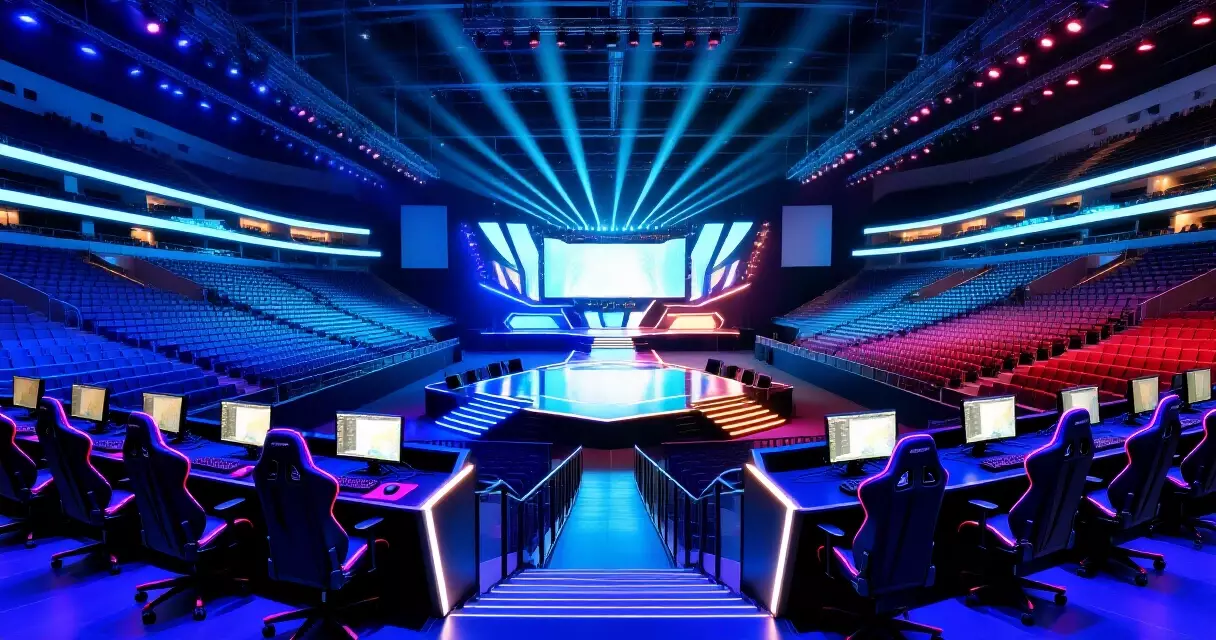
The arena spans three distinct operational zones across its 30,000 square feet, each designed to serve a different audience segment. Understanding the layout is important for anyone evaluating the venue as a model for future builds – a topic we explore at length in our guide on how to build an esports venue.
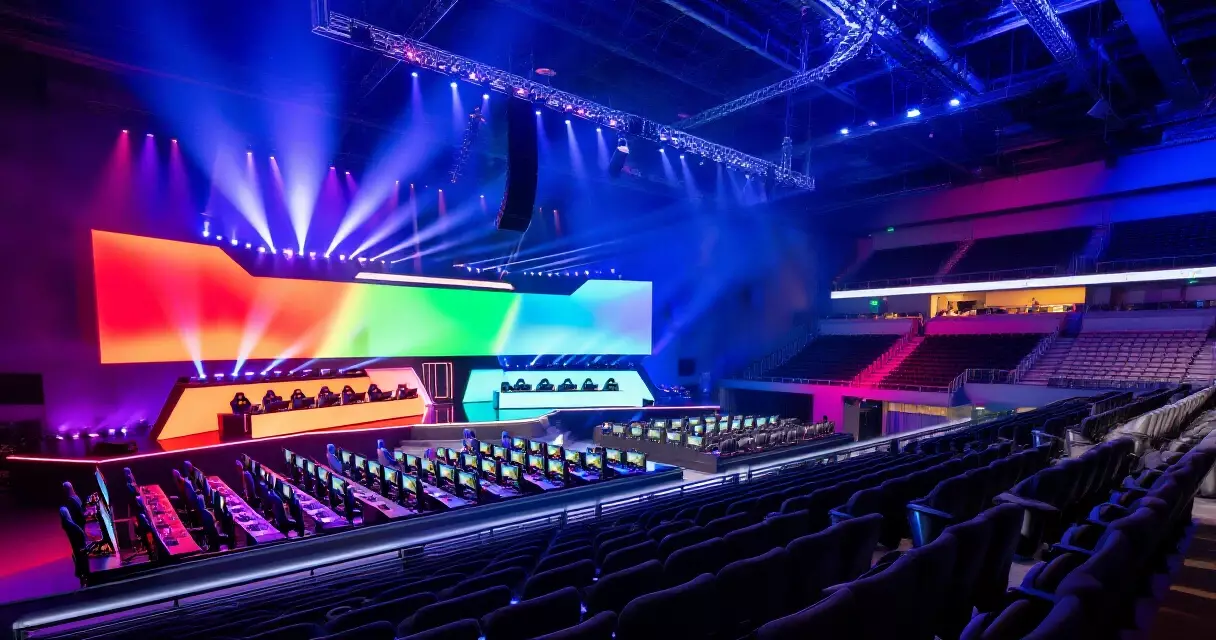
The ground-floor main event stage is the centerpiece. It holds approximately 1,000 spectators in tiered seating facing a broadcast-quality production stage, flanked by large-format LED display panels. The stage itself is elevated and skirted with RGB lighting systems, creating the visual atmosphere that has become a signature of high-production esports events. Commentator booths and broadcast positions are integrated directly into the space, so productions can go live without significant additional rigging.
The upper floors shift from spectator seating to participatory gaming. Open-play gaming pods equipped with high-performance PCs – primarily HyperX-branded peripheral setups running on Intel and NVIDIA hardware – allow walk-in visitors to pay hourly rates for competitive-grade gaming sessions. This open-play model is a meaningful differentiator from pure-spectator venues, because it generates daily revenue regardless of whether a headline event is scheduled.
A dedicated broadcast studio within the facility means productions do not need to ship in temporary broadcast infrastructure for streaming or television coverage. This significantly reduces per-event costs and time-to-live for online audiences – a point the esports venue technology requirements guide on this site covers in detail.
Technology and AV Specifications
Technology infrastructure is where HyperX Arena Las Vegas made its most ambitious statements at launch. The venue was designed from the ground up as a broadcast-first facility, which meant the AV and network specifications had to meet the demands of live streaming, television production, and low-latency competitive play simultaneously.
The main stage LED wall system consists of multiple large-format panels capable of displaying match feeds, player cam cutaways, sponsor graphics, and real-time statistics overlays. The display resolution and brightness levels are engineered for camera capture as much as for in-person visibility – a distinction that separates broadcast-grade esports venues from standard gaming lounges. Allied Esports commissioned a purpose-built audio system with directional speaker arrays calibrated for the tiered seating configuration, so crowd noise and commentary feeds do not bleed into broadcast microphones.
Network infrastructure is fiber-backed with redundant routing, which is non-negotiable for competitive play where packet loss can invalidate match results. The competition PCs on stage run on a dedicated VLAN isolated from the open-play and visitor network segments, preventing congestion from foot-traffic gaming from affecting tournament connections. This kind of network architecture is standard in purpose-built venues but was novel for a casino resort environment in 2018.
| Specification | Detail | Notes |
|---|---|---|
| Main stage display | Large-format LED panels, multi-screen array | Broadcast-calibrated brightness |
| Network backbone | Fiber, redundant routing | Segregated competition VLAN |
| Broadcast studio | On-site permanent studio | Reduces per-event production cost |
| Open-play PCs | ~150 stations, HyperX peripheral kits | Intel/NVIDIA hardware |
| Audio system | Directional speaker arrays | Calibrated for broadcast isolation |
| Console gaming support | Available in open-play sections | Complements PC-primary setup |
Notable Events and Programming History
Since opening, HyperX Arena Las Vegas has hosted a range of competitive titles and formats. Allied Esports ran its own Odyssey tournament series at the venue, spanning games including poker – bridging the casino audience – alongside mainstream titles like Fortnite, Call of Duty, and various fighting game circuits. The venue’s proximity to the Las Vegas Strip means it consistently captures convention-goers and tourists alongside dedicated esports fans, a demographic mix that few other esports venues can claim.
The facility has served as a broadcast hub for events that were not physically hosted at the Luxor, with production teams using the on-site studio for remote coverage. This use case – venue as broadcast infrastructure rather than just event space – has become increasingly common as the esports media rights landscape matured (Newzoo, 2023 Global Esports & Live Streaming Market Report).
WPT (World Poker Tour) events have also taken place at the venue, reflecting the deliberate cross-entertainment strategy that Allied Esports used to keep the space viable outside of pure esports programming. The crossover between poker broadcasting – with its spectator-drama structure – and esports broadcasting shares more production DNA than it might initially appear. For a broader look at how comparable venues handle programming diversity, see our Riot Games Arena Los Angeles review.
The HyperX Arena proved that a permanent esports venue inside a casino resort is not a novelty act – it is a viable long-term entertainment model when the programming strategy extends beyond a single game or genre.
Fan Experience and Visitor Amenities
The visitor experience at HyperX Arena Las Vegas is shaped by its casino-resort context in ways both advantageous and limiting. On the positive side, the Luxor’s existing hospitality infrastructure means food, beverages, accommodation, and entertainment options surround the venue. Visitors attending an event can book a hotel room directly above the arena, grab dinner at one of the resort’s restaurants, and walk directly into a live esports event without navigating a separate venue district. This convenience factor is one of the strongest arguments for the casino-integrated venue model.
Inside the arena, food and beverage service is available at a bar area designed to keep viewers engaged without leaving the spectator section. The bar’s positioning acknowledges that esports fans – particularly in a Las Vegas context – overlap significantly with nightlife and entertainment audiences, not just competitive gaming purists.
For walk-in gaming visitors, the open-play pod pricing has varied over time but has generally followed a per-hour model competitive with upscale gaming cafes. Visitors can drop in without a reservation during off-event periods, giving the space a consistent low-level buzz even on non-event days. This contrasts with pure-spectator venues that sit dark between events – a challenge that our article on how esports venues make money addresses directly.
HyperX Arena vs. Other Major Esports Venues: Comparison Table
Positioning HyperX Arena against comparable dedicated esports facilities reveals where it leads the field and where newer builds have surpassed it. The venues below represent the primary competitive set for top-tier dedicated esports infrastructure, as featured in our ranking of the 15 best esports arenas in the world.
| Venue | Location | Capacity | Opened | Open Play | Casino Integrated |
|---|---|---|---|---|---|
| HyperX Arena Las Vegas | Las Vegas, NV | ~1,000 | 2018 | Yes (~150 pods) | Yes (Luxor) |
| Riot Games Arena (LA) | Los Angeles, CA | ~400 | 2020 | No | No |
| Blizzard Arena (Burbank) | Burbank, CA | ~450 | 2017 | No | No |
| Alienware Arena (Dallas) | Arlington, TX | 100,000+ (stadium) | 2021 | Partial | No |
| ESL FACEIT Hub Venues | Multiple (global) | Varies | 2019+ | Yes | No |
The comparison underscores HyperX Arena’s unique position: it is not the largest venue in the sector, but it is the only major dedicated esports facility permanently embedded in a casino resort on the Las Vegas Strip. For context on the Blizzard Arena’s different approach, see our Blizzard Arena Burbank review.
Pros and Cons
Any honest venue assessment needs to weigh what works against what does not. HyperX Arena Las Vegas has real strengths, but also structural constraints that newer venue concepts have addressed.
| Pros | Cons |
|---|---|
| Pioneer status – first dedicated casino-resort esports venue globally | Spectator capacity (~1,000) modest vs. stadium-scale venues |
| 30,000 sq ft with open-play pods generating non-event revenue daily | Casino floor access creates under-21 logistical complications |
| Permanent broadcast studio reduces per-event production costs | Corporate ownership transitions created operational uncertainty |
| Strong tourist and convention footfall from Strip location | Not a purpose-designed standalone building – constrained by hotel layout |
| Integrated hotel, dining, and entertainment ecosystem | Noise bleed from casino environment can affect immersive event atmosphere |
| Multi-title and cross-entertainment programming flexibility | Open-play pod pricing may feel high for local gaming community |
Business Model and Revenue Streams
The HyperX Arena business model is more layered than a standard event venue. Revenue flows from four primary streams: event ticket sales, open-play gaming fees, food and beverage sales, and sponsorship and naming rights. The HyperX deal itself demonstrated that naming rights for a permanent esports venue can attract significant investment from hardware brands seeking long-term association with competitive gaming culture.
Allied Esports also generated revenue from content production – selling broadcast packages and event production services to game publishers and tournament organizers who wanted to use the permanent studio infrastructure rather than build temporary rigs. This content-as-a-service angle is a revenue stream that analysts at Newzoo identified as a growing component of venue economics as early as 2020 (Newzoo, Global Esports Market Report 2020).
The casino-resort partnership adds an additional financial layer: MGM Resorts benefits from foot traffic routed through the Luxor casino floor, giving the hotel a financial incentive to support the venue’s operational continuity even during periods of lower esports event activity. This co-dependency is structurally different from standalone esports venues, which carry the full operational burden themselves.
The casino-resort partnership is not just a real estate deal – it is a built-in audience acquisition channel that standalone esports venues have to pay marketing dollars to replicate.
Who Should Visit HyperX Arena Las Vegas?
For esports fans visiting Las Vegas for any reason – conference, vacation, or a dedicated esports event – the venue is worth at least a walk-through. The combination of open-play gaming access and the arena’s visual spectacle makes it an experience with no direct equivalent elsewhere on the Strip. The Luxor itself is a short ride from the main convention district, so attendees at events like CES or SEMA can add a gaming session without significant detour.
Event organizers looking at Las Vegas as a host city should treat HyperX Arena as the natural first call for events up to 1,000 in spectator attendance. Its broadcast infrastructure makes it particularly suitable for streamed or televised tournaments where production quality is the priority. For events requiring larger spectator counts, the venue cannot accommodate the scale – organizers would need to look at T-Mobile Arena or Allegiant Stadium for those capacities.
Venue developers and investors studying the model will find HyperX Arena Las Vegas instructive as a template, even if the specific casino-resort context is difficult to replicate. The three-zone layout, the emphasis on broadcast infrastructure, and the multi-title programming strategy have all influenced how venues designed since 2018 approach their own builds. For a broader view of how the sector has evolved, the Esports Venues Guide for 2026 provides current context.
Frequently Asked Questions
Where exactly is HyperX Esports Arena Las Vegas located?
HyperX Esports Arena Las Vegas is located inside the Luxor Hotel and Casino at 3900 South Las Vegas Boulevard, Las Vegas, Nevada 89119. The Luxor sits at the southern end of the Las Vegas Strip near the Mandalay Bay resort. The arena occupies approximately 30,000 square feet on the ground floor of the pyramid-shaped resort. Visitors arriving by vehicle can use Luxor’s valet or self-parking facilities. The Las Vegas Monorail does not stop at Luxor directly, but it is accessible via a short walk from the Excalibur stop or via the MGM Grand station with a connecting walkway. The address is on the main Strip corridor and well-served by rideshare services, making it easy to reach from any major hotel in the city.
What is the seating capacity at HyperX Arena Las Vegas?
The main event stage at HyperX Arena Las Vegas accommodates approximately 1,000 spectators in tiered seating. This places it in the mid-tier range for dedicated esports venues – larger than boutique studio arenas like the Riot Games Arena in Los Angeles (which holds around 400) but significantly smaller than stadium-scale esports facilities or converted traditional arenas. The 1,000-seat configuration is well-suited for regional tournaments, qualifier events, and broadcast-first productions where spectator count is secondary to camera-ready aesthetics. For events requiring larger crowds, Las Vegas offers several large arenas on or near the Strip that have hosted major esports championships, as covered in the major esports arenas guide on this site.
Can the public visit HyperX Arena Las Vegas without attending an event?
Yes. The open-play gaming floor is accessible to the public during operating hours, independent of any scheduled competitive event. Visitors can pay per-hour fees to use one of approximately 150 high-performance gaming stations equipped with HyperX peripherals. The gaming pods include PC stations running current-generation hardware and console gaming options. This walk-in availability is one of the venue’s core design features – it distinguishes HyperX Arena from pure-spectator esports venues that are only operational on event nights. Visitors must pass through the Luxor casino floor to access the arena, and standard Las Vegas casino policies apply, meaning those under 21 should confirm access routes with the hotel before visiting. Pricing for open-play sessions has varied over time and checking the venue’s current schedule directly is advisable before planning a visit.
Who owns HyperX Arena Las Vegas and how has ownership changed?
The venue was originally developed and operated by Allied Esports International, a company that built a global network of esports entertainment venues. Allied Esports partnered with MGM Resorts International to secure space within the Luxor. In 2019, Kingston Technology’s HyperX brand acquired naming rights to the arena, leading to the current HyperX Esports Arena Las Vegas branding. In 2021, Allied Esports was sold to COVA Acquisition Corp, a special-purpose acquisition company, in a transaction that separated Allied Esports from its parent structure. This corporate transition created a period of uncertainty around programming continuity, though the venue remained operational. As of the most recent publicly available information, the space continues to operate under the HyperX naming rights arrangement within the Luxor complex.
What games and events have been hosted at HyperX Arena Las Vegas?
HyperX Arena Las Vegas has hosted events across multiple game titles and entertainment formats since opening in 2018. Competitive esports programming has spanned titles including Fortnite, Call of Duty, Hearthstone, and various fighting game circuits. Allied Esports ran its own Odyssey tournament series at the venue, which covered both traditional esports titles and unconventional crossover events including poker tournaments broadcast in esports production style. The World Poker Tour has also used the venue, reflecting the deliberate entertainment-crossover strategy that keeps the space programmed year-round. The venue’s permanent broadcast studio has been used for content productions beyond events hosted physically on site, further expanding its utility as a media asset rather than purely an event-night facility.
How does HyperX Arena Las Vegas compare to Blizzard Arena Burbank?
Both venues occupy similar positions in the dedicated esports space as purpose-built mid-tier arenas with strong broadcast infrastructure, but their contexts differ substantially. Blizzard Arena Burbank, reviewed separately on this site at Blizzard Arena Burbank Review, was built specifically for Blizzard Entertainment’s own titles – primarily the Overwatch League and Hearthstone events – and sits in a traditional venue district near Hollywood. HyperX Arena operates as a multi-title, open-access facility inside a casino resort, giving it broader programming flexibility and daily walk-in revenue. Blizzard Arena seats around 450 compared to HyperX Arena’s 1,000. Neither venue has the stadium scale of Alienware Arena in Arlington, Texas, but both represent the dedicated boutique-to-mid-tier model that the majority of professional esports organizations have used for regular-season league play.
Is HyperX Arena Las Vegas worth visiting for a non-gamer Las Vegas tourist?
For visitors with no particular interest in competitive gaming, the HyperX Arena is unlikely to be a destination attraction. Its primary appeal is to gaming enthusiasts, esports fans, and attendees at scheduled events. That said, the visual impact of the main stage – the LED lighting, the production-grade displays, and the scale of the setup – is genuinely striking for anyone curious about what purpose-built esports infrastructure looks like in practice. Las Vegas tourists who have seen the emergence of esports in mainstream media and want a concrete reference point will find the venue educational and visually impressive. For families, the under-21 casino-access complication is worth investigating before visiting. Open-play gaming offers accessible entertainment if someone in the group is a casual gamer, even if competitive esports is not a specific interest.
What is the significance of HyperX Arena for the esports industry overall?
HyperX Arena Las Vegas carries outsized historical significance relative to its physical size. Opening in 2018, it was the first permanent dedicated esports venue to operate inside a major casino resort, demonstrating that the market for live esports entertainment could justify significant capital investment in permanent infrastructure outside of traditional sports venues or convention centers. The three-zone model it pioneered – main event stage, open-play gaming floor, and on-site broadcast studio – has become a template referenced by venue developers globally. Its placement on the Las Vegas Strip also established Las Vegas as a viable long-term hub for major esports events, a position the city has consolidated through subsequent major tournament placements. As Newzoo noted in its 2023 Global Esports and Live Streaming Market Report, physical esports venues have increasingly diversified their revenue models beyond event-night tickets, a shift that HyperX Arena’s multi-stream design anticipated at its 2018 launch.
Sources
- The Hollywood Reporter, “Allied Esports Opens World’s First Casino-Based Esports Arena” (2018) – https://www.hollywoodreporter.com/
- Newzoo, Global Esports & Live Streaming Market Report 2023 – https://newzoo.com/insights/trend-reports/newzoos-global-esports-live-streaming-market-report-2023-free-version
- Wikipedia, “Allied Esports” – https://en.wikipedia.org/wiki/Allied_Esports
- Newzoo, Global Esports Market Report 2020 – https://newzoo.com/
Further reading
Top Esports Organizations 2026: Teams, Rosters, and Performance Rankings