
Summary
The global esports audience surpassed 577 million viewers in 2024, according to Newzoo's Global Esports & Live Streaming Market Report, and the infrastructure race to accommodate that audience on the ground is accelerating at a pace the industry has never...
Table of contents
- 1 Why Esports Venues Are Different From Traditional Sports Arenas
- 2 Types of Esports Venues: Matching Scale to Purpose
- 3 Network and IT Infrastructure: The Foundation Everything Else Rests On
- 4 Player Station Design: Hardware, Ergonomics, and Acoustics
- 5 AV Production and Broadcast Infrastructure
- 6 Power, Cooling, and Physical Building Requirements
- 7 Regulatory, Permitting, and Accessibility Requirements
- 8 Financing and Revenue Modeling for Esports Venues
- 9 Staffing, Operations, and Technology Management
- 10 Frequently Asked Questions About Building an Esports Venue
- 10.1 How much does it cost to build an esports venue from the ground up?
- 10.2 What are the most critical technology investments for a competition-grade venue?
- 10.3 Do you need special permits or licenses to operate an esports venue?
- 10.4 How long does it take to build and open an esports venue?
- 10.5 What is the minimum internet bandwidth required for an esports venue?
- 10.6 How do esports venues make money without major events?
- 10.7 What games should an esports venue be built to support?
- 10.8 Are there industry organizations that provide guidance for esports venue developers?
- 11 Sources
The global esports audience surpassed 577 million viewers in 2024, according to Newzoo’s Global Esports & Live Streaming Market Report, and the infrastructure race to accommodate that audience on the ground is accelerating at a pace the industry has never seen. Purpose-built esports venues – ranging from 2,000-seat arenas to 50-station community gaming centers – are now opening across the United States at a rate of several dozen per year, each one forcing developers to solve a genuinely novel engineering and business puzzle.
Why Esports Venues Are Different From Traditional Sports Arenas
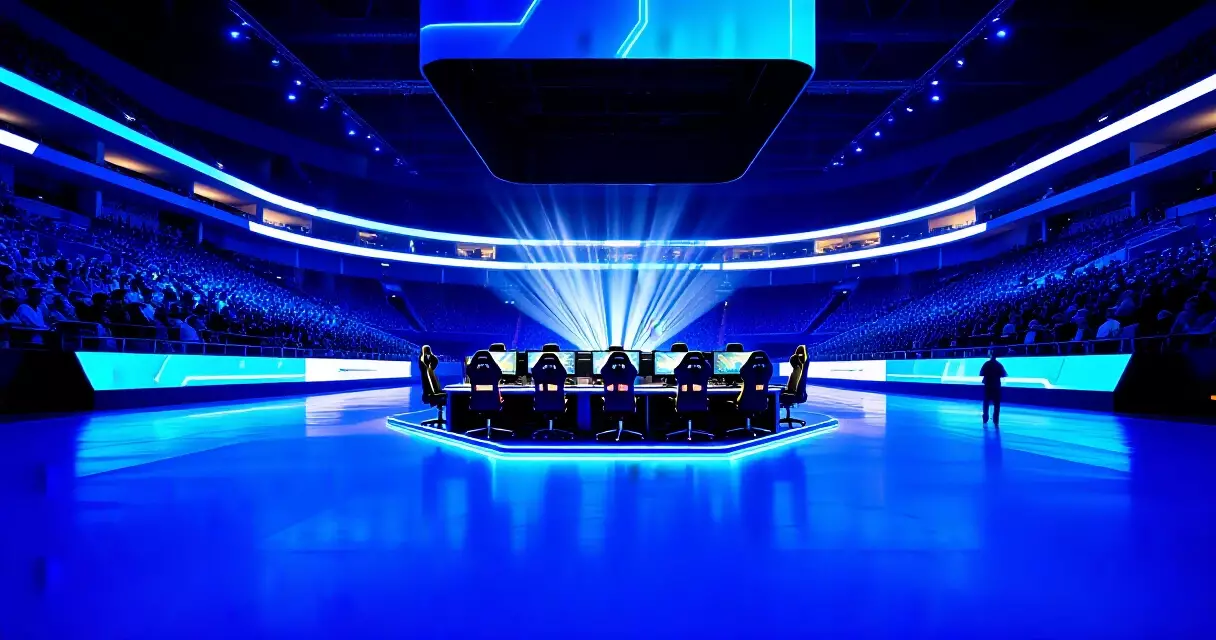
A conventional sports arena is built around sight lines to a single playing surface. An esports venue must simultaneously serve the players in isolated, acoustically dampened booths, the live audience watching on massive LED walls, and a broadcast audience that can number in the millions and has zero tolerance for technical glitches. These three audiences have fundamentally different – and sometimes conflicting – requirements, which is why general-purpose concert halls converted for gaming events almost always feel like a compromise.
Electricity load is the starkest early signal of the difference. A 500-seat theater might draw 200 kW during a sold-out show. A 500-seat esports venue running 50 high-end gaming stations, a broadcast production suite, and a full LED backdrop can require 400–600 kW or more – and that demand must be available on redundant circuits with automatic failover measured in milliseconds, not seconds. A single dropped match frame during a championship moment can trigger player protests and broadcast disruptions that cost organizers tens of thousands of dollars.
Types of Esports Venues: Matching Scale to Purpose
Before any permit is pulled, developers need clarity on which tier of venue they are building. Each tier carries a different cost profile, regulatory footprint, and audience expectation. Getting the tier wrong – particularly by over-building for an unproven local market – is the most common cause of early closure among esports venues that opened between 2018 and 2023.
| Venue Tier | Typical Capacity | Player Stations | Est. Build Cost (USD) | Primary Revenue Model |
|---|---|---|---|---|
| Community Gaming Center | Walk-in, no fixed seats | 20–60 | $250K–$1.5M | Hourly seat rental, memberships, LAN events |
| Regional Esports Lounge | 50–200 spectator seats | 30–80 | $1M–$4M | Hourly play, tourneys, F&B, sponsorships |
| Mid-Tier Esports Arena | 300–1,500 seats | 40–100 stage stations | $4M–$20M | Event ticketing, broadcast rights, naming rights |
| Flagship Esports Arena | 2,000–7,000+ seats | 50–150 stage stations | $20M–$100M+ | League partnerships, tier-1 event hosting, mixed-use F&B |
The National Association of Collegiate Esports (NACE) has documented a surge in campus esports facility investment – more than 200 U.S. colleges operated dedicated esports arenas or practice facilities as of 2024, many in the $500K–$2M range. These collegiate builds provide a useful cost benchmark for community-scale operators because universities tend to publish detailed project disclosures.
Network and IT Infrastructure: The Foundation Everything Else Rests On
No single factor affects competitive play quality more than network architecture. Professional tournaments run by the ESL, Riot Games, and Activision Blizzard specify maximum latency tolerances – typically 1–5 ms between player stations and the game server – and venues that cannot consistently meet those specs simply will not be selected to host tier-1 events. Building toward that standard from day one is cheaper than retrofitting fiber runs and switching hardware later.
The backbone of any serious esports venue is a dedicated fiber optic ring connecting every player station, the production control room, the broadcast uplink suite, and the venue management systems. Shared ISP connections – even gigabit ones – introduce jitter variance that competitive play cannot tolerate. Operators should plan for a minimum 10 Gbps internal switching fabric with 1–10 Gbps uplink redundancy to at least two separate ISPs. Cisco, Aruba (HPE), and Juniper Networks are the most commonly specified enterprise switching vendors in published esports venue case studies.
Wi-Fi should be treated as a spectator amenity, not a competition network. All player stations must use wired connections, and the wireless network for audience devices should be on a separate VLAN with strict bandwidth throttling to prevent it from interfering with the competition infrastructure. Ubiquiti UniFi and Cisco Meraki are popular choices for the spectator-facing wireless layer at mid-tier venues.
“The network is the playing field. Every other investment in an esports venue is visible to the audience, but the network is what the players actually compete on – and they will notice every millisecond.”
Player Station Design: Hardware, Ergonomics, and Acoustics
Player stations in a competition venue are a different category of investment from consumer gaming chairs and desk rigs. Tournament-grade hardware specifications are typically set by game publishers or tournament organizers, and a venue that intends to host multiple titles needs stations flexible enough to reconfigure between, say, a first-person shooter setup (240 Hz 1080p monitors) and a strategy game setup (144 Hz 1440p or 4K panels). The ability to hot-swap peripherals and monitor configurations in under 15 minutes is a practical operational requirement for back-to-back event weekends.
Standard tournament PCs at tier-1 venues typically run Intel Core i7/i9 or AMD Ryzen 7/9 processors paired with NVIDIA GeForce RTX 4070 or RTX 4090-class GPUs as of 2026. ASUS ROG, MSI, and Alienware (Dell) are the most frequently named OEM partners in sponsored venue deals. Monitors from ASUS ROG Swift, BenQ ZOWIE, and Alienware dominate the competitive circuit, with the BenQ ZOWIE XL2546K (240 Hz, 1080p, 24.5-inch) and ASUS ROG Swift Pro PG248QP (540 Hz) both appearing on major tournament approved-hardware lists.
Acoustic isolation is often underestimated in early design phases. Player booths must attenuate crowd noise to prevent players from being distracted – or, in games like League of Legends and CS2, from accidentally overhearing opponent audio cues. Industry standard is 25–30 dB noise reduction between the stage floor and the interior of each booth. This typically requires a combination of double-glazed acrylic booth panels, acoustic foam lining on all interior surfaces, and positive air pressure ventilation so booths can be sealed during play without becoming uncomfortably warm. HVAC noise inside the booth itself must be controlled below 30 dBA, which rules out most standard commercial HVAC diffusers.
AV Production and Broadcast Infrastructure
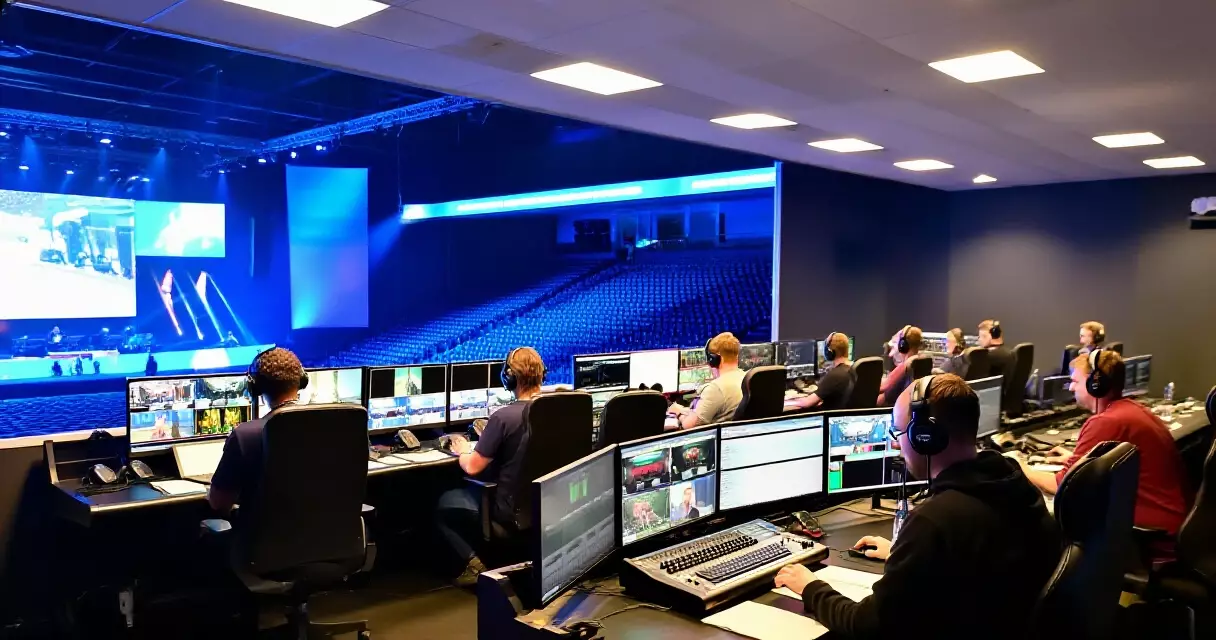
The broadcast production suite is the revenue engine of any tier-1 esports venue. A well-configured production room can generate income from streaming rights, in-venue advertising slots, and replay packages independently of ticket revenue – which means it deserves a proportionally larger share of the capital budget than venue developers sometimes allocate. Riot Games, which operates its own broadcast standards for Valorant and League of Legends events, publishes detailed technical specifications that aspiring venue partners must meet before being approved as an official event host.
The LED display wall is the single most expensive visible element of an esports arena. A high-quality 4K LED wall using Absen, Unilumin, or ROE Visual panels runs roughly $800–$1,500 per square meter installed, depending on pixel pitch. A 15 m × 6 m backdrop wall – fairly typical for a 1,000-seat venue – therefore costs $72,000–$135,000 in panels alone before rigging, power distribution, and control hardware. Tighter pixel pitches (P2.5 or P1.9) improve image quality at close viewing distances but add cost; for venues where the nearest audience seats are more than 8 meters from the screen, P3.9 or P4.8 panels deliver acceptable quality at lower cost.
Broadcast-quality camera infrastructure typically follows the multi-camera shooting style used by Riot, ESL, and PGL in their broadcast productions: fixed overhead rig cameras for player face-cam feeds, mobile camera operators on the venue floor for crowd reaction shots, and a dedicated observer client PC for in-game camera control. The production switcher stack at most mid-tier venues centers on a Blackmagic Design ATEM Constellation or equivalent, feeding into an OBS-based or vMix-based streaming encoder chain. Larger venues often contract Telestream or Grass Valley hardware encoders for reliability on tier-1 streams.
Power, Cooling, and Physical Building Requirements
Power planning is the discipline that separates projects that open on time from those that stall waiting for utility upgrades. The U.S. Energy Information Administration notes that commercial esports and data-intensive entertainment facilities can have load densities 3–5× higher than standard retail construction – a fact that often surprises building owners who are leasing existing commercial space and assume the existing electrical service is sufficient.
A practical power budget for a 500-seat mid-tier esports arena:
| System | Estimated Load (kW) | Redundancy Requirement |
|---|---|---|
| Player stations (50 × ~1.2 kW) | 60 | UPS on each station |
| LED walls + display infrastructure | 60–100 | Bypass panel |
| Production / broadcast suite | 30–50 | Generator + UPS |
| HVAC / cooling (elevated load) | 120–200 | N+1 chiller/CRAC |
| Lighting (stage + house) | 40–80 | DMX-controlled circuits |
| F&B / concessions | 30–60 | Standard commercial |
| Total estimated | 340–550 kW | Minimum 20% headroom |
Cooling is tightly coupled to power: gaming hardware generates substantial heat, and player comfort – plus hardware reliability – requires maintaining stage-floor temperatures below 22°C (72°F) even under full competition load. Standard office HVAC systems are rarely sufficient. Purpose-built esports venues increasingly use precision cooling units (CRAC units or in-row cooling) similar to those used in data centers, supplemented by conventional building HVAC for the spectator bowl. The floor plenum design – routing cold air under the stage floor and up through perforated panels beneath each player station – has become a common solution borrowed from broadcast television studio design.
“Budget conversations about esports venues almost always start with the LED wall. They should start with the electrical service – because the LED wall won’t matter if you can’t power it reliably.”
Regulatory, Permitting, and Accessibility Requirements
Esports venues in the United States are classified as assembly occupancies under the International Building Code (IBC), which triggers a specific set of egress, occupant load, and fire suppression requirements. The Americans with Disabilities Act (ADA) requirements apply in full, including accessible spectator seating, accessible concession counters, and accessible player-position accommodations for any venue that hosts public-facing gaming events. The ADA National Network provides guidance on assembly venue accessibility compliance that esports venue designers should consult early in the design process.
Zoning classification varies significantly by municipality. Some cities have created entertainment district overlays that simplify permitting for mixed-use venues that combine food service, live events, and gaming – cities like Columbus (Ohio), Arlington (Texas), and Indianapolis have been particularly proactive. Others still classify high-density gaming facilities under rules written for arcades or billiard halls, which can create unexpected restrictions on hours of operation or alcohol service that affect the venue’s revenue model.
Noise ordinances present a recurring challenge for esports venues located in mixed commercial or urban neighborhoods. The crowd noise from a sold-out 1,500-seat event can easily breach municipal nighttime decibel limits at property lines, and the low-frequency rumble from subwoofer-heavy PA systems can penetrate building envelopes more effectively than mid-range frequencies. Acoustic modeling during the design phase – using tools like EASE or Odeon – and construction of adequate sound barriers is significantly cheaper than the post-occupancy remediation and legal costs that come from noise complaints.
Those considering how a top-tier venue compares to existing championship facilities can learn a great deal from sites like Major Esports Arenas and Venues: Where Championships Are Won, which details how the world’s leading venues have handled precisely these design and operational challenges.
Financing and Revenue Modeling for Esports Venues
The capital stack for an esports venue rarely looks like a standard commercial real estate deal. Public funding – through economic development grants, TIF (Tax Increment Financing) districts, and tourism bureau allocations – has played a significant role in many of the highest-profile U.S. builds. Esports Stadium Arlington, which opened in 2018 at roughly $10 million, was funded in large part through the City of Arlington’s convention and events budget. The $50 million Allied Esports HyperX Arena in Las Vegas relied on a combination of private equity and a hotel property partnership with the Luxor.
On the revenue side, operators typically model six distinct streams:
- Event ticketing: $15–$80 per ticket depending on event tier and seating category
- Naming rights and sponsorships: $250K–$5M+ annually for significant venues with proven viewership
- Broadcast licensing: negotiated per-event with publishers and tournament organizers
- Hourly seat/PC rental: $5–$15/hour at community-facing facilities
- Food and beverage: $18–$35 per capita spend is a common event-night benchmark
- Corporate events and team practice leases: increasingly important as professional teams seek dedicated scrim facilities
The venues that have proven financially sustainable over the 2018–2026 period share a common trait: they do not rely on a single revenue stream. The esports event market has enough scheduling volatility that a venue dependent solely on hosting paid tournaments will face long dark periods. The most resilient models layer daily walk-in gaming revenue with a rotating calendar of community tournaments, corporate team-building events, and LAN party nights that keep the venue active even when no professional event is scheduled.
Understanding the broader landscape of where competitive gaming takes place today is valuable context for new venue planners – the Esports Venues: Guide to Competitive Gaming Arenas 2026 provides a useful survey of the current facility market.
Staffing, Operations, and Technology Management
A purpose-built esports venue operates at the intersection of live entertainment venue management and IT infrastructure management – two disciplines that rarely live in the same org chart. The technical director role at a mid-tier esports arena typically requires a background spanning broadcast production, enterprise networking, and gaming hardware, which makes qualified candidates both rare and expensive. Planning for this staffing gap during the build phase – including budget for external systems integrators and managed service contracts – is essential.
Core operational staff at a 500–1,500 seat venue will typically include: a venue general manager, a technical director, 2–4 broadcast engineers (some may be contracted per-event), a network administrator, a hardware/PC technician, a tournament operations coordinator, an events and partnerships manager, and variable front-of-house staff scaling with event size. Annualized labor costs for this core team run $400K–$800K in U.S. markets, before per-event contract labor.
Preventive maintenance schedules for gaming hardware are often neglected in early venue operations planning. High-end gaming PCs under daily competitive loads experience significantly higher component failure rates than consumer machines used a few hours per week. Establishing a 6-month GPU/CPU thermal paste refresh cycle, a quarterly memory and SSD health audit, and a 2-year full system refresh cycle – along with spare parts inventory for the most failure-prone components – avoids the scenario where a component failure forces mid-event substitutions on a critical match day.
For those interested in how player skill development intersects with venue use – particularly for training-focused facilities – Mobile Esports Training Tips: How Pro Players Practice and Peak Faster offers useful context on how professionals approach structured training environments.
Frequently Asked Questions About Building an Esports Venue
How much does it cost to build an esports venue from the ground up?
The cost range is wide because the term covers fundamentally different project scales. A community gaming center with 30–50 stations, basic A/V, and no fixed spectator seating can be built and equipped for $300,000–$1.5 million in most U.S. markets. A regional venue with 200–500 spectator seats, a proper stage, broadcast infrastructure, and full LED wall installation typically lands in the $3 million–$12 million range. A flagship destination arena with 2,000+ seats, touring-grade AV production, and premium hospitality spaces starts at $20 million and has no practical upper ceiling – the Fusion Arena proposal in Philadelphia was budgeted at $50 million before it was shelved. Land and building shell costs are separate and can dwarf the fit-out budget in major markets like New York, Los Angeles, or San Francisco.
What are the most critical technology investments for a competition-grade venue?
In order of competitive impact: first, a dedicated fiber network with sub-5 ms latency between stations and game servers, supported by redundant ISP uplinks. Second, enterprise-grade switching hardware from Cisco, Aruba, or Juniper ensuring traffic isolation between competition, production, and spectator VLANs. Third, uninterruptible power supply (UPS) systems on every player station to prevent match interruption from micro-outages. Fourth, tournament-specification gaming PCs with current-generation GPUs and monitors certified for the titles you intend to host. Fifth, a professional broadcast suite capable of producing streams that meet the technical specifications of major publisher partners like Riot Games, Valve, or Activision Blizzard. Any of these five failing during a tournament can disqualify the venue from future professional event consideration.
Do you need special permits or licenses to operate an esports venue?
Yes – esports venues that host live audiences are classified as assembly occupancies under the International Building Code, triggering a full suite of building permits, fire suppression requirements, egress design standards, and occupant load calculations. Separately, venues that serve food and alcohol require state and local food service licenses and liquor licenses, which vary significantly in cost and processing time by state. ADA compliance is federally mandated for any public-facing venue regardless of size. In some municipalities, operating a commercial gaming facility with coin-operated or token-operated machines may trigger arcade or amusement device licensing requirements even when the primary business model is PC gaming rather than traditional arcade machines. Engaging a local attorney familiar with entertainment venue permitting before signing a lease or purchase agreement is strongly advised.
How long does it take to build and open an esports venue?
For a community-scale gaming center in existing commercial shell space, a realistic timeline from lease signing to first event is 6–12 months, assuming permitting goes smoothly. Mid-tier venues in the 300–1,500 seat range typically require 12–24 months from design kick-off to opening day, with the longest lead times usually attributable to LED wall and broadcast equipment procurement – major LED suppliers like Absen and ROE Visual often quote 12–16 week lead times during peak demand periods. Ground-up flagship arenas have ranged from 24 months (Esports Stadium Arlington) to 48+ months when public financing and approval processes are involved. Technology procurement should begin in parallel with construction, not sequentially after it, to avoid opening-day delays from long-lead AV and networking hardware.
What is the minimum internet bandwidth required for an esports venue?
The bandwidth requirement is less important than latency and jitter for the competition network itself – most competitive titles consume only 50–200 Mbps total across a full 10-player station setup. The real bandwidth demand comes from the broadcast streaming output (a 1080p60 stream at broadcast quality runs 6–15 Mbps; 4K streams run 25–50 Mbps per encoder output), spectator Wi-Fi (plan for 1–2 Mbps per concurrent spectator device), and the venue management and ticketing systems. A 1 Gbps dedicated fiber circuit is a practical minimum for a mid-tier competition venue, with a secondary 500 Mbps or 1 Gbps circuit from a different ISP for failover. Community-scale venues can operate on 500 Mbps with a 100 Mbps backup, but should plan the physical infrastructure (conduit, fiber runs) for easy capacity upgrades.
How do esports venues make money without major events?
The most financially stable venues generate income across at least four distinct streams that do not all depend on professional event scheduling. Daily open gaming – where members of the public pay hourly to use high-spec PCs – provides consistent baseline revenue. Monthly or annual membership programs add predictable recurring income. Corporate events, including team-building experiences, product launches, and private LAN parties, often command premium pricing and fill weekday calendar gaps that consumer gaming does not. Community tournament programs – weekly and monthly competitions with entry fees – build local audience loyalty while generating revenue at minimal incremental cost. Several successful mid-tier U.S. venues have also partnered with local high school and collegiate esports programs to offer practice facility leases, creating a steady income stream that is entirely decoupled from professional event hosting.
What games should an esports venue be built to support?
Hardware and network flexibility is more valuable than optimizing for a single title. The competitive esports landscape shifts – games that commanded large live audiences in 2020 (Overwatch League, for instance) may have reduced circuit presence by 2026, while new titles emerge and grow rapidly. A venue built around tournament-spec PCs capable of running any Windows-native title at maximum performance, with monitors switchable between 1080p240Hz and 1440p144Hz configurations, can host CS2, Valorant, League of Legends, Dota 2, Fortnite, Rocket League, and most other tier-1 titles without hardware changes. Console game tournaments – fighting games, sports simulations, and titles like FIFA/EA Sports FC – require a separate console station infrastructure (typically 40-inch 4K OLED displays with console mounts) that should be planned as a modular add-on rather than a permanent stage fixture.
Are there industry organizations that provide guidance for esports venue developers?
Several organizations publish relevant standards and resources. The National Association of Collegiate Esports (NACE) is the most active publisher of facility guidelines in the U.S. collegiate context. The Entertainment Services and Technology Association (ESTA) publishes technical standards for entertainment industry rigging, electrical, and broadcast infrastructure that apply directly to esports venue AV builds. The Global Esports Federation (GEF) and ESL/FACEIT (now part of the Saudi-owned Savvy Games Group) both publish technical event hosting specifications that serve as de facto venue infrastructure standards for operators who want to host their events. The International Association of Venue Managers (IAVM) offers venue management education and certification programs that translate well to the esports context even though they are not esports-specific.
Sources
- Newzoo Global Esports & Live Streaming Market Report 2024 – https://newzoo.com/resources/blog/global-esports-market-report-2024-free-version
- National Association of Collegiate Esports (NACE) – https://www.nacesports.org
- ADA National Network – ADA Assembly Venue Requirements – https://www.ada.gov/law-and-regs/ada/
- International Association of Venue Managers (IAVM) – https://www.iavm.org
- Entertainment Services and Technology Association (ESTA) – https://www.esta.org
- U.S. Energy Information Administration – Commercial Buildings Energy Consumption Survey – https://www.eia.gov/consumption/commercial/
- PwC Global Sports Survey 2024 – https://www.pwc.com/gx/en/industries/sports/sports-survey.html
Top Esports Organizations 2026: Teams, Rosters, and Performance Rankings