
Summary
When Riot Games opened its dedicated live-event venue inside its West Los Angeles campus in 2022, it gave the esports industry something rare: a purpose-built arena owned and operated by the same publisher responsible for the games played on its...
Table of contents
- 1 Background: Why Riot Built Its Own Arena
- 2 Venue Specifications and Technical Infrastructure
- 3 Events Hosted: LCS, VCT, and Beyond
- 4 Fan Experience: Ticketing, Sightlines, and Atmosphere
- 5 Broadcast Production Quality
- 6 Specs Table and Comparison to Peer Venues
- 7 Pros and Cons
- 8 Revenue Model and Business Context
- 9 How It Compares: Riot Games Arena vs. Esports Stadium Arlington
- 10 Frequently Asked Questions
- 10.1 Where exactly is Riot Games Arena located?
- 10.2 How many people does Riot Games Arena hold?
- 10.3 Which games and tournaments are played at Riot Games Arena?
- 10.4 How do I buy tickets to events at Riot Games Arena?
- 10.5 Is Riot Games Arena open to the public, or do you need a ticket?
- 10.6 How does Riot Games Arena compare to other esports venues in terms of fan experience?
- 10.7 Has Riot Games Arena hosted any major championship events?
- 10.8 What should I bring or expect when attending an event at Riot Games Arena?
- 11 Sources
When Riot Games opened its dedicated live-event venue inside its West Los Angeles campus in 2022, it gave the esports industry something rare: a purpose-built arena owned and operated by the same publisher responsible for the games played on its stage. The Riot Games Arena seats roughly 1,000 spectators, yet it regularly sells out for championship-level events that attract global viewership in the tens of millions – a ratio that makes it one of the most efficient esports production facilities on earth.
Background: Why Riot Built Its Own Arena
Riot Games was founded in 2006 and released League of Legends in 2009. By 2012 the game’s Season 2 World Championship filled the USC Galen Center in Los Angeles with over 8,000 fans, and the Season 3 World Championship at Staples Center drew 15,000. Those early stadium shows proved that fans would pay to watch competitive games live, but renting large general-purpose arenas created constant friction: poor sightlines for monitors, inadequate fiber infrastructure, and staging crews unfamiliar with broadcast-grade esports production.
Riot responded by investing in a permanent home. The company’s West Los Angeles headquarters already housed multiple production studios used for LCS broadcasts. Expanding that footprint into a live-audience venue allowed Riot to control every variable – from the fiber backbone to the concession menu – that shapes the fan and broadcast experience. The arena opened ahead of the 2022 LCS Spring Split and has since hosted LCS regular-season weeks, LCS Championship events, and select Valorant Champions Tour (VCT) North America matches.
Venue Specifications and Technical Infrastructure
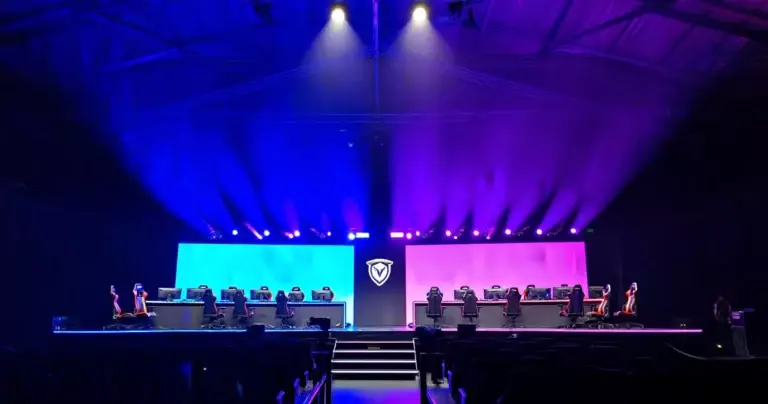
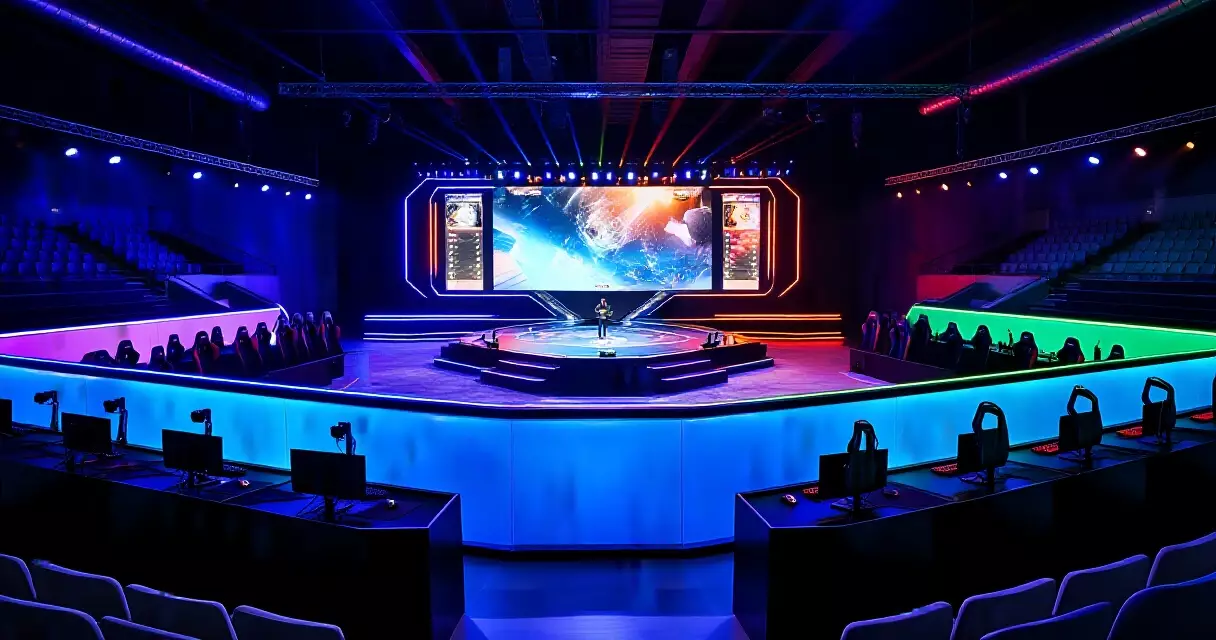
The arena occupies purpose-converted space within Riot’s main campus building. Because Riot designed it from scratch for esports, the technical spec sheet reads differently from a converted concert hall or sports arena. The main stage faces a raked seating bowl that keeps every seat within a tight viewing cone of the competition monitors and the central LED display. Stage-to-back-row distances are short enough that spectators in the last row can read player health bars on the large screen without optical aids.
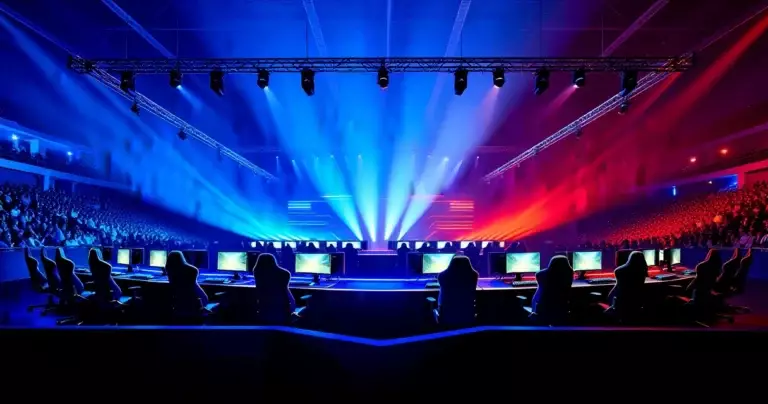
Broadcast infrastructure is baked into the structure. Dedicated fiber runs connect stage PCs directly to production control rooms housed in the same building, eliminating latency caused by long cable runs common in rental venues. The lighting grid supports fully programmable RGB shows synchronized to in-game events – a feature that became a signature of LCS broadcasts and influenced how other esports venues approach AV and stage design.
Sound design is another area where the venue outperforms larger multipurpose buildings. The ceiling treatment reduces echo, allowing the house audio system to deliver clean crowd-reactive sound effects and caster commentary at high volume without muddying speech intelligibility. This matters in a setting where understanding casters is part of the atmosphere for attendees who may not play the game at a high level themselves.
Events Hosted: LCS, VCT, and Beyond
The primary tenant of Riot Games Arena is the League of Legends Championship Series (LCS), North America’s top professional LoL league. LCS regular-season weeks run across the Spring and Summer Splits, with playoff and championship rounds typically reserved for larger rented venues when Riot wants to scale audiences. From 2022 onward, select playoff weekends have also taken place at the Riot arena itself, allowing the production team to deliver a polished broadcast without the operational complexity of an off-campus show.
The Valorant Champions Tour (VCT) Americas league also uses the facility for regular-season matches. VCT Americas competes in a dedicated league format that Riot launched in 2023 as part of its restructured partnership-team model. Having a fixed home venue simplified scheduling for teams, many of which relocated to Los Angeles specifically to train near the production hub.
Beyond league play, the arena hosts special events including player signings, community watch parties for international events, and media days. During Worlds seasons when the LCS is on hiatus, the space has been repurposed for content production, underscoring its flexibility as a multi-function facility within a corporate campus.
Fan Experience: Ticketing, Sightlines, and Atmosphere
Attending an event at Riot Games Arena starts with the ticketing process, which has historically been the most friction-heavy part of the experience. Tickets for popular playoff weekends routinely sell out within minutes of release. Riot has used a first-come-first-served model through its esports website as well as the Ticketmaster platform for larger events. Prices for general-admission standing and seated options have ranged from roughly $20 for a single regular-season session to over $80 for premium championship weekend passes, according to historical listings tracked by community fan sites.
Inside the venue, sightlines are the headline feature. Because the bowl was designed specifically for a fixed-position stage rather than adapted from a basketball court or concert floor, there are no partially obstructed seats. The main LED screen is large relative to the room size, and supplementary side screens provide close-up player camera feeds so fans tracking individual player performance never lose visual access.
Every seat in Riot Games Arena is a good seat – a claim that very few venues in competitive gaming can make with a straight face.
The concession area is compact but functional. Options lean toward grab-and-go snacks and branded merchandise rather than the elaborate food courts found at larger arenas. Riot merchandise – including game-themed apparel and limited-edition event items – is available on-site, and sell-out rates for exclusive drops have been a consistent talking point in fan community discussions on Reddit’s r/leagueoflegends and r/ValorantCompetitive boards.
Accessibility features include ADA-compliant seating sections and ramp access from the building entrance. The campus setting means parking is primarily in Riot’s adjacent structure, with validated parking offered for ticket holders depending on event size. Public transit options via the Expo Line Metro stop at Culver City provide an alternative for attendees coming from elsewhere in the Los Angeles basin.
Broadcast Production Quality
One of the most significant differentiators between Riot Games Arena and a rented venue is production consistency. When a league like LCS stages matches at a hotel ballroom or a remote studio, broadcast quality can vary depending on local contractor skill and available gear. At the Riot arena, the same crew, the same gear racks, and the same fiber infrastructure are in place every week. This consistency shows in the final broadcast product: camera movements are predictable and rehearsed, lighting cues hit on time, and technical dropouts are rare.
The production team at the venue has pioneered several visual techniques that have since been adopted by other esports broadcasters. These include in-game overlay graphics synchronized with the physical lighting grid – so when a team gets a pentakill, the arena floods with that team’s colors – and drone-style camera moves using overhead rigs that give the broadcast a cinematic quality uncommon in esports. For a deeper look at how these setups are built, our guide on esports venue technology requirements breaks down the network, AV, and stage components involved.
Specs Table and Comparison to Peer Venues
The table below compares Riot Games Arena against three frequently cited peer venues in the North American esports market. Capacity and primary tenant data come from official venue announcements and league press materials.
| Venue | Location | Capacity | Primary Esports Tenant | Ownership Model |
|---|---|---|---|---|
| Riot Games Arena | West Los Angeles, CA | ~1,000 | LCS, VCT Americas | Publisher-owned |
| Blizzard Arena (now vacant) | Burbank, CA | ~450 | Overwatch League (2018–2019) | Publisher-leased |
| Esports Stadium Arlington | Arlington, TX | 2,500 | Various (IEM, ESL, HLTV) | City-owned, operator-managed |
| Kia Forum / Arena partnerships | Los Angeles area | 17,000+ | LCS Worlds, ad-hoc esports | Private, multi-use |
The comparison highlights a clear positioning difference. Riot Games Arena sits in the small-capacity, high-production-quality quadrant. Esports Stadium Arlington, at 2,500 seats, is the largest dedicated esports venue in the United States and serves a broader multi-publisher event calendar. The Blizzard Arena in Burbank, which Activision Blizzard leased from a television production facility, operated at a smaller scale before the Overwatch League moved to a city-based home-market model. Understanding where each venue sits in the market is essential context for evaluating Riot’s approach; a fuller ranking appears in our list of the 15 best esports arenas in the world.
Pros and Cons
After reviewing the venue across the dimensions of fan experience, production quality, accessibility, and event variety, the advantages and limitations break down as follows.
| Pros | Cons |
|---|---|
| All seats have unobstructed sightlines to the main screen and stage | ~1,000 capacity means tickets sell out extremely fast |
| Consistent broadcast-grade production every event week | Limited to Riot IP (LoL, Valorant) – no third-party tournaments |
| Synchronized LED light shows tied to in-game moments | Concession options are basic compared to larger arenas |
| Walkable from Culver City Metro (Expo Line) | Parking limited; campus structure fills quickly on playoff weekends |
| Merchandise exclusives available only at the venue | Campus security protocols can slow entry at peak event times |
| Fan engagement activations (photo booths, product stations) on-site | No large outdoor tailgate or plaza space for pre-event gathering |
Revenue Model and Business Context
Riot Games Arena is not designed as a profit center in isolation. Its business logic sits within Riot’s broader esports monetization strategy, which draws revenue from league team partnership fees, in-game cosmetic sales tied to esports events (event passes, team skins, VCT gun buddies), sponsorship integrations, and international broadcast licensing. Ticket revenue from a 1,000-seat venue running 30–40 live event days per year at $20–$80 per ticket is modest compared to those other streams.
The arena’s real financial value is in reducing per-event production cost. Riot does not pay venue rental fees, union labor call minimums tied to external buildings, or equipment transportation for the events hosted at its campus. Those savings, compounded across dozens of live show days each year, make the owned-venue model financially rational even at small ticket revenue scale. Our analysis of how esports venues make money covers this framework in detail for operators considering similar investments.
Riot’s arena is less a ticketing business and more an infrastructure investment that pays dividends across every broadcast it produces.
For the professional teams competing in LCS and VCT Americas, having a consistent home venue provides logistical stability. Teams know the stage setup, the practice facilities on campus, and the audience size for every regular-season event. That predictability makes it easier to plan travel, media schedules, and player preparation routines. For a broader look at how this compares across the global scene, the Esports Venues Guide 2026 maps out the landscape.
How It Compares: Riot Games Arena vs. Esports Stadium Arlington
The two most-discussed dedicated esports venues in the United States are Riot Games Arena and Esports Stadium Arlington (ESA). They represent different philosophies in venue design and programming, and understanding that contrast helps prospective attendees and industry observers set accurate expectations.
ESA, operated by the City of Arlington’s Parks and Recreation department in partnership with OGE Entertainment Group, opened in 2018 inside the Irving Convention Center at Las Colinas before moving to its permanent 100,000-square-foot home. At 2,500 seats with an adjacent broadcast studio and a flexible floor configuration that can expand for standing-room events, ESA hosts events across multiple publishers – Counter-Strike, Call of Duty, Rocket League, and more – making it a neutral-ground facility. The city ownership structure means ESA generates public economic impact data, including figures cited by the Arlington Convention and Visitors Bureau showing multi-million-dollar local economic activity from major events.
Riot Games Arena, by contrast, is single-publisher, single-campus, and optimized for broadcast rather than maximum attendance. Neither model is strictly superior – they serve different strategic goals. ESA offers scale and publisher diversity; Riot’s arena offers production consistency and IP-aligned experience design. Attendees choosing between a League of Legends event at the Riot arena and a Counter-Strike event at ESA are effectively choosing between two different categories of esports live experience.
Frequently Asked Questions
Where exactly is Riot Games Arena located?
Riot Games Arena is located within Riot Games’ main headquarters campus in West Los Angeles, California. The address is in the Playa Vista / Culver City corridor of West LA. The venue is accessible by car via the I-405 or I-10 freeways, and by public transit via the Metro Expo Line (now E Line) with the Culver City station being the nearest stop. Attendees arriving by Metro should plan for approximately a 10-15 minute walk or a rideshare connection from the station to the campus entrance. Riot typically publishes specific directions and parking instructions with each event ticket confirmation email.
How many people does Riot Games Arena hold?
Riot Games Arena holds approximately 1,000 spectators in its primary seated configuration. This capacity figure has been cited in Riot press materials and is consistent with reports from journalists who have covered LCS and VCT Americas events on-site. The number is intentionally small relative to major multipurpose arenas – this is a deliberate design choice to keep the viewing experience intimate and to maintain high broadcast production quality. When Riot wants to scale audience size for championship events such as LCS Finals or Valorant Champions, it typically moves those shows to rented venues like the Kia Forum, Crypto.com Arena, or other large Los Angeles venues that can hold 10,000 or more fans.
Which games and tournaments are played at Riot Games Arena?
The arena hosts events exclusively for Riot Games titles. The two primary competitions are the League of Legends Championship Series (LCS), North America’s top professional LoL league, and the Valorant Champions Tour (VCT) Americas league, which covers North and South American VCT partnership teams. Regular-season match weeks for both leagues run at the venue from late January through August most years. Playoff rounds may be held at the campus venue or moved to larger rented spaces depending on expected demand. Occasionally the arena also hosts special events such as media days, community activations, and watch parties for international competitions like the LoL World Championship or VCT Champions when those events take place overseas.
How do I buy tickets to events at Riot Games Arena?
Tickets are sold through the official Riot Esports website (lolesports.com for LCS events and valorantesports.com for VCT events) as well as through Ticketmaster for select larger events. General availability sales go live weeks before the event and for popular playoff weekends can sell out in under an hour. Riot has periodically offered presale access to registered Riot account holders or to fans who sign up for event notification emails, which can improve the odds of securing seats before general availability opens. Prices for regular-season sessions typically start around $20 for standing room or basic seats, with premium and VIP options at higher price points. Resale platforms carry tickets after sellout, though prices are typically marked up significantly.
Is Riot Games Arena open to the public, or do you need a ticket?
Riot Games Arena is located inside a corporate campus and is not a public facility in the way that a city-owned arena would be. Entry requires a valid event ticket purchased through official channels. On non-event days the venue is not accessible to the general public since it operates within Riot’s private headquarters. Campus security checks credentials at entry points, and the process can be slow on high-attendance playoff weekends. Attendees are advised to arrive at least 30 minutes before doors open to clear security, pick up merchandise, and find seats before match start. Riot has occasionally organized campus tours or community events that allow limited public access, but these are announced separately and are not a regular occurrence.
How does Riot Games Arena compare to other esports venues in terms of fan experience?
For raw broadcast production quality and sightline consistency, Riot Games Arena ranks among the best in North America. Every seat faces the stage directly, the LED production is among the most sophisticated at any recurring esports event in the region, and the sound system delivers clear audio without the echo problems common in large multi-purpose arenas. Where it falls short relative to larger venues like Esports Stadium Arlington or the Kia Forum is in amenities, concession variety, and the communal atmosphere that comes with a bigger crowd. A 1,000-seat arena is intimate, which some fans love and others find anticlimactic after watching international events held in 20,000-seat stadiums. For a comparative ranking of global venues, see our roundup of the 15 best esports arenas in the world.
Has Riot Games Arena hosted any major championship events?
The arena has hosted LCS Championship weekend events and select VCT Americas playoff matches. For the highest-stakes events – LCS Finals and Valorant Champions – Riot typically selects larger venues to accommodate the scale of audience demand and the production ambition those marquee events call for. The 2022 and 2023 LCS Championship events were held off-campus at larger venues, while regular-season and earlier playoff rounds remained at the Riot campus arena. This hybrid approach lets Riot use the home venue for the majority of its live event calendar while scaling to bigger spaces for its marquee moments, a strategy discussed in detail in our overview of major esports arenas and championship venues.
What should I bring or expect when attending an event at Riot Games Arena?
Attendees should bring a valid government-issued ID, their event ticket (digital or printed), and comfortable clothing appropriate for an air-conditioned indoor venue. The campus environment means dress codes are casual and gaming-themed apparel is common and welcome. Bags are subject to security screening; small bags or clear bags are typically preferred to speed entry. Food and drink options on-site are limited to what the venue provides, so some fans eat before arriving. Expect merchandise lines to be long immediately after doors open – if securing a limited-edition event item is a priority, budgeting extra time before the first match is advisable. Photography policies vary by event, so checking Riot’s event FAQ for the specific show before attending is a practical step.
Sources
- Riot Games official press releases – riotgames.com/en/news
- Wikipedia: Esports Stadium Arlington – en.wikipedia.org/wiki/Esports_Stadium_Arlington
- Wikipedia: League of Legends Championship Series – en.wikipedia.org/wiki/League_of_Legends_Championship_Series
- Wikipedia: Valorant Champions Tour – en.wikipedia.org/wiki/Valorant_Champions_Tour
- Arlington Convention and Visitors Bureau – arlington.org
- Ticketmaster platform information – en.wikipedia.org/wiki/Ticketmaster
Top Esports Organizations 2026: Teams, Rosters, and Performance Rankings