Summary
Analyzing the software library ready for Nintendo's next-generation console. Check out the full list of launch titles and performance leaks.
Table of contents
- 1 Upgraded Hardware: The Technical Foundation of the Switch 2
- 2 Speculative Launch Library: Nintendo Switch 2
- 3 Third-Party Support and Backwards Compatibility
- 4 Frequently Asked Questions (FAQ)
- 4.1 When will the Nintendo Switch 2 launch?
- 4.2 Will the Switch 2 cost more than the original?
- 4.3 Does the Switch 2 feature an OLED screen?
- 4.4 Will my current Switch accessories work on the Switch 2?
- 5 Developer Tools, SDK Upgrades, and Third-Party Portability
- 5.1 The Influence of Cloud Gaming and Subscription Services
- 5.2 Game Development Tools, Physics Engines, and Production Pipeline
- 5.3 Rarity, Microtransactions, and Virtual In-Game Economies
- 5.4 Community Moderation, Anti-Cheat Systems, and Online Security
- 6 Conclusion
The hybrid console revolution that started with the Nintendo Switch in 2017 is finally entering its next phase. Industry reports, developer leaks, and official teasers have confirmed that Nintendo’s next-generation console, widely referred to as the Nintendo Switch 2, is set to launch. With upgraded hardware powered by custom NVIDIA architecture, including DLSS upscaling and ray tracing support, the console aims to bring modern AAA gaming to a portable format. In this deep dive, we evaluate the confirmed games, rumored launch titles, and what this new hardware means for the future of Nintendo’s iconic franchises.
Upgraded Hardware: The Technical Foundation of the Switch 2
The original Switch has struggled to run modern third-party AAA titles due to its aging mobile hardware. The Switch 2 aims to solve this with a custom NVIDIA Tegra processor featuring Ampere architecture. This upgrade introduces support for Deep Learning Super Sampling (DLSS), allowing the console to upscale lower-resolution inputs to a crisp 1080p in handheld mode and up to 4K when docked. Combined with increased RAM and a faster custom NVMe SSD, the Switch 2 will dramatically reduce loading times and allow developers to port modern games with minimal visual compromises compared to Xbox Series S and PlayStation 5.
To see how this new hybrid system compares to current-gen home consoles and portable options, check out our detailed review of the PlayStation 5 Pro Long-Term Review: Is It Worth the Upgrade in 2026? and read our hardware analysis of Valve’s handheld in the Steam Deck OLED 2026 Review: Still the Best Handheld PC Gaming Experience? to stay fully informed on the console landscape.
Speculative Launch Library: Nintendo Switch 2
| Game Title | Publisher / Developer | Confirmation Status | Technical Enhancements on Switch 2 |
|---|---|---|---|
| New 3D Mario Project | Nintendo EPD | Highly Rumored (Launch Day Title) | 4K Docked resolution, advanced lighting, and zero loading times. |
| Metroid Prime 4: Beyond | Nintendo / Retro Studios | Confirmed Cross-Gen | Locked 60 FPS performance, enhanced textures, and HDR support. |
| Monster Hunter Wilds Port | Capcom | Rumored Launch Window | Utilizes NVIDIA DLSS to maintain playable frame rates in handheld mode. |
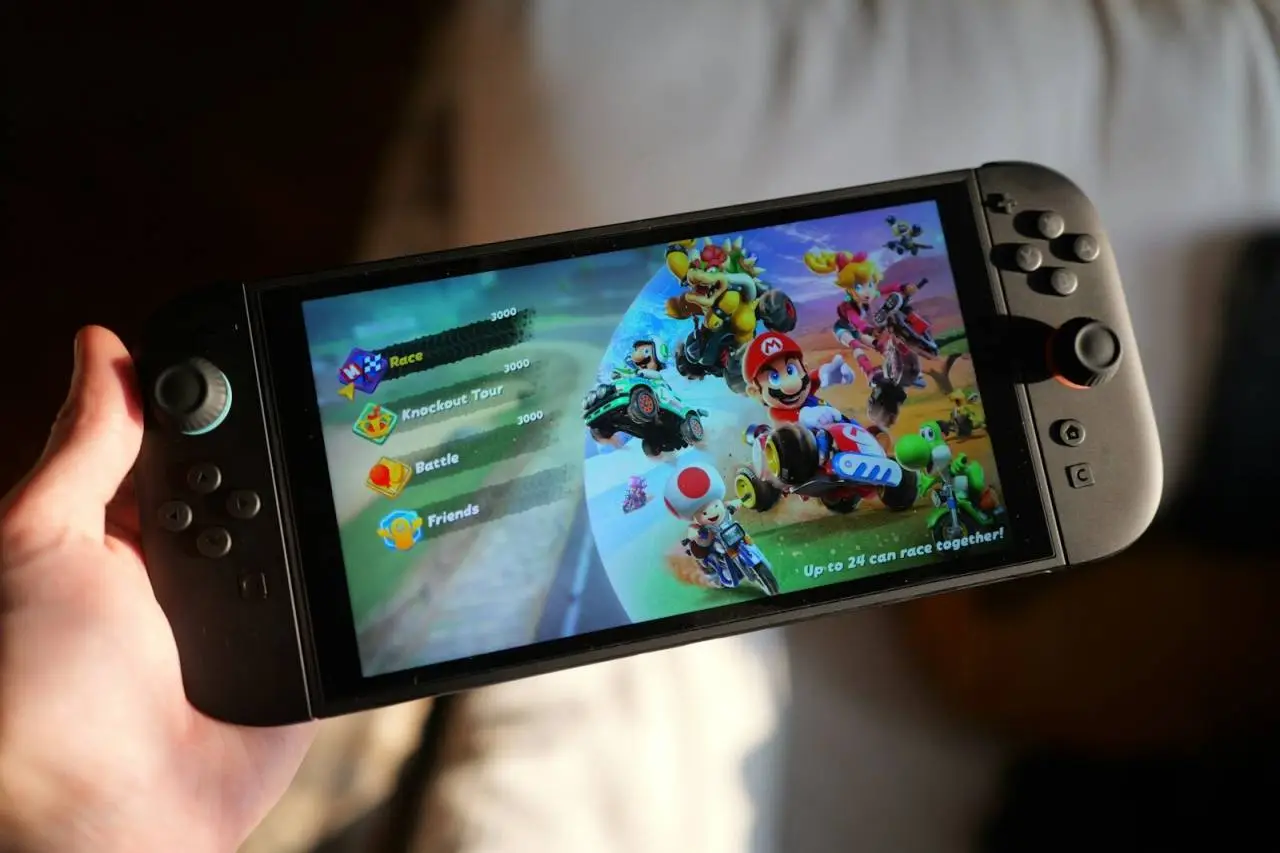
| Mario Kart 8 Deluxe (Enhanced) | Nintendo | Highly Rumored (Day One Update) | Upscaled 4K visuals, improved draw distances, and faster lobby loading. |
Third-Party Support and Backwards Compatibility
One of the biggest questions surrounding the Switch 2 is backwards compatibility. Nintendo executives have hinted that the transition to the next platform will be smooth, with players able to access their existing Nintendo Account and digital Switch library. Physical cartridge compatibility remains highly likely, though some upgrades may require digital patches. The inclusion of modern hardware features like DLSS has also made it much easier for third-party developers to port current-generation games, ensuring that the Switch 2 will not suffer from the software droughts that plagued previous Nintendo consoles.
- First-Party Polish: Traditional Nintendo IP will run with unprecedented visual fidelity, targeting locked frame rates.
- Third-Party AAA Ports: Titles previously deemed impossible for portable play will run successfully using DLSS.
- Backwards Compatibility: Players can likely play their original Switch library with automatic performance boosts.
- Improved Joy-Cons: Redesigned controllers featuring magnetic attachments and drift-resistant analog sticks.
Frequently Asked Questions (FAQ)
When will the Nintendo Switch 2 launch?
While Nintendo has not announced a specific date, industry reports and financial guidance point to a launch in the first half of 2026.
Will the Switch 2 cost more than the original?
Given the upgraded internal components, analysts expect the Switch 2 to retail between $399 and $449, making it slightly more expensive than the original console at launch.
Does the Switch 2 feature an OLED screen?
Initial launch models are rumored to feature a high-quality LCD panel to keep manufacturing costs down, with an OLED version planned for a later date.
Will my current Switch accessories work on the Switch 2?
USB-C accessories and standard Bluetooth controllers (like the Pro Controller) will work, though Joy-Cons may require updates due to the rumored magnetic attachment design.
Developer Tools, SDK Upgrades, and Third-Party Portability
One of the primary reasons developers are excited about the Nintendo Switch 2 is the overhaul of Nintendo’s software development kits (SDKs) and developer tools. The original Switch required studios to perform massive optimization miracles to port modern games, often leading to delayed releases or visually compromised ports. With the Switch 2, Nintendo has worked closely with NVIDIA to provide developers with robust API support and optimized compilers that make porting games from PC, PlayStation 5, and Xbox Series X|S much simpler.
The key to this ease of porting is the integration of modern hardware features like unified memory architecture and specialized hardware decompression blocks. These features allow games to stream textures and assets directly from the high-speed NVMe SSD, mimicking the file structures of modern home consoles. Third-party studios can leverage standard engines like Unreal Engine 5 and Unity with minimal custom coding, utilizing DLSS upscaling to scale the visual presentation to match the Switch 2’s target resolution. This developer-friendly approach ensures that the Switch 2 will receive day-and-date third-party releases, bridging the gap between Nintendo’s iconic first-party ecosystem and the wider world of AAA gaming.
The Influence of Cloud Gaming and Subscription Services
The distribution of modern video games has been transformed by cloud streaming platforms and subscription-based libraries. Major publishers partner with subscription services to offer day-one access to their titles, expanding their player base and securing steady licensing revenues. Cloud streaming technology has also matured, allowing players with lower-end hardware or smart TVs to stream high-fidelity games directly over the internet with minimal input latency. This focus on accessibility is redefining game monetization, with developers prioritizing recurring content updates and player engagement over traditional retail sales.
Game Development Tools, Physics Engines, and Production Pipeline
The creation of high-fidelity open-world games relies on continuous updates to game development tools, advanced physics engines, and collaborative production pipelines. Studios utilize procedural generation tools to design massive terrain structures and foliage layouts, allowing artists to focus on custom-crafted cities and quest hubs. Physics engines are optimized to handle complex simulations, including vehicle deformations, dynamic weather reactions, and realistic character movements. This developer-friendly workflow allows studios to streamline their production cycles and focus on delivering polished, bug-free gameplay experiences.
Rarity, Microtransactions, and Virtual In-Game Economies
Modern games often feature virtual economies driven by cosmetic microtransactions, item rarity tiers, and community marketplaces. Players collect character skins, weapon wraps, and unique accessories to customize their in-game appearance, driving massive digital revenues for publishers. These virtual assets are managed through secure databases and digital storefronts, with select rare items trading for high values on community-driven secondary markets. Developers balance these microtransactions carefully, ensuring they focus on cosmetic customization rather than pay-to-win mechanics to preserve competitive integrity.
Community Moderation, Anti-Cheat Systems, and Online Security
Ensuring a secure, toxicity-free environment in online multiplayer games requires robust community moderation and advanced anti-cheat systems. Developers deploy kernel-level anti-cheat software that monitors system files in real-time, identifying and banning third-party cheating programs. Additionally, AI-driven moderation tools analyze in-game chat and voice communications, identifying toxic behaviors and enforcement actions automatically. By prioritizing security and player welfare, developers preserve the competitive integrity of their games, building a safe and welcoming space for their communities.
Conclusion
The Nintendo Switch 2 is poised to be another massive success for the Japanese gaming giant. By combining their legendary first-party software output with upgraded hardware capable of running modern AAA games, Nintendo is creating the ultimate gaming device. Prepare your wallets and get ready for the next evolution of portable play.
For official announcements and corporate updates, check out the official Nintendo Corporate Website.