
Summary
When 18,000 fans packed Chase Center in San Francisco for the 2022 League of Legends World Championship Finals, Riot Games had already spent weeks installing dedicated fiber uplinks, a temporary broadcast compound, and a full satellite redundancy layer – because...
Table of contents
- 1 Why Esports Venues Have Unique Technology Demands
- 2 Network Infrastructure: The Non-Negotiable Foundation
- 3 Audio/Visual Systems: Screens, Sound, and Broadcast Signal Chains
- 4 Stage Design and Player Booth Specifications
- 5 Real-World Venues Setting the Benchmark
- 6 Scaling Technology Requirements by Venue Tier
- 7 Frequently Asked Questions
- 7.1 Why do esports venues use wired ethernet instead of Wi-Fi for players?
- 7.2 What refresh rate do professional esports players use, and does the venue need to support it?
- 7.3 How do venues prevent crowd noise from affecting players on stage?
- 7.4 What happens to the network if the internet connection drops mid-match?
- 7.5 How much does it cost to build a Tier 2 regional esports venue with proper technology?
- 7.6 What is an observer PC and why does every competitive stage need one?
- 7.7 Do mobile esports events have different venue technology requirements?
- 8 Sources
When 18,000 fans packed Chase Center in San Francisco for the 2022 League of Legends World Championship Finals, Riot Games had already spent weeks installing dedicated fiber uplinks, a temporary broadcast compound, and a full satellite redundancy layer – because the arena’s standard infrastructure simply wasn’t built for it. That contrast reveals everything about modern esports venue technology: the requirements are precise, the tolerances are tight, and a single misconfigured switch can derail a match watched by millions. Whether you’re evaluating an existing facility or planning a purpose-built arena, understanding these specs is non-negotiable.
Why Esports Venues Have Unique Technology Demands
Traditional sports venues are built around spectator comfort and broadcast cameras. Esports venues carry an additional layer: the players themselves are interacting with networked software in real time, and any degradation in that digital environment directly affects competitive outcomes. A 50ms latency spike in an NBA arena doesn’t change how a shot is taken; in a Counter-Strike 2 match, it can render an entire round’s decision-making moot.
This creates a design philosophy where the technology stack has to serve three audiences simultaneously: competitors who need zero-lag, controlled conditions; broadcasters who need high-quality signal chains; and in-person fans who need immersive visual and audio experiences. Those three requirements pull in different directions, and reconciling them is the core challenge of esports venue design.
The stakes are high enough that organizations like ESL FACEIT Group, Riot Games, and Activision Blizzard publish formal technical riders that venue partners must meet before a Tier 1 event can be confirmed. These aren’t suggestions; they’re contractual baselines. Understanding them is the starting point for anyone serious about building or outfitting a competitive esports facility.
Network Infrastructure: The Non-Negotiable Foundation
Networking is the single most critical technology layer in any esports venue. Without a reliable, low-latency network, no amount of LED walls or broadcast cameras matters. Every Tier 1 tournament organizer requires dedicated fiber – not shared ISP connections – as a baseline. Shared consumer-grade or small-business broadband is explicitly disqualified from ESL Pro Tour, Riot Games Competitive Operations, and Call of Duty League venue contracts.
The minimum specification is 1 Gbps symmetrical dedicated fiber per stage. For major events, a 10 Gbps backbone is the practical standard; Intel Extreme Masters events at Cologne and Katowice have provisioned 10–40 Gbps of raw bandwidth to handle simultaneous game server traffic, broadcast encoding streams, replay system feeds, and operations data. A 2022 Cisco case study on esports venues found that while a 16-player LAN stage itself consumes roughly 50–100 Mbps of game traffic, total venue bandwidth demand including broadcast, VOD delivery, spectator Wi-Fi, and back-of-house operations routinely exceeds 1–2 Gbps at any given moment.
Latency targets are game-specific but universally strict. ESL and FACEIT rulebooks set a maximum acceptable in-game ping of 80ms, but competitive play targets sub-20ms latency within the local network. CS2 uses 128-tick servers at LAN events, which means the server sends and receives game state updates every 7.8ms – making jitter tolerance below 1–2ms a practical operational requirement, not a theoretical one. Riot Games’ Valorant competitive rules require 128 Hz tickrate for tournament servers, with the same low-jitter demand.
Redundancy is equally critical. ESL Pro Tour venue contracts require dual ISP feeds with automatic failover configured. The failover must be seamless enough that a primary link failure mid-match triggers zero packet loss on the player network; typically this is achieved through BGP load-balancing across two independent upstream providers entering the building on physically separate conduits.
| Network Requirement | Tier 2 Regional Venue | Tier 1 Major Event | Source |
|---|---|---|---|
| Dedicated fiber uplink | 1 Gbps symmetrical | 10 Gbps+ backbone | ESL Pro Tour venue contracts |
| Max in-game player ping | 80ms | Sub-20ms (LAN target) | ESL / FACEIT rulebooks |
| Server tickrate (CS2 / Valorant) | 64-tick acceptable | 128-tick required | ESL CS2 Admin Rules; Riot Valorant competitive rules |
| Redundancy | Single ISP with UPS | Dual ISP, auto-failover | ESL Pro Tour venue contracts |
| Player network isolation | VLAN separation | Dedicated physical LAN segment | ESL / Riot venue ops guides |
| Spectator Wi-Fi | Shared SSID | High-density APs, isolated from player network | BLAST Premier venue specs |
One often-overlooked element is spectator Wi-Fi management. Thousands of smartphones in a venue create significant RF interference and can degrade even wired networks through wireless signal noise affecting peripherals. BLAST Premier’s partial venue specifications explicitly call for high-density Wi-Fi access points for audiences on a completely separate network segment from the competitive play infrastructure. This dual-network architecture – one for fans, one for competition – is standard practice at purpose-built esports venues like Esports Stadium Arlington and HyperX Arena Las Vegas.
Audio/Visual Systems: Screens, Sound, and Broadcast Signal Chains
The AV stack at an esports venue serves two distinct purposes: delivering the competitive environment to players, and delivering the spectacle to everyone else. These requirements diverge significantly at the display layer.
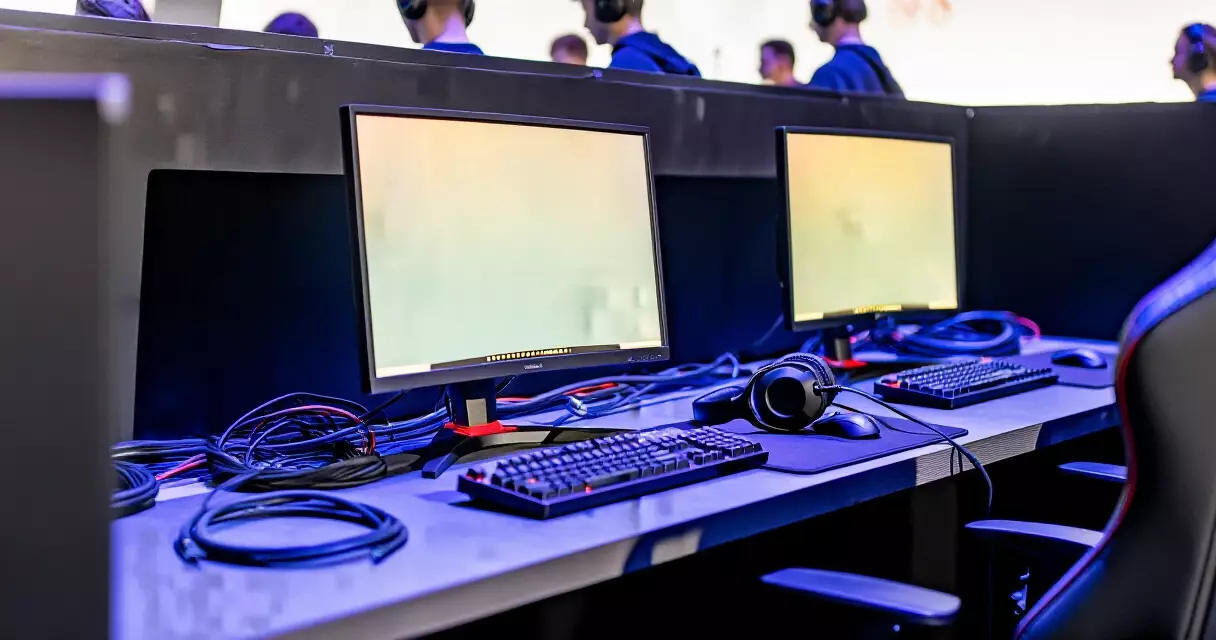
For players, monitors must run at 240 Hz or 360 Hz refresh rates. BenQ Zowie and ASUS ROG are the official monitor partners for ESL and Riot events respectively, and their tournament-spec panels run at these frame rates to match the output of high-end gaming PCs. A 360 Hz monitor renders a new frame every 2.8ms, so a display bottleneck at 144 Hz or 165 Hz would artificially limit competitive performance even on a perfect network. Player monitors are typically 24–25 inch, positioned at eye level within each booth, with strict cable management requirements running all video signal through the booth floor.
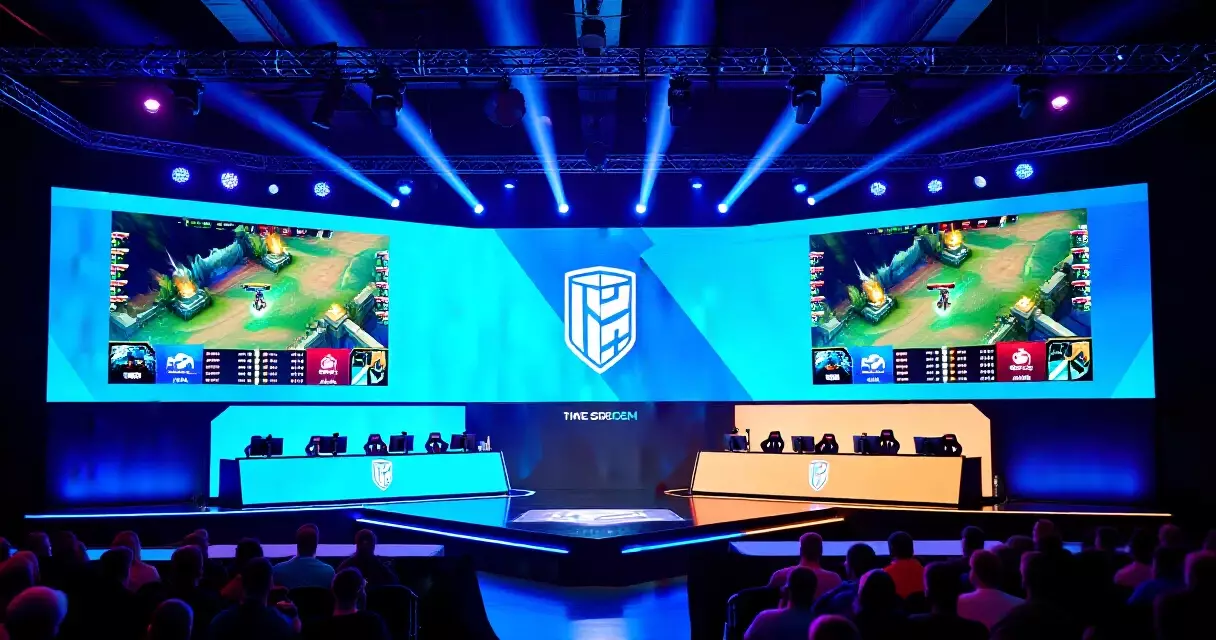
For audience and broadcast, the main stage LED video wall is the centerpiece. Standard pixel pitch at Tier 1 events is P2.5 to P4 (2.5mm to 4mm), capable of displaying at 1080p or 4K depending on the total panel count and the venue’s viewing distances. HyperX Arena Las Vegas operates a 50-foot-wide main LED wall. Esports Stadium Arlington features more than 90 displays throughout the venue alongside its main stage wall. These are not consumer TVs – they are modular LED tile systems from manufacturers like ROE Visual, Leyard, or Absen, assembled and calibrated on-site.
Player monitors run at 360 Hz while the audience watches on a 4K LED wall – an esports venue must perform flawlessly at both ends of that spectrum simultaneously.
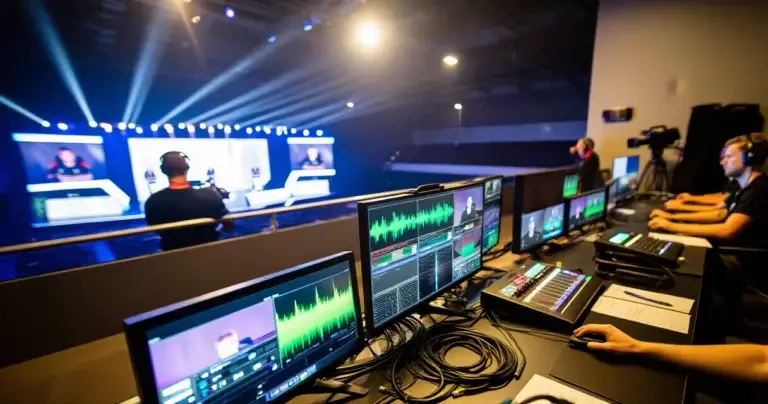
Broadcast output standards have risen sharply. The League of Legends Championship Series moved to a 4K production pipeline in 2022. IEM Katowice 2023 deployed more than 20 cameras including robotic camera systems such as Camerobot rigs and cable cams for dynamic overhead shots. EVS XT servers are the industry standard for instant replay systems at Tier 1 ESL, Riot, and Activision Blizzard events – the same hardware used in professional football and Formula 1 broadcasts. For any venue aspiring to host Tier 1 content, a broadcast control room with EVS infrastructure, multi-camera routing, and at minimum 1080p60 output (with 4K capability as a growth target) is required.
Audio is frequently underestimated in venue planning. Esports events use Dante audio networking protocol for routing signals across the venue, with mixing consoles such as the Yamaha RIVAGE PM series documented at multiple ESL events. The challenge is managing crowd noise: the audience needs immersive sound reinforcement while player booths must remain acoustically sealed. This typically requires separate PA zones, directional subwoofer arrays angled away from the stage, and active noise monitoring near the booth perimeters. Lighting at Tier 1 events uses moving head fixtures including Robe BMFL and Clay Paky Sharpy units, with LED pixel-mapped rigs synchronized to in-game events – a practice Riot Games pioneered at its rebuilt LCS studio in Los Angeles in 2020.
Stage Design and Player Booth Specifications
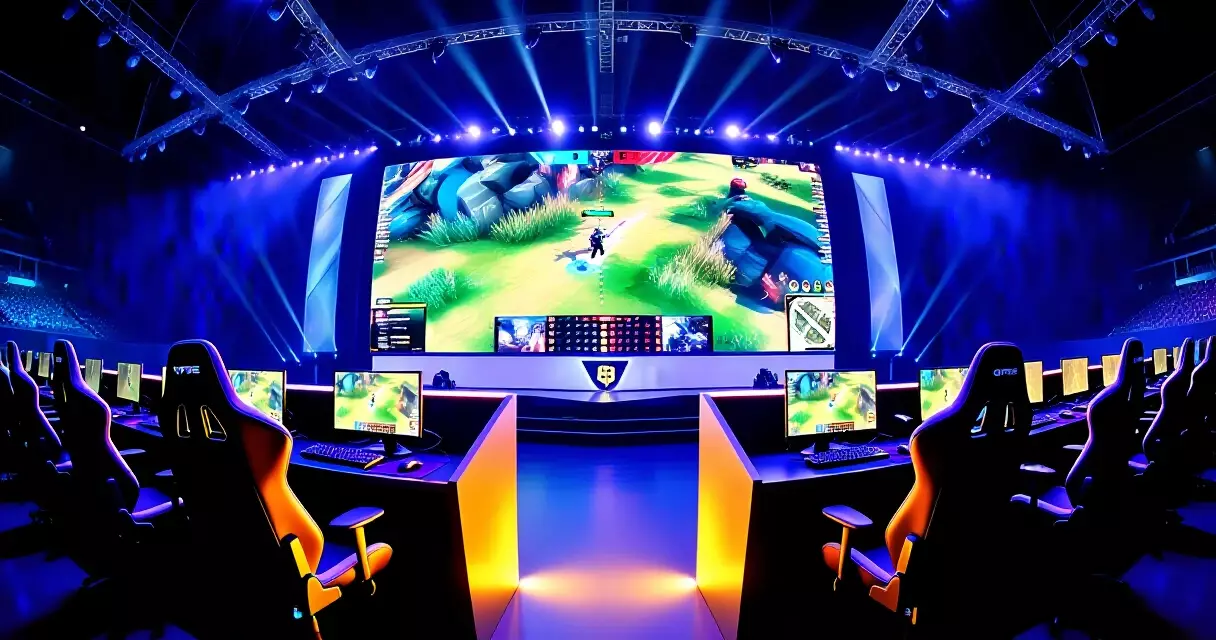
The stage itself is a controlled technical environment. A standard Tier 1 LAN stage for a 5v5 title positions two team booths symmetrically, each containing five PC stations. The layout must allow both teams to be visible to the audience while ensuring neither team can see the other’s screens or hear the other’s voice communications.
Booth sound isolation is a hard requirement that emerged from competitive controversy. The issue crystallized at ESL One Cologne 2014, when crowd noise during a CS:GO match leaked directional audio cues to players on stage – information that affected in-game decisions. Since then, ESL and all major organizers have mandated booths with a minimum attenuation of 25–30 dB. In practice, purpose-built booths use acoustically treated panels, sealed cable entry points, and headphone monitoring rather than open speaker audio for in-game sound.
Physical infrastructure beneath the stage matters as much as what’s visible. All production-grade stage builds route power and data cabling under raised flooring – typically aluminum extrusion platforms or carpet-covered riser systems – to eliminate trip hazards and enable rapid reconfiguration between events. Power provisioning requires dedicated 20A or 30A circuits per player station, with the full stage typically drawing 100–200A total. UPS (uninterruptible power supply) backup for critical systems – game servers, network switches, broadcast signal chains – is non-negotiable.
Each station runs a tournament-grade PC. Average build cost per competitive station is $2,000–$4,000 for tournament-grade hardware. A 10-team LAN event with 50 stations therefore represents $100,000–$200,000 in PC hardware alone, before peripherals, displays, or network gear. Call of Duty League Home Series specifications from 2020 (reported by Dot Esports) required standardized Alienware PC configurations, ensuring no station-to-station variance in hardware performance.
Off-stage, every Tier 1 event also requires at least one dedicated on-stage referee per match and a separate observer PC position. The observer controls in-game cameras for broadcast, and their feed must sit on the same LAN segment as the players to avoid game-state desynchronization on the production stream. This is a technical requirement that surprises many venue operators: the broadcast observer is not watching a stream – they’re running a game client connected to the match server, positioned on-site.
| Stage Component | Specification | Standard / Source |
|---|---|---|
| Player monitor refresh rate | 240 Hz minimum; 360 Hz for top Tier 1 events | ESL / Riot partner specs (BenQ Zowie, ASUS ROG) |
| Booth sound isolation | 25–30 dB attenuation minimum | ESL tournament administration rules |
| Power per station | Dedicated 20A–30A circuit | Venue operator interviews, SportsPro Media 2022 |
| Stage total power draw | 100–200A with UPS on critical systems | Production company standards (PRG, ATOMIC3D) |
| LED wall pixel pitch (audience) | P2.5–P4 (2.5mm–4mm) | Industry production standards (ROE Visual, Leyard) |
| Broadcast output minimum | 1080p60; 4K increasingly standard | Riot LCS (4K from 2022); ESL broadcast specs |
| Replay system | EVS XT server | ESL, Riot, Activision Blizzard event documentation |
| PC cost per station (tournament-grade) | $2,000–$4,000 | Venue operator estimates, SportsPro Media 2022 |
Real-World Venues Setting the Benchmark
Three facilities in the United States define the current benchmark for purpose-built esports venue technology, each with a distinct approach to the infrastructure challenge.
Esports Stadium Arlington (Arlington, Texas) opened in November 2018 and remains North America’s largest dedicated esports arena at 100,000 square feet, with a 1,500-seat live event space and a 12,000-square-foot broadcast studio. It operates multiple 10 Gbps fiber uplinks and features 90-plus displays throughout the facility. The venue is funded jointly by the City of Arlington and Esports Entertainment Group and has hosted DreamHack Dallas, ELEAGUE, and Call of Duty League events. The broadcast studio operates as a standalone rental facility, making it one of the few esports venues where the production infrastructure is available independently of the main arena.
HyperX Arena Las Vegas (Luxor Hotel, Las Vegas) – originally opened as Allied Esports Arena in October 2018 and rebranded in 2020 – covers 30,000 square feet with approximately 1,000 seats and a 50-foot-wide LED main display wall. Its placement inside a casino hotel creates unusual infrastructure considerations: the venue must isolate its competitive network from hotel Wi-Fi systems while managing RF environments that consumer-facing gaming floors make particularly noisy. HyperX (Kingston Technology) supplies peripherals throughout the venue as naming rights partner.
Riot Games LCS Studio (Los Angeles, California) functions differently: it’s a permanent broadcast studio with a studio audience capacity of roughly 350–400, rebuilt in 2020 with a new LED stage surround and a full 4K production pipeline. The LCS studio is notable because Riot controls the entire technology stack from player network to broadcast delivery, allowing tighter integration than any third-party venue can achieve. The 2020 rebuild reportedly cost $4–6 million (per Dot Esports reporting), making it one of the more expensive studio-scale esports investments on record.
These venues didn’t emerge in isolation. They are part of a broader pattern of purpose-built esports infrastructure that has reshaped what competitive gaming arenas look like globally. Understanding their specs helps clarify what any aspiring venue is actually competing against.
Esports Stadium Arlington’s 12,000-square-foot broadcast studio can operate independently of the arena floor – a design choice that turns infrastructure into a revenue stream even on non-event days.
Scaling Technology Requirements by Venue Tier
Not every esports venue needs to meet Tier 1 major event specifications. The industry organizes venues and events into tiers that correspond directly to different technology requirements, and building to the wrong tier wastes capital or disqualifies the facility from the events it actually wants to host.
A Tier 2 regional venue – typically 5,000–10,000 square feet – requires $500,000 to $2 million in technology infrastructure according to venue operator interviews published by SportsPro Media in 2022. This covers networking, AV, PC hardware, and basic broadcast capability at 1080p. It does not require EVS replay systems, robotic camera rigs, or 10 Gbps backbone capacity – though leaving conduit capacity for future upgrades is sensible planning.
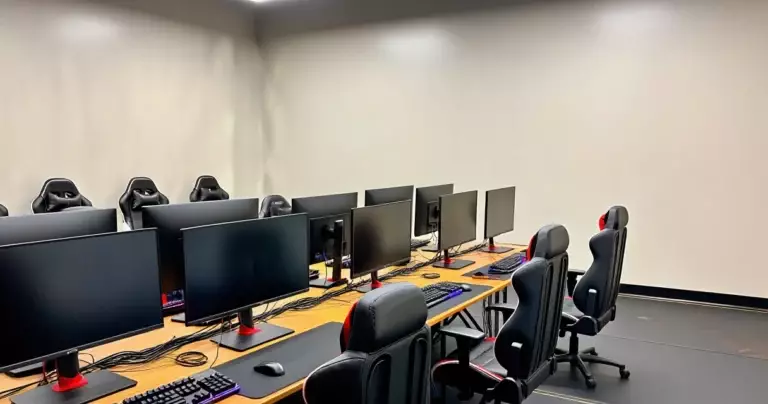
A university esports facility or gaming lounge represents a Tier 3 approach where competitive integrity requirements drop significantly, but basic esports-grade infrastructure still matters. The National Association of Collegiate Esports (NACE) and its affiliated programs have driven a wave of campus-based facility investment since 2018; these spaces typically operate on 1 Gbps campus fiber, use 144 Hz–240 Hz consumer gaming monitors, and forgo broadcast infrastructure entirely in favor of streaming PC setups. Latency requirements remain strict for the games played, but the production layer is minimal.
For any venue aiming to attract traveling events from ESL FACEIT Group or Riot Games, the most practical approach is to build the Tier 2 baseline in permanent infrastructure – fiber, isolation, power – and treat the rest as rentable production overlays. Production companies like PRG and ATOMIC3D regularly supply temporary stage builds, LED systems, and broadcast gear to venues that already have the underlying network and power sorted. The permanent infrastructure is the hard part; the spectacle layer can be leased per event.
The world’s leading esports arenas represent the ceiling of what’s possible, but the technical principles that make them functional scale down to any facility. What doesn’t scale is the assumption that a standard multipurpose venue can host competitive esports without infrastructure investment – Riot’s experience at Chase Center in 2022 proved that even an 18,000-seat NBA arena requires weeks of dedicated temporary infrastructure before it can host a Worlds Finals.
Frequently Asked Questions
Why do esports venues use wired ethernet instead of Wi-Fi for players?
Wi-Fi introduces variable latency and is susceptible to interference from the thousands of smartphones and devices carried by spectators. When a venue fills with fans, the 2.4 GHz and 5 GHz spectrums become congested, producing unpredictable packet delivery times that can cause latency spikes mid-match. Wired ethernet delivers a consistent, deterministic connection. CS2 and Valorant – the two most widely played games at Tier 1 LAN events – use 128-tick servers that send game state updates every 7.8ms. Any wireless-induced jitter above 1–2ms is detectable and affects competitive outcomes. All Tier 1 event organizers, including ESL FACEIT Group and Riot Games, require wired connections for all player stations, with the competitive network running on a completely isolated segment from any public-facing wireless infrastructure.
What refresh rate do professional esports players use, and does the venue need to support it?
Professional players in most Tier 1 titles use monitors running at 240 Hz or 360 Hz. A 360 Hz display renders a new frame every 2.8ms, reducing the gap between what happens in the game engine and what the player’s eye perceives. The venue must support this because tournament organizers specify monitor models as part of their technical rider. ESL events use BenQ Zowie panels at these refresh rates; Riot Games events use ASUS ROG monitors. Beyond the display itself, the PC hardware at each station must output frame rates high enough to feed these screens – typically 300–500+ frames per second in games like CS2 or Valorant. This means tournament PCs need high-end CPUs and GPUs, and the power infrastructure per station must support that hardware load reliably under continuous use.
How do venues prevent crowd noise from affecting players on stage?
Player booths are acoustically isolated enclosures built to attenuate ambient sound by a minimum of 25–30 dB, per ESL tournament administration rules. This standard was formalized after the ESL One Cologne 2014 controversy, when crowd noise during a CS:GO match provided players with directional audio information about enemy positions – information that is part of the in-game experience and should not be supplemented by external sound. Modern booths use acoustically treated panels, sealed cable entry points, and provide in-game audio exclusively through closed-back headphones. Players hear only what the game engine delivers; the crowd hears everything through the PA system. Additional measures include monitoring ambient noise levels near booth perimeters and positioning directional PA speakers away from the stage area.
What happens to the network if the internet connection drops mid-match?
Tier 1 venues require dual ISP feeds on physically separate conduits, configured with automatic BGP failover. When the primary uplink fails, routing shifts to the secondary provider without manual intervention. The failover must complete quickly enough to avoid match-disrupting packet loss – typically in under one second with properly configured BGP timers. On-stage game servers for LAN events run locally within the venue network, meaning player-to-server traffic doesn’t traverse the internet at all during a match; only the broadcast stream and remote operations feeds are internet-dependent. UPS systems back critical network switches, the game server hardware, and broadcast signal chains to protect against power disruptions as well as connectivity failures.
How much does it cost to build a Tier 2 regional esports venue with proper technology?
A Tier 2 regional esports venue covering 5,000–10,000 square feet requires $500,000 to $2 million in technology infrastructure alone, according to venue operator interviews published by SportsPro Media in 2022. This covers dedicated fiber networking, AV systems, PC hardware for player stations, and basic broadcast capability. PC hardware for player stations runs $2,000–$4,000 per machine at tournament grade; a 50-station venue represents $100,000–$200,000 in PCs before peripherals, displays, or networking. Esports Stadium Arlington cost $10 million to build in total, funded by the City of Arlington. The Riot Games LCS studio rebuild in 2020 cost a reported $4–6 million for a 350-seat facility. These figures demonstrate that per-square-foot technology costs in esports venues significantly exceed those of traditional entertainment venues. For a fuller breakdown, see our guide on how to build an esports venue.
What is an observer PC and why does every competitive stage need one?
An observer PC runs a game client connected to the live match server and is used by a dedicated broadcast operator to control in-game cameras for the production stream. The observer does not watch a replay or a stream – they are playing the match in spectator mode in real time, moving virtual cameras to capture action for the broadcast. Because the observer client must receive the same live game state as the players, it must be on the same local network segment as the player PCs and game server. Placing the observer on a different network segment or running it over an internet connection introduces game-state latency on the broadcast feed. ESL tournament rules require at least one observer position per match stage, and high-production events deploy multiple observers for different camera angles and game zones.
Do mobile esports events have different venue technology requirements?
Mobile esports tournaments present a different set of infrastructure challenges. Players use smartphones or tablets rather than PCs, which eliminates the high-power station requirements but introduces device connectivity complexity. Cellular signal management becomes critical: venue operators must coordinate with carriers to suppress in-building cellular reception in competition areas, forcing all devices onto a controlled Wi-Fi network rather than cellular data – the opposite of the approach for PC titles. The controlled Wi-Fi must still meet strict latency and jitter requirements. Titles like PUBG Mobile and Mobile Legends: Bang Bang are played at Tier 1 events with tens of thousands of spectators; the infrastructure challenge is ensuring consistent, low-latency Wi-Fi for all competitor devices simultaneously in an RF-saturated environment. For more on the competitive side of this format, see our coverage of what mobile esports is and how it works.
Sources
- ESL / FACEIT CS2 Tournament Administration Rules (ESL FACEIT Group, 2024) – play.eslgaming.com
- Riot Games Valorant Competitive Ruleset – playvalorant.com
- Cisco esports venue network case study (2022) – cisco.com
- Grand View Research – Esports Market Size Report (2023) – grandviewresearch.com
- Mordor Intelligence – Esports Venue Market Forecast (2023) – mordorintelligence.com
- City of Arlington, TX – Esports Stadium Arlington press release (2018) – arlingtontx.gov
- SportsPro Media – Esports venue operator infrastructure interviews (2021–2022) – sportspromedia.com
- Dot Esports – Riot Games LCS studio rebuild reporting (2020) – dotesports.com
- Dot Esports – Call of Duty League Home Series venue specs (2020) – dotesports.com
- Wikipedia – Esports Stadium Arlington – en.wikipedia.org/wiki/Esports_Stadium_Arlington
Top Esports Organizations 2026: Teams, Rosters, and Performance Rankings